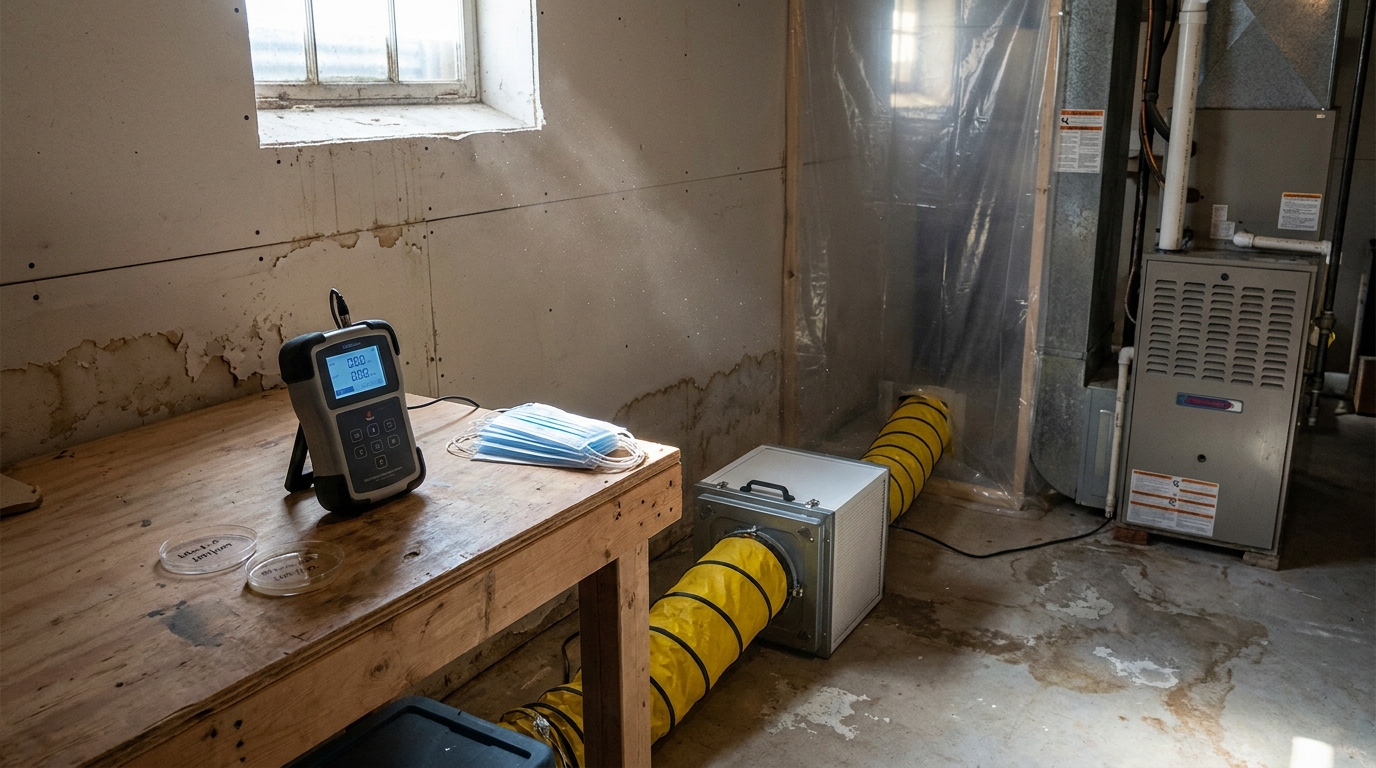
How Do Mold Spores Travel Through the Air?
Mold spores travel through air currents generated by HVAC systems, opening doors, foot traffic, and natural convection, remaining airborne for hours before settling on surfaces.
Understanding how do mold spores travel starts with their size. Most mold spores measure between 1 and 30 micrometers in diameter, with many falling in the 2 to 10 micrometer range. According to MoldSci, their microscopic size and low mass allow them to become airborne extremely easily. For perspective, a human hair is roughly 50 to 100 micrometers wide, meaning many spores are 5 to 50 times smaller than a single strand of hair.
The role of air currents and HVAC systems
Central heating and cooling systems are the primary distribution mechanism for mold spores inside homes. According to MoldSci, HVAC systems create powerful air currents that can carry microscopic contamination from a single source to every conditioned space in a structure, often within hours of initial contamination. Air ducts act as an expressway for spores, silently carrying them from one end of a house to another. Even something as simple as opening a door between rooms creates a pressure shift that moves spore-laden air into previously uncontaminated spaces.
How long spores remain airborne
A 2024 case study on Aspergillus niger found that a mild indoor airflow disturbance caused significant spore release within 0.18 seconds. Between 30.4% and 85.2% of those spores remained airborne for at least 10 minutes after the disturbance. [Source: ScienceDirect] Smaller spores, particularly those from Penicillium and Aspergillus species at around 1 micrometer, can stay suspended even longer because their settling velocity is extremely low.
Particle size and travel distance
Spore size directly determines how far and how fast particles travel. Some mold species can eject spores at speeds up to 55 miles per hour, propelling them up to 8 feet even without ambient air currents. Once airborne, room air currents carry them much farther. General dispersal ranges span from a few inches to hundreds of miles depending on air currents, humidity, temperature, and spore weight. [Source: MoldSci]
Can Mold Spores Travel on Clothing and Personal Items?
Mold spores attach to fabric fibers, hair, shoes, and tools, transferring between rooms or buildings when people move through contaminated areas without protective gear.
A detailed experimental study at Cornell University examined clothing as a carrier of Aspergillus spores in hospitals and confirmed that cotton fabrics readily transport fungal spores between environments. [Source: Cornell] This finding applies directly to residential settings where homeowners walk through a moldy basement, then carry spores on their clothes into bedrooms and living areas.
How spores attach to fabrics and surfaces
Spores cling to textured surfaces through electrostatic attraction and physical entanglement with fibers. Rough fabrics like cotton and wool trap more spores than smooth synthetics. According to air quality practitioners on Reddit’s mold community, general ambient air usually contains low hundreds to low thousands of spores per cubic meter in average living conditions. That baseline means clothing picks up spores constantly, but concentrations spike dramatically when someone enters a contaminated space.
Cross-contamination during remediation work
One of the most common ways homeowners accidentally spread mold is by carrying contaminated materials through clean areas during DIY cleanup. Walking a bag of moldy drywall through a hallway distributes spores along the entire path. Professional remediators use sealed containment barriers and dedicated exit routes for exactly this reason. If you’re tackling a mold remediation project, changing clothes and showering after working in contaminated areas helps reduce this transfer.
Why shoes are a primary vector
Shoes contact floors directly, and floors are where settled spores accumulate most densely. Walking through a room with active mold growth embeds spores into shoe treads, which then deposit them with every subsequent step. Industry practitioners typically recommend shoe covers or dedicated footwear when entering and leaving contaminated zones.
Do Mold Spores Spread Through Water?
Water carries spores through plumbing leaks, condensation runoff, and flooding, depositing them on new surfaces where moisture allows immediate germination and colonization.
According to the EPA, mold can begin to grow on wet materials within 24 to 48 hours after water exposure once airborne spores land and find moisture. This means water isn’t just a transport mechanism. It’s also the activation trigger.
Spore movement in standing water and leaks
Floodwater and plumbing leaks carry spores along their flow path, depositing them on every surface the water contacts. A slow leak behind a wall can spread spores across several feet of drywall and subfloor before anyone notices visible growth. Homeowners dealing with basement water damage and mold should recognize that the contamination zone often extends well beyond the visible wet area.
How condensation spreads spores vertically
Condensation on cold water pipes, window frames, and HVAC components creates thin films of water that carry spores downward by gravity. A sweating cold-water pipe in a wall cavity can deposit spore-laden moisture on framing members several feet below the original colony. This vertical transport mechanism often explains why mold appears on lower floors beneath bathrooms or kitchens.
The difference between wet and dry dispersal
Some mold species release spores primarily when dry (dry dispersal), relying on air currents. Others release spores into water droplets or mucilaginous masses (wet dispersal), relying on splashing or flowing water. According to research published in the Annals of Botany, in all dry-spore forms, the number of spores set free increases as the speed of the air stream rises. [Source: Oxford University Press] Understanding which type you’re dealing with affects cleanup strategy.
What Conditions Make Mold Spores Travel Faster?
High humidity above 60%, active air movement from fans or HVAC, physical disturbance during cleaning, and temperature differentials all accelerate spore dispersal throughout indoor spaces.
Humidity’s effect on spore release
Many mold specialists warn that when outside humidity exceeds 60%, opening windows can sustain or worsen mold growth indoors. [Source: Your Mold Solutions] High humidity also keeps spores viable longer after they land, increasing the chance that transported spores will germinate on new surfaces. Conversely, very low humidity can cause colonies to dry out and release more spores as the substrate contracts.
Temperature gradients and convection currents
Warm air rises and cool air sinks, creating natural convection loops inside homes. These temperature-driven currents move spores vertically between floors without any mechanical assistance. The stack effect, where warm air exits through upper-level openings and pulls cooler air in at lower levels, is especially powerful in winter. According to Indoor Science, this stack effect pulls spores from basements and crawlspaces into upper levels, particularly during cold weather.
Why disturbing mold colonies releases spore clouds
Physical disturbance is the single fastest way to aerosolize spores. The 2024 Aspergillus niger case study found that each disturbance event released approximately 100,000 to 150,000 colony-forming units per cubic meter into the air. [Source: ScienceDirect] Experimental work shows that spores often roll along surfaces before detaching, and higher airflow velocity shortens the rolling phase and increases detachment. Even walking near a colony or vacuuming with a standard (non-HEPA) vacuum can trigger massive releases.
How Far Can Mold Spores Travel Indoors?
Indoors, spores typically travel several feet from the source via natural air currents, but HVAC systems can distribute them throughout an entire building within hours.
| Dispersal Scenario | Typical Distance / Timeframe | Key Factor |
|---|---|---|
| Initial ejection from colony | Up to 8 feet | Forcible discharge mechanism |
| Within one room (natural air currents) | Entire room, seconds to minutes | Local air movement, walking |
| Between adjacent rooms | Hours to one day | Door openings, pressure differences |
| Entire home via HVAC | Within 24 to 48 hours | Central air distribution |
| Basement to second floor (stack effect) | Detectable but ~70% lower concentration | Temperature-driven vertical airflow |
Typical dispersal radius without mechanical systems
Without HVAC running, spore travel depends on natural convection, foot traffic, and door openings. In a still room, spores from a colony can reach surfaces several feet away within minutes of disturbance. Between rooms connected by open doorways, spores typically migrate within hours to a day.
HVAC-assisted distribution patterns
According to MoldSci, spores can penetrate small openings in building materials and HVAC systems, distributing to every conditioned space in a structure often within hours. Multiple remediation sources report that mold spores can spread from room to room throughout an entire home within 24 to 48 hours when central air is operating. [Source: Indoor Science]
Vertical vs. horizontal spread in multi-story homes
A field study discussed by Indoor Science found that mold spores from a basement source were still detectable on the second floor, but concentrations fell by about 70% between the basement and second floor. [Source: Indoor Science] This confirms that basement mold can work its way into almost any indoor area of a home via air movement, though concentrations diminish with distance and floor height.
Does Opening Windows Help or Hurt Mold Spore Spread?
Opening windows during active mold growth increases outdoor spore entry but can reduce indoor concentrations through dilution. The net effect depends on outdoor spore levels and ventilation rate.
When ventilation reduces indoor spore counts
On dry, low-pollen days when outdoor humidity is well below 60%, opening windows can dilute elevated indoor spore concentrations by introducing cleaner air. This works best when there’s a cross-breeze that creates genuine air exchange rather than just stirring indoor air. However, opening windows is not a mold remediation method and will not eliminate mold by itself. [Source: Your Mold Solutions]
Outdoor spore levels and seasonal variation
On a typical summer day, outdoor air can contain about 1,000 to 50,000 spores per cubic meter, with Cladosporium often dominating. [Source: Mold Removal Experts] A 2024 University of Manchester study found that during summer, hazardous mold species including Aspergillus fumigatus were more abundant in hospital rooms with outside-facing windows compared to interior rooms. [Source: University of Manchester] This suggests that opening windows during peak outdoor spore season can actually increase indoor mold exposure.
The containment vs. dilution trade-off
Research on intermittent window opening found that it increased settled spore counts on nearby textiles by 210% compared with constant low-flow mechanical exhaust ventilation. [Source: Alibaba LifeTips] The temperature gradients created by intermittent opening cause condensation on walls, windowsills, and behind furniture, creating secondary moisture reservoirs for mold growth. During active remediation, containment with negative air pressure is far more effective than ventilation through windows.
Common Mistakes That Accelerate Spore Travel
Using fans near mold, dry-brushing colonies, skipping containment barriers, and running HVAC during remediation are the most common errors that spread spores throughout homes.
Why fans make the problem worse
Homeowners often place fans near water-damaged areas to speed drying. If mold has already begun growing (which can happen within 24 to 48 hours of water exposure, according to the EPA), fans blast spores into the air and distribute them across the room and into adjacent spaces. The increased airflow velocity also increases spore detachment from colonies, compounding the problem. If drying is needed, it should happen before mold establishes, or after contaminated materials have been removed.
The dry-brushing mistake
Scrubbing visible mold with a dry brush or wiping it with a dry cloth launches massive spore clouds. Research shows that even mild airflow disturbances release 100,000 to 150,000 CFU per cubic meter. [Source: ScienceDirect] Physically scrubbing a colony is far more aggressive than a gentle air current. Wet wiping or HEPA vacuuming captures spores rather than dispersing them. Any cleaning of visible mold should use damp methods.
HVAC operation during cleanup
Running the heating or cooling system while disturbing mold colonies sends freshly aerosolized spores directly into the ductwork, which then distributes them to every room with a register. Professional remediators shut down HVAC systems serving the contaminated zone and seal supply and return vents before beginning work. For DIY projects, turning off the system and covering nearby vents with plastic sheeting and tape is a minimum precaution.
If you’ve discovered active mold growth, understanding spore travel is the first step, but containment requires proper technique. For growth larger than 10 square feet, consult a certified mold remediation professional who can establish negative air pressure and prevent cross-contamination.
Frequently Asked Questions
These are the most common questions homeowners ask about mold spore movement, answered with current research and practical guidance.
Can mold spores travel through walls?
Spores themselves don’t penetrate solid drywall, but they travel through gaps around electrical outlets, plumbing penetrations, and cracks in framing. They also move through wall cavities via air currents, particularly when pressure differences exist between rooms. Water leaks inside walls carry spores along the moisture path, depositing them on framing and insulation where growth can occur hidden from view.
Do air purifiers stop mold spores from traveling?
HEPA air purifiers can capture airborne mold spores, since HEPA filters are rated to trap 99.97% of particles 0.3 micrometers and larger, and most mold spores are 1 to 30 micrometers. However, air purifiers reduce airborne concentrations rather than eliminating the source. They work best as a supplemental measure during and after remediation, not as a substitute for removing the mold colony itself.
How quickly do spores settle after disturbance?
A 2024 study on Aspergillus niger found that 30.4% to 85.2% of released spores remained airborne for at least 10 minutes after disturbance. [Source: ScienceDirect] Smaller spores from species like Penicillium and Aspergillus, at around 1 micrometer, can stay suspended considerably longer. According to InspectApedia, these small spores move through a building like a gas. In a room with any air movement at all, full settling can take hours.
Can spores travel from a neighbor’s unit in apartments?
Yes. In multi-unit buildings, spores travel through shared HVAC systems, gaps around plumbing stacks, electrical conduit penetrations, and under doors. The stack effect in taller buildings creates strong vertical airflow that pulls spores from lower units upward. Shared hallways also serve as distribution corridors. If you suspect mold in an adjacent unit, a certified industrial hygienist can perform air sampling in your space to determine whether cross-contamination is occurring.
Are mold spores always present in indoor air?
Yes. According to air quality practitioners, general ambient air typically contains low hundreds to low thousands of spores per cubic meter in average living conditions. [Source: Reddit] Outdoor concentrations are even higher, ranging from about 1,000 to 50,000 spores per cubic meter on a typical summer day. [Source: Mold Removal Experts] The presence of spores alone doesn’t indicate a problem. Elevated indoor counts relative to outdoor levels, or the presence of species not found outdoors, signals active indoor growth.
Does killing mold stop spore travel?
No. Dead mold spores remain allergenic and can still become airborne. Killing a colony with bleach or biocide doesn’t eliminate the spores already present on surfaces and in the air. The EPA recommends physical removal of contaminated materials rather than simply treating them with chemicals. Dead colonies left in place will continue to release particles when disturbed.