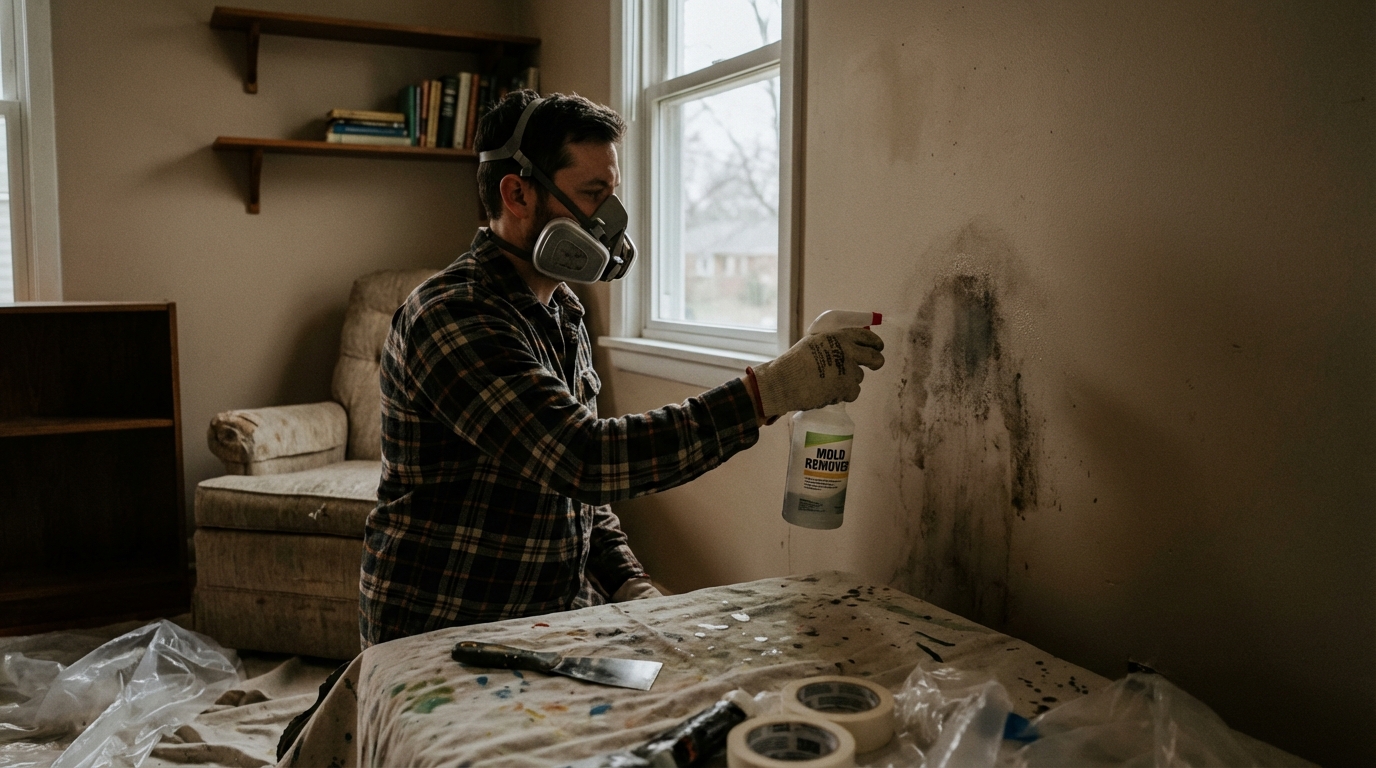
The short answer: Small areas of surface mold on drywall (under 10 square feet) can usually be removed with a bleach-water solution, proper protective gear, and thorough drying. Anything larger, anything behind the wall, or any mold following water damage should be handled by a licensed professional.
Mold on drywall is one of the most common home remediation problems — and one of the most mishandled. The instinct is to scrub it off and move on. Sometimes that works. But drywall is made of gypsum sandwiched between paper layers, and mold loves paper. If the mold has penetrated into the wall rather than sitting on the surface, cleaning the front won’t solve the problem.
This guide will tell you exactly when you can DIY it, how to do it safely, and when to stop and call someone.
When You Can DIY — and When You Can’t
Before you do anything, measure the affected area. The EPA recommends homeowners handle mold removal themselves only when the area is less than 10 square feet (roughly 3 feet by 3 feet).
Beyond that threshold, the risks change:
- Larger infestations typically mean the mold has spread behind the drywall
- Disturbing large amounts of mold releases a significant volume of spores into the air
- At that scale, proper containment requires more than closing a door
Call a professional if:
- The area exceeds 10 square feet
- You smell mold but can’t see it (it’s likely behind the wall)
- The drywall is soft, crumbling, or feels damp
- Mold appeared after a flood, roof leak, or burst pipe
- You have respiratory conditions, asthma, or a compromised immune system
- The mold has returned after a previous cleaning
The gray zone: when the situation isn’t obvious
Some scenarios don’t fit neatly into DIY or professional. A visible patch of 8 square feet with a strong musty odor disproportionate to its size is a warning sign — odor indicates active spore production, often from a colony larger than what’s visible on the surface. Treat it as if it’s already over 10 square feet. Similarly, bathroom ceilings are subjected to repeated steam cycling; even a small patch there may have significant depth from repeated moisture penetration over months or years.
A word on mold after water damage: Any mold that followed a leak, flood, or burst pipe is a different category. Water intrusion events push moisture into wall cavities where it wicks through insulation, framing, and the back face of the drywall. The surface patch you see is frequently just the front edge of a larger colony on the cavity side. Professional assessment is the right first step after any water event, regardless of visible patch size.
What You’ll Need
Gather everything before you start — once you begin, you don’t want to touch doorknobs or cabinets with contaminated gloves:
- Respirator: N-95 minimum ($15–$30 for a box of 10); P-100 half-face respirator for better protection ($25–$40 for the mask, $10–$15 for replacement cartridges). A surgical mask does not filter mold spores. Use the P-100 if the area is close to the 10 sq ft limit, if the mold is visibly heavy, or if you have any sensitivity.
- Gloves: Nitrile or rubber, at least wrist length ($8–$15 for a box of 50 nitrile). Avoid latex if you have an allergy.
- Goggles: Sealed, non-vented safety goggles ($5–$15). Mold spores irritate eyes.
- Cleaning solution: Household bleach runs $4–$8/gallon; borax powder $8–$12/box (enough for multiple cleanings). Commercial mold cleaners like Concrobium Mold Control or RMR-141 run $15–$30 and are ready to use.
- Brushes and sponges: Stiff-bristle scrub brush ($5–$10); sponges for wiping ($3–$5 for a pack). These get disposed of after use.
- Plastic sheeting and tape: 4-mil poly sheeting ($15–$20 for a roll); painter’s tape ($5).
- Fan and dehumidifier: A box fan works for airflow ($20–$40). A portable dehumidifier is the more important item ($130–$250 for a 30-pint unit). If you don’t own one, this is worth renting or borrowing — inadequate drying is the single biggest reason mold comes back.
Contractor-grade vs. consumer options: For a one-time small patch, consumer-grade equipment is fine. For basements, rental properties, or spaces with recurring moisture problems, upgrade to the P-100 respirator and a quality dehumidifier. The cost difference is modest; the protection difference is not.
Step-by-Step: Removing Mold from Drywall
Step 1: Assess the Area
Look carefully at the full extent of the growth. Mold is often larger than it appears — the visible patch is frequently just the center of a larger colony.
The press test: Gently press on the drywall at the center of the mold patch and around its edges. Firm, solid resistance is a good sign — the gypsum is intact. Any softness, sponginess, or give under light pressure means the mold has penetrated through the paper facing into the gypsum core. That panel needs to be cut out and replaced, not cleaned.
Using a moisture meter: Pin-type meters run $20–$40 at hardware stores. Press the pins into the drywall next to the mold patch. Above 20% moisture content is a go/no-go signal — the drywall is still actively wet, cleaning it is pointless, and the moisture source must be found first. Below 15% is dry enough to proceed. 15–20% is borderline; let it dry more if you can.
Reading water stain patterns: The shape and location of water staining around a mold patch tells you where the moisture came from. A stain that’s wider at the top and tapers down indicates water running from above — look for a roof or window leak directly overhead, or a pipe in the ceiling. A stain that’s wider at the bottom indicates water wicking upward, which points to a floor-level source: slab moisture, a baseboard pipe, or flooding. A circular stain suggests a point source directly behind the wall. Following the stain pattern to its origin is more useful than just treating the visible mold.
Step 2: Protect Yourself and Contain the Area
Put on your respirator, goggles, and gloves before you open any doors or windows in the room.
Close off the space:
- Tape plastic sheeting over any HVAC vents
- Turn off your central air/heat to prevent spore distribution
- If the room has a window, position a fan blowing outward — this creates slight negative pressure that keeps spores from drifting into the rest of the house
Step 3: Prepare Your Cleaning Solution
For painted or sealed drywall: Mix 1 cup of household bleach (sodium hypochlorite, 5–8.25% concentration) with 1 gallon of cool water. Do not use hot water — it accelerates bleach breakdown. Never mix bleach with ammonia or vinegar.
For unpainted or unfinished drywall: Bleach can damage the paper facing and doesn’t penetrate porous materials effectively. Use a borax solution instead: 1 tablespoon of borax powder dissolved in 1 gallon of warm water. Borax is a natural mineral salt that inhibits mold growth and won’t damage drywall paper.
“Bleach strips the color from mold and the homeowner believes they killed it, but the toxic aspects remain and mold typically grows back. On porous surfaces, this is not a good answer.”
— Kodie L. Brush, IICRC-Certified, Steam Green Cleaning and Restoration Inc.
Commercial mold cleaners: Ready-to-use products like Concrobium Mold Control and RMR-141 are worth knowing about. Concrobium encapsulates and crushes mold cells as it dries, leaving a residue that inhibits regrowth — useful for areas prone to recurring moisture. RMR-141 is an EPA-registered disinfectant with a broader kill spectrum; it’s the better choice when treating the wall cavity side of a cut-out section before patching. Neither requires mixing and both are safe on drywall paper. Cost ($15–$30 per bottle) is higher than bleach or borax, but for problem areas the added protection is usually worth it.
Vinegar note: White vinegar kills roughly 82% of mold species on hard surfaces. However, it doesn’t penetrate drywall well, and its acidic nature can damage the paper facing over time. It’s a reasonable option for small surface spots, but bleach or borax is more effective on drywall specifically.
Step 4: Apply and Wait
Spray or sponge the cleaning solution generously onto the affected area. Make sure you’ve wet the entire mold colony plus a 2-inch margin around it. Let it sit for 10–15 minutes — this contact time is what kills the mold; don’t rush it.
Step 5: Scrub and Remove
Using your stiff-bristle brush, scrub in firm circular motions. You’re working to break up the mold colony and lift it from the surface. Use a damp sponge to wipe the residue away.
Immediately dry the surface with a clean cloth. Do not rinse with plain water — you’d re-wet the surface and undo your work.
Bag all used sponges, cloths, and cleaning materials in a plastic garbage bag. Seal it. Take it directly outside.
Step 6: Dry Thoroughly
This is the step most DIYers skip or underdo — and it’s why mold comes back.
Direct a fan at the cleaned surface. Leave it running for a minimum of 24–48 hours for drywall — and if you’ve opened the wall and exposed any wood framing behind it, extend that to 72 hours for the framing. Wood holds moisture more stubbornly than gypsum, and mold will recolonize wet framing even after the drywall face reads dry.
For dehumidifier placement: position it 3–5 feet from the treated wall, run it on its highest setting, and keep the door closed. Opening the door lets in ambient humid air from the rest of the house and extends drying time significantly. Monitor with a hygrometer ($10–$15 at any hardware store) — you want the room at or below 50% relative humidity before you’re done. If the area still feels cool to the touch after 48 hours, keep drying.
Step 7: Apply Mold-Inhibiting Primer
Once the area is fully dry, apply a mold-inhibiting primer before repainting. This step is frequently skipped or done wrong — standard latex primer provides no protection.
Reliable options: Zinsser Mold Killing Primer (contains an EPA-registered biocide that kills residual spores as it dries), KILZ Mold & Mildew Primer (water-based, low VOC, good general choice), and Sherwin-Williams Moisture-Resistant Primer for areas with ongoing humidity like bathrooms. These run $20–$35/gallon.
The distinction between mold-inhibiting primer and mold-resistant paint matters. Mold-resistant paint (Sherwin-Williams Duration, Benjamin Moore Aura) contains inhibitors in the topcoat, but it is not a substitute for priming first. Primer penetrates the drywall surface and seals it; paint sits on top of the primer. For any mold-prone area, you need both.
Replacing Drywall vs. Cleaning It — A Practical Decision Guide
Not every mold situation on drywall is a cleaning problem. Before you reach for the bleach, run through this table:
| Situation | Recommendation |
|---|---|
| Surface mold only, paint intact, drywall firm | Clean — bleach or borax solution, dry thoroughly |
| Mold on paper facing, drywall still firm | Clean deeply + apply encapsulant primer (Concrobium or Zinsser) |
| Drywall soft, spongy, or crumbling | Replace — cutting out is the only real fix |
| Mold area exceeds 10 sq ft | Professional assessment first |
| Mold returned after a previous cleaning | Replace + locate and fix the moisture source |
| Mold appeared after a flood or burst pipe | Always replace — hidden contamination likely on the cavity side |
When you do need to replace, cut out at least 12 inches beyond the visible growth on all sides. This isn’t overcautious — mold colonies extend further than the discoloration indicates, and cutting to the visible edge leaves active mold in the wall. Once the section is removed, treat exposed framing and insulation before patching.
What to Do If the Mold Returns
If mold reappears within 2–4 weeks, there are two possibilities:
- Incomplete removal: Mold penetrated deeper than the surface treatment reached
- Active moisture source: There is ongoing water intrusion you haven’t located or fixed
In either case, the next step is to cut out the affected drywall section — 12 inches beyond the visible growth on all sides — and replace it. This also gives you the chance to inspect the wall cavity and insulation, which may also need replacement.
Beyond those two possibilities, there are three less obvious moisture sources worth checking when mold keeps returning:
Plumbing leaks behind the wall: A slow drip from a supply line or drain fitting can wet insulation and the back of the drywall for months before showing on the surface. Two ways to check without opening the wall: the water meter test (turn off all fixtures, read the meter, wait 30–60 minutes, read again — any movement means a leak somewhere in the system) and thermal imaging. A contractor with an infrared camera can pinpoint wet areas in minutes by detecting the temperature differential between wet and dry drywall. Many home inspectors offer this as an add-on service.
Attic condensation dripping into walls: Common in cold climates. When warm, humid interior air rises into an under-insulated or poorly sealed attic, it meets cold surfaces and condenses. That water accumulates and eventually runs down through top plates into wall cavities. The mold shows up on interior walls below the ceiling line, often in corners. If this is the cause, fixing the wall won’t solve anything until the attic air sealing is addressed.
HVAC condensation lines: A clogged or improperly pitched condensate drain line from a central air handler or mini-split will overflow when the system runs. The water typically ends up in a ceiling or wall cavity near the air handler or above a supply duct. If your mold is appearing in a location near HVAC equipment or along a ceiling run, inspect the condensate system before opening the wall.
Understanding Why Mold Grows on Drywall
Drywall is made of a gypsum mineral core pressed between two layers of paper. Mold doesn’t eat gypsum, but it absolutely eats paper — drywall paper is an ideal food source. Combine it with moisture above 60% relative humidity and temperatures between 60°F and 80°F, and you have perfect mold conditions.
Common moisture sources behind drywall mold:
- Pipe leaks behind walls (slow drips are easy to miss)
- Roof or window leaks that water tracks down inside walls
- Condensation in poorly insulated exterior walls, especially in humid climates
- High indoor humidity from bathrooms, kitchens, or lack of ventilation
- Flooding that wasn’t dried within 48 hours
Vapor drive and climate: Where you live affects which walls are most vulnerable. Moisture moves through building materials from areas of high vapor pressure to low — a process called vapor drive. In hot, humid climates (Gulf Coast, Southeast), outdoor humidity pushes inward through exterior walls, so mold tends to grow on the room-facing surface of exterior drywall. In cold climates (Upper Midwest, Northeast), interior humidity pushes outward toward the cold exterior, and mold often grows on the cavity side of the drywall near the exterior sheathing — invisible from inside until growth is significant. Neither situation is solved by cleaning alone; vapor barriers and proper insulation placement address the underlying cause.
Drywall at floor level near concrete: Drywall installed directly on or near a concrete slab floor with no vapor break is a common hidden cause of recurring basement mold. Concrete continuously wicks ground moisture, which migrates into any porous material it contacts. The correct fix is to terminate the drywall at least 1/2 inch above the slab with a treated bottom plate — if this detail was omitted originally, recurring mold at the base of walls is the predictable result.
Fix the moisture source first. Always.
This sounds like a job for a professional.
Large infestations, water damage, and mold behind walls require licensed remediation. Get matched to a local contractor — free, no obligation.
Cost of Professional Mold Remediation on Drywall
If you’re weighing DIY vs. professional, here’s what professional remediation typically costs:
| Scope | Typical Cost |
|---|---|
| Small area (< 10 sq ft) | $500–$1,500 |
| Medium room (10–30 sq ft) | $1,500–$3,500 |
| Large area or multiple rooms | $3,500–$7,500+ |
| Behind drywall + replacement | Add $500–$2,000 |
What’s typically included: containment setup (plastic barriers, negative air pressure), HEPA air scrubbers, removal and disposal of affected materials, antimicrobial treatment, and a final visual inspection.
What’s often extra: drywall replacement and finishing, painting, and post-remediation air testing by a third-party industrial hygienist. That air test — a spore trap run after the work is done — costs $150–$300 and is worth requesting for any job over $2,000. It confirms the spore count has returned to normal background levels.
How to vet a contractor: Ask for IICRC S520 certification — the industry standard for professional mold remediation. Keep the inspector separate from the remediator; hiring the same company to test and then clean is a conflict of interest. Get a written scope of work before any work begins that specifies what’s being removed, what’s being treated, and what the clearance criteria are.
These figures vary significantly by location, severity, and whether asbestos abatement is also required (in homes built before 1980). Get 2–3 quotes before committing.