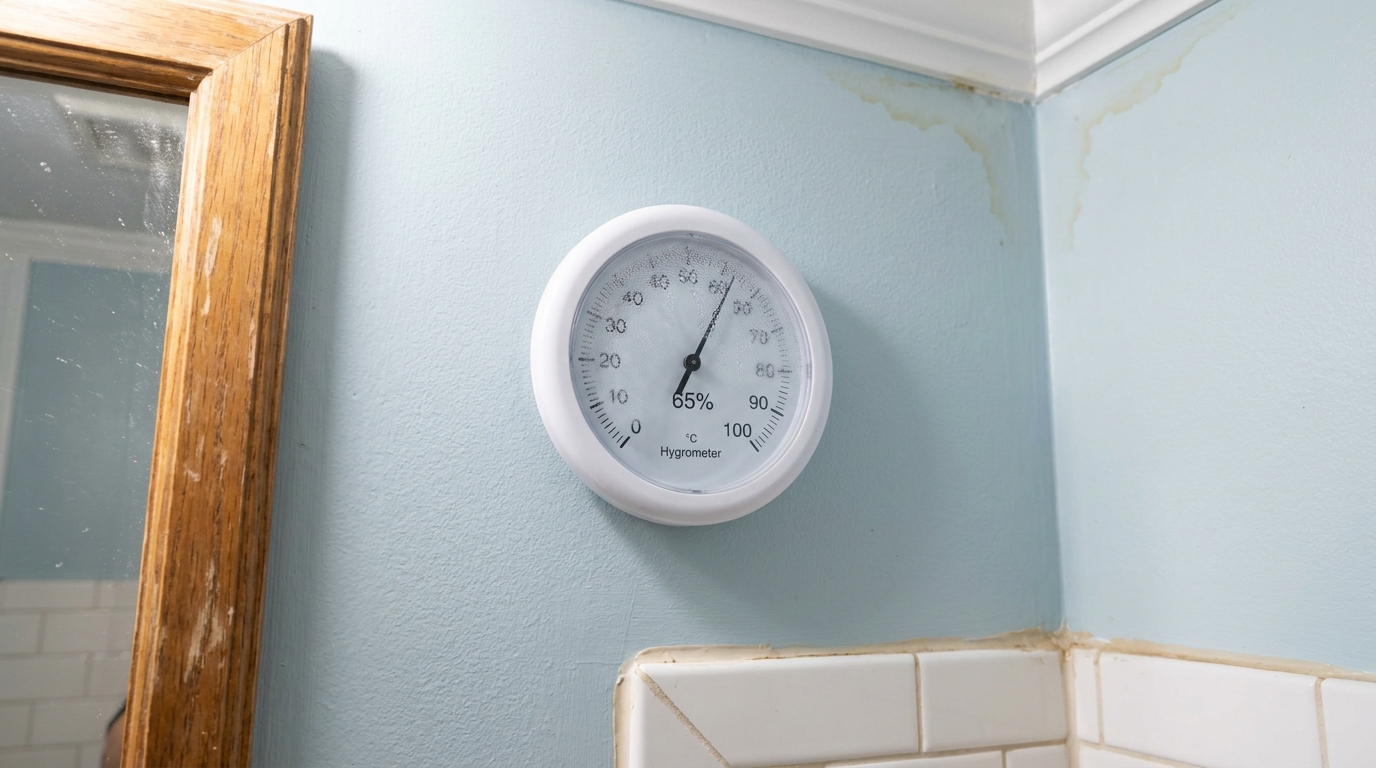
What Is the Difference Between Humidity and Relative Humidity?
Humidity measures the total water vapor in air (absolute humidity), while relative humidity measures how much moisture air currently holds compared to its maximum capacity at a given temperature.
When someone says “the humidity is 60%,” they almost always mean relative humidity. But understanding humidity relative humidity differences is essential for homeowners trying to interpret hygrometer readings, predict condensation, and prevent mold. These two measurements describe fundamentally different things, and confusing them leads to poor decisions about ventilation and dehumidification.
Absolute Humidity: The Total Water Content
Absolute humidity is the actual mass of water vapor per volume of air, measured in grams per cubic meter (g/m³). According to Wikipedia, if air contains 10 g of water vapor per cubic meter, its absolute humidity is 10 g/m³ regardless of temperature. Think of it as a straightforward weight measurement: how many grams of water are floating in this air right now?
This number doesn’t change when you heat or cool the air (assuming no moisture is added or removed). It’s a fixed quantity, like measuring how much sugar is dissolved in a glass of water.
Relative Humidity: The Percentage of Saturation
Relative humidity (RH) is the ratio of the current amount of water vapor in the air to the maximum amount the air can hold at that temperature, expressed as a percentage. According to the National Weather Service, RH tells you how “full” the air is relative to its capacity. At 100% RH, the air is saturated, and any additional cooling or moisture leads to condensation, dew, or fog.
Why Temperature Changes Everything
Here’s where homeowners get tripped up. Warm air can hold far more water vapor than cold air. According to engineering data cited by Wikipedia, air at 86°F (30°C) can hold approximately 30 g/m³ of water vapor at saturation, while air at 32°F (0°C) can hold only about 5 g/m³. That means both rooms could read “80% RH” on a hygrometer, but the warm room contains six times more actual water (24 g/m³ vs. 4 g/m³).
This is exactly why 60% RH in your heated living room during winter feels completely different from 60% RH in your un-air-conditioned house in July.
Why Does Relative Humidity Change When Temperature Changes?
Warm air holds more water vapor than cold air, so when temperature drops, the same amount of moisture becomes a higher percentage of capacity, raising relative humidity without adding any water.
According to research published in Nature, the water-holding capacity of air increases by roughly 7% per 1°C of warming. A practical rule of thumb from atmospheric science: maximum absolute humidity roughly doubles for every 20°F (about 11°C) increase in temperature. [Source: Wikipedia]
The Saturation Point: How Much Water Air Can Hold
Every temperature has a saturation point, the maximum amount of water vapor the air can contain. Below that limit, water evaporates freely. At the limit, the air is “full.” Beyond it, water condenses out as liquid.
| Air Temperature | Max Water Vapor (Saturation) | At 80% RH, Actual Water Vapor |
|---|---|---|
| 32°F (0°C) | ≈ 5 g/m³ | ≈ 4 g/m³ |
| 50°F (10°C) | ≈ 9 g/m³ | ≈ 7 g/m³ |
| 68°F (20°C) | ≈ 17 g/m³ | ≈ 14 g/m³ |
| 86°F (30°C) | ≈ 30 g/m³ | ≈ 24 g/m³ |
Data derived from engineering references cited by Wikipedia and Attuneiot.
What Happens When Air Cools (The Dew Point)
Suppose air at 68°F contains 10 g/m³ of water vapor. At that temperature, the maximum capacity is about 17 g/m³, so RH is roughly 59%. Now cool that air to 50°F without removing any moisture. The capacity drops to about 9 g/m³, but the air still holds 10 g/m³. The air can’t hold it all. RH hits 100%, and the excess condenses as water droplets on the nearest cold surface, your window, your basement wall, or the inside of an exterior wall cavity.
That temperature at which condensation begins is the dew point.
Real Example: Why Your Basement Feels Damp in Summer
On a July day, warm outdoor air at 85°F and 70% RH enters your 65°F basement through open windows or air leaks. That warm air carries a lot of water vapor. When it contacts cool basement walls and floors, its temperature drops, its capacity shrinks, and RH spikes toward saturation. The result: condensation on concrete, a musty smell, and conditions perfect for mold, even though you were “letting fresh air in.”
What Is Specific Humidity and How Is It Different?
Specific humidity measures grams of water vapor per kilogram of air and stays constant regardless of temperature, unlike relative humidity which changes with temperature even when moisture content is unchanged.
According to Britannica, specific humidity is a mass-based ratio: the mass of water vapor divided by the mass of moist air, expressed in g/kg. Because it’s a ratio of masses rather than a comparison to a temperature-dependent capacity, it doesn’t shift when the thermostat changes.
For homeowners, specific humidity matters in one key way: it’s why meteorologists and building scientists sometimes say outdoor RH is misleading. A study of 144 homes in the U.S. Northeast found that outdoor absolute/specific humidity was strongly correlated with indoor absolute humidity year-round, while outdoor RH was a poor predictor of indoor RH. [Source: NIH/PubMed]
In practical terms, if you want to know how much moisture outdoor air will bring into your home, look at the dew point or specific humidity on your weather app, not the RH percentage.
Which Type of Humidity Matters for Mold Growth?
Relative humidity matters most for mold because mold spores respond to moisture availability at surfaces, which correlates with RH. Most species need sustained RH above 60% to germinate.
Why Mold Responds to Relative Humidity
Mold doesn’t “drink” water vapor directly. It needs moisture on or within the materials it colonizes, like drywall, wood, or carpet. RH determines how much moisture those materials absorb from surrounding air. When RH is high, porous materials become damp enough to support fungal growth even without visible water. According to the EPA, humidity or dampness alone (water vapor in the air) can supply enough moisture for mold growth.
The 60% Threshold: What Research Shows
The EPA states that indoor relative humidity should be kept below 60%, ideally between 30% and 50%. [Source: EPA] Most mold species grow most aggressively above 70% RH, according to IICRC S520 mold remediation standards. Broome County (NY) Health Department guidance notes that relative humidity levels above 70% appear to be optimal for fungal or mold spore growth.
This is why two rooms can both read 60% RH on a hygrometer, yet mold grows in one and not the other. The room with poor air circulation may have localized pockets near walls or behind furniture where RH is significantly higher than the room average. If you’re seeing signs of mold in your house, checking humidity in multiple spots is critical.
Temperature’s Role in Mold Risk
Mold grows fastest between about 77°F and 86°F, though many species can grow at temperatures as low as 40°F. A cool basement at 60% RH may develop mold more slowly than a warm attic at 60% RH, but neither is safe if that level persists for days or weeks.
How Do You Measure Relative Humidity Accurately?
Use a digital hygrometer with ±3% accuracy or better, placed away from walls and moisture sources, and take readings at multiple locations since RH varies significantly room to room.
Hygrometer Types and Accuracy Levels
Common portable hygrometers are often accurate to about ±2.5% RH, with some reaching ±0.5% RH. [Source: Daviteq] Sling psychrometers, the old-fashioned wet-bulb/dry-bulb instruments, can have expected errors of 5% to 7% RH even in laboratory-grade form, which is why digital meters are generally recommended for homeowners.
For most home use, a digital thermo-hygrometer in the $15 to $40 range provides adequate accuracy. Look for models that specify ±3% RH or better on the packaging.
Where to Place Your Hygrometer
Place the sensor where it reflects true air conditions. Avoid direct sunlight, heating vents, and steam from showers or cooking. For mold prevention, the most important locations are basements, crawl spaces, bathrooms, and any room where you’ve noticed condensation or musty odors. Readings taken 3 to 4 feet off the floor, away from exterior walls, give the most representative results.
How Often to Check Readings
RH fluctuates throughout the day. Morning readings tend to be higher (cooler temperatures), while afternoon readings drop as the house warms. Check at least twice daily for a week to establish a pattern. If sustained readings exceed 60%, it’s time to investigate moisture sources and consider mold testing to determine whether mold has already established.
What Are Ideal Indoor Humidity Levels by Season?
Target 30 to 50% RH year-round, but winter may require 30 to 40% to prevent condensation on cold surfaces, while summer often needs active dehumidification to stay below 50% in humid climates.
Winter: Balancing Comfort and Condensation Risk
Carrier recommends a winter target of 30 to 40% RH. [Source: Carrier] When outdoor temperatures drop below 10°F, indoor humidity may need to go even lower to prevent window condensation. WHO/NIH guidance illustrates why: outdoor air at -8°C (about 18°F) and 100% RH, when heated to 68°F indoors, drops to only about 15% RH. [Source: NIH] That’s why winter air often feels painfully dry, even though outdoor RH looks high.
Summer: Managing High Outdoor Humidity
Carrier advises keeping summer humidity below 45% RH for optimal comfort and mold prevention. [Source: Carrier] In humid climates, air conditioning alone may not be sufficient. An oversized AC unit cools air quickly but doesn’t run long enough to remove moisture, leaving RH high even when the temperature feels comfortable.
Why One Target Doesn’t Work Year-Round
The common advice to “keep humidity at 50%” ignores the physics of condensation. In winter, 50% RH at 70°F indoor air will produce condensation on any surface colder than about 50°F, which includes most single-pane windows and poorly insulated walls. In summer, 50% RH is a reasonable ceiling, but the challenge is keeping it that low when outdoor dew points are high.
How Does Outdoor Humidity Affect Indoor Relative Humidity?
Outdoor humidity infiltrates through ventilation, air leaks, and open doors or windows, raising indoor RH especially in summer. A home surrounded by 80% outdoor humidity will struggle to maintain 50% indoors without dehumidification.
However, outdoor RH itself is a poor predictor of what happens inside. A multi-country study found only a weak correlation (r = 0.32) between airport outdoor RH and indoor RH. [Source: NIH/PubMed] That’s because RH depends on both moisture content and temperature, and indoor temperatures differ substantially from outdoor temperatures. Outdoor specific humidity (the actual water content) is a much better predictor of indoor conditions.
The practical takeaway: on hot, humid summer days, keep windows closed and run air conditioning or a dehumidifier. Opening windows to “air out” a cool basement on a humid day actually makes moisture problems worse.
What Causes High Relative Humidity Inside a Home?
Common causes include poor ventilation, water intrusion, everyday activities like cooking and showering, basement moisture from groundwater, and HVAC systems that don’t adequately dehumidify.
Moisture Sources: Where Water Enters Your Home
The University of Minnesota Extension notes that when relative humidity exceeds 50%, moisture problems may occur. [Source: UMN Extension] Common sources include:
-
Daily activities: A family of four can generate 2 to 3 gallons of water vapor per day through breathing, cooking, showering, and laundry.
-
Water intrusion: Roof leaks, plumbing leaks, and foundation cracks introduce liquid water that evaporates into indoor air.
-
Groundwater: Basements and crawl spaces absorb moisture through concrete slabs and walls via capillary action.
Ventilation Problems That Trap Humidity
Health Canada notes that high RH above 55% in a home can result from inadequate ventilation or large moisture sources indoors. Bathrooms without exhaust fans, dryer vents that terminate indoors, and sealed-up homes with no mechanical ventilation all trap moisture. Modern energy-efficient construction can make this worse by reducing natural air exchange.
HVAC Issues That Affect Humidity Control
An oversized air conditioner short-cycles, cooling the air quickly but not running long enough to condense moisture from the air. The result is a cool house that still feels clammy. A properly sized system runs longer cycles, pulling more moisture across the evaporator coil and lowering RH effectively.
Can You Have High Absolute Humidity but Low Relative Humidity?
Yes. Hot air can contain large amounts of water vapor yet still show low relative humidity because warm air’s capacity is so high. This is why desert air at 110°F can contain measurable moisture but feel bone-dry.
Consider this example from Attuneiot: if air contains 10 g/m³ of water vapor and the temperature allows a maximum of 20 g/m³, RH is 50%. Heat that same air until its capacity rises to 40 g/m³, and RH drops to 25%, even though the absolute moisture hasn’t changed at all.
For homeowners, this explains why a hot attic might read 30% RH on a hygrometer but still contain enough moisture to cause problems if that air migrates to a cooler area (like the underside of the roof deck at night).
How Do Dehumidifiers Work with Relative Humidity?
Dehumidifiers remove water vapor from air, lowering absolute humidity, which in turn reduces relative humidity at any given temperature. Most units include humidistats that cycle on and off to maintain a target RH level.
How Dehumidifiers Lower RH
A refrigerant dehumidifier draws air across a cold coil, cooling it below its dew point so water condenses out. The now-drier air passes over a warm coil and returns to the room at roughly the same temperature but with less moisture. This reduces both absolute humidity and relative humidity.
Understanding Capacity Ratings (Pints Per Day)
Dehumidifier capacity is rated in pints of water removed per day, but that number is tested at specific conditions, typically 80°F and 60% RH (the AHAM standard). In a 65°F basement, the same unit will extract significantly less moisture because cooler air holds less water vapor and the temperature differential across the coils is smaller. Industry practitioners typically estimate a 30% to 50% reduction in effective capacity at basement temperatures compared to rated conditions.
Why Temperature Affects Dehumidifier Performance
Below about 65°F, standard refrigerant dehumidifiers lose efficiency rapidly because the coils can ice up. For cold basements or crawl spaces, desiccant dehumidifiers perform better since they use a moisture-absorbing material rather than refrigeration.
What Is Dew Point and Why Does It Matter?
Dew point is the temperature at which air becomes saturated and water vapor condenses into liquid. It indicates absolute moisture content and predicts exactly where condensation will form on cold surfaces.
How Dew Point Relates to Relative Humidity
When air temperature equals the dew point, RH is 100%. The further apart they are, the lower the RH. According to WHO/NIH guidance, air at 68°F (20°C) and 58% RH, when cooled to 52°F (11°C), reaches 100% RH and condensation begins. [Source: NIH]
Using Dew Point to Predict Condensation
If your indoor dew point is 55°F, any surface colder than 55°F will collect condensation. This is why single-pane windows fog in winter, why cold water pipes “sweat” in summer, and why poorly insulated exterior walls develop hidden moisture problems.
Why Dew Point Is More Useful Than RH for Some Decisions
Dew point doesn’t change with temperature (it reflects actual moisture content, like specific humidity). When deciding whether to open windows, checking the outdoor dew point is more useful than checking outdoor RH. A dew point above 60°F means the outdoor air is genuinely muggy and will raise indoor moisture levels. A dew point below 55°F generally means outdoor air won’t cause indoor condensation problems.
How Does Relative Humidity Affect Indoor Air Quality?
RH below 30% dries mucous membranes and increases airborne dust, while RH above 60% promotes mold, dust mites, and bacterial growth. The 30 to 50% range optimizes both comfort and health.
The EPA recommends indoor RH between 30% and 50%, and never sustained above 60%. [Source: EPA] Below 30%, dry air can aggravate respiratory conditions, increase static electricity, and cause wood furniture and flooring to crack. Above 60%, biological contaminants thrive. Dust mites, which are a major allergen source, require RH above 50% to survive and reproduce.
If you’ve been measuring sustained RH above 60% and notice musty odors or visible discoloration, the next step is determining whether mold has already taken hold. A mold test kit can help assess your home’s air quality, or a certified mold inspector can provide a professional evaluation.
Frequently Asked Questions
Here are answers to the most common questions homeowners ask about humidity, relative humidity, and indoor moisture control.
Is 60% relative humidity too high for a house?
Yes. The EPA recommends keeping indoor RH below 60% and ideally between 30% and 50%. Sustained RH above 60% creates conditions where mold can germinate on organic surfaces, especially in areas with poor air circulation. [Source: EPA]
Why does my hygrometer show different readings in different rooms?
RH varies by room because temperature, ventilation, and moisture sources differ throughout a home. A bathroom after a shower may read 80% RH while a sunny living room reads 40%. Basements are typically higher because they’re cooler and closer to ground moisture. Always measure in multiple locations to get a complete picture.
Does opening windows lower indoor humidity?
It depends on outdoor conditions. If the outdoor dew point is below about 55°F, opening windows can help reduce indoor moisture. If the outdoor dew point is above 60°F (common in summer across much of the eastern U.S.), opening windows will actually raise indoor humidity, especially in cool basements.
What’s the difference between dew point and relative humidity?
Dew point tells you the actual moisture content of the air and doesn’t change with temperature. Relative humidity tells you how close the air is to saturation at its current temperature. A dew point of 65°F always means the same amount of moisture, while 65% RH could mean very different moisture levels depending on whether it’s 50°F or 90°F.
Why is my basement humid even with no leaks?
Warm, humid outdoor air entering a cool basement raises RH dramatically because the cooler temperature reduces the air’s capacity. Concrete walls and floors also absorb and release ground moisture. Even without visible leaks, a basement can sustain RH above 70% in summer without active dehumidification.
How accurate are cheap hygrometers?
Common portable hygrometers are often accurate to about ±2.5% RH, with some reaching ±0.5% RH. [Source: Daviteq] For mold prevention decisions, ±3% accuracy is generally sufficient. Avoid analog dial hygrometers, which can drift significantly over time.
Can mold grow at 50% relative humidity?
Most mold species need sustained RH above 60% to germinate, so 50% RH at room temperature is generally safe. However, localized conditions matter. Behind furniture against a cold exterior wall, surface RH can be much higher than the room average. If you suspect hidden mold despite acceptable room-level readings, a professional assessment can check for localized moisture problems.
Should I use a humidifier and dehumidifier in the same house?
In many climates, yes, at different times of year. Winter heating dries indoor air below 30% RH, making a humidifier helpful for comfort. Summer humidity often pushes indoor RH above 50%, requiring a dehumidifier, especially in basements. The key is monitoring with a hygrometer and responding to actual readings rather than guessing.