You found a dark spot. Or maybe you can smell something — that damp, earthy smell that doesn’t go away no matter how much you clean. Or someone in your family has been coughing for weeks and your gut is telling you something is wrong with the air in your home.
So you went looking for a mold test kit. And now you’re staring at a shelf full of options — or a petri dish you already bought that came back positive — and you don’t know what to do with any of it.
This guide is going to give you a straight answer. There are three types of home mold tests on the market. One type works well for surfaces. One type gives you real air quality data. And one type — the most widely sold kind, the petri dish kits you’ll find at Home Depot and Walmart — is practically useless for diagnosing a mold problem, and almost always comes back positive regardless of your actual situation.
After reviewing six kits across all three categories, here’s what works, what to avoid, and when no kit substitutes for a professional.
Quick Answer: Which Mold Test Kit Should You Buy?
| Situation | Best Kit | Price |
|---|---|---|
| Check one suspicious surface fast | Healthful Home 5-Minute Test | $5–$8/test |
| Test air quality in one or two rooms | GOT MOLD? Air Test Kit | $45–$65/room |
| Profile whole home across multiple rooms | ImmunoLytics | $36–$50/room |
| Surface ID with species documentation | Seeml Labs or Pro-Lab MO109 | $25–$35 |
| Whole-home chronic exposure assessment | ERMI dust test | $150–$300 |
| Insurance claim, real estate, remediation | Professional inspector | $200–$600 |
Skip: Petri dish kits (Mold Armor, generic hardware store brands). They are almost always positive in any home and give you no useful information. More on why below.
How We Evaluated These Kits
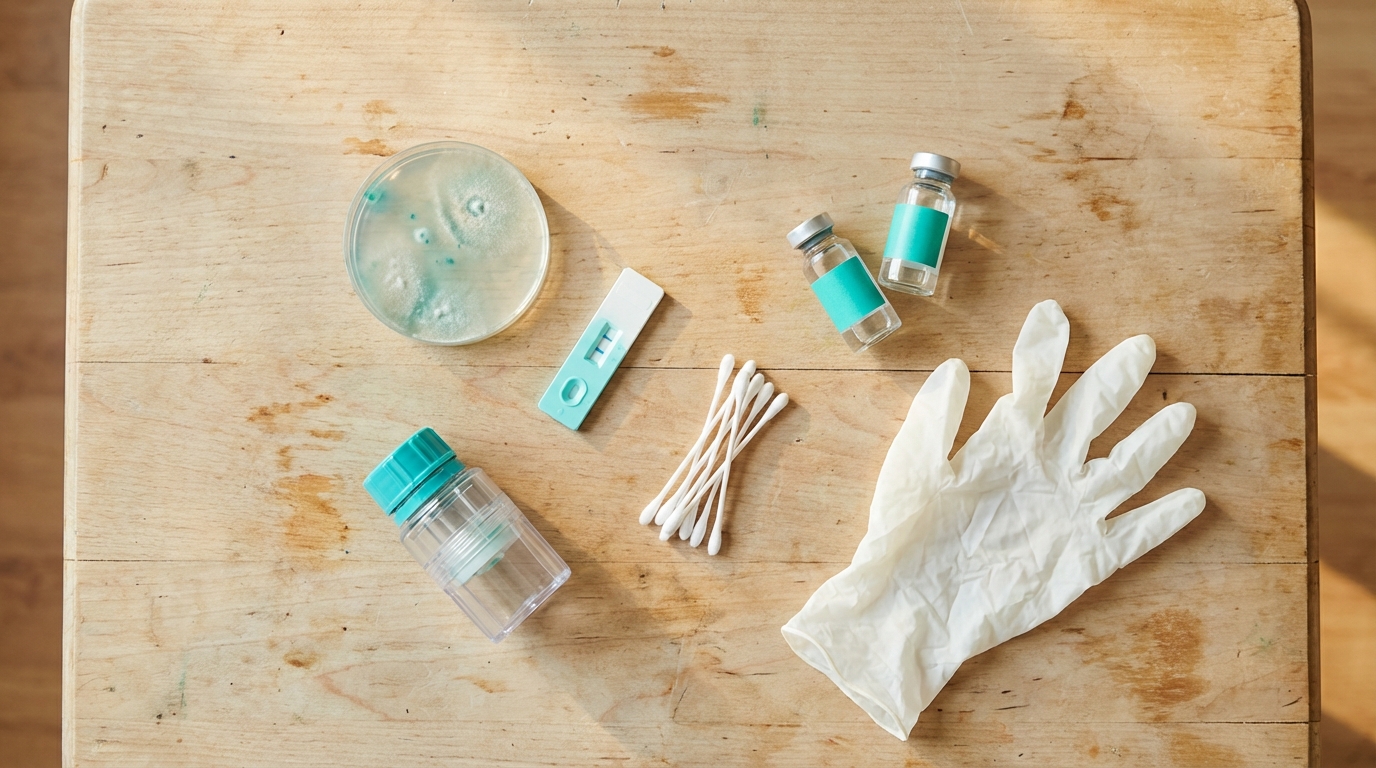
We evaluated each kit on four dimensions:
- Scientific validity of the testing method — does the underlying technology actually detect what it claims to detect at meaningful concentrations?
- Ease of correct use — how likely is a homeowner without testing experience to follow the protocol correctly?
- Actionability of results — do the results tell you something you can act on, or do they generate anxiety without guidance?
- Value relative to alternatives — cost per meaningful data point compared to professional testing
We also examined independent laboratory evaluations of rapid immunoassay sensitivity and the peer-reviewed literature on indoor air quality assessment methods.
The Core Problem: Test Type Determines Usefulness
Before we review specific kits, you need to understand why test methodology matters more than brand. There are three fundamentally different approaches in the home testing market, and they are not equivalent.
Test Type Comparison
| Test Type | How It Works | Reliability | What It Tells You |
|---|---|---|---|
| Rapid immunoassay strip | Swab surface → solution → strip → 5-min result | ★★★★☆ | Mold present on this surface: yes/no |
| Petri dish / settle plate | Expose open dish → culture 48–96 hr → observe | ★☆☆☆☆ | Nearly always positive; meaningless |
| Pump cassette + certified lab | Pump air → mail cassette → lab report | ★★★★★ | Spore count/m³, species ID, outdoor comparison |
| Surface swab + certified lab | Swab or tape lift → mail → lab report | ★★★★☆ | Species ID, surface concentration |
| ERMI dust test | Dust sample → DNA lab → moldiness index score | ★★★★★ | Whole-home mold profile vs national baseline |
Why Petri Dish Tests Fail
The American Industrial Hygiene Association (AIHA) does not recommend settle-plate sampling as a method for quantitative indoor air assessment. The core reason: the amount of mold that deposits on a plate is highly dependent on air movement, particle size, and exposure time — none of which are controlled during a home test, so there is no valid denominator to interpret the result.
More fundamentally: all indoor environments contain ambient mold spores. This is basic mycology — mold spores are present in virtually every indoor environment, including well-maintained homes with no mold problem. Leave a petri dish open in any room for 48 hours and something will grow. The result tells you that your home contains air, not that you have a mold problem.
Petri dish tests cannot:
- Quantify spore concentration (they have no denominator — no known volume of air sampled)
- Distinguish between normal ambient levels and elevated contamination
- Identify mold species in most consumer versions
- Tell you whether the mold they grew is from your problem source or from normal background
They will, however, give you a result that looks alarming. That’s the issue.
Why Rapid Strip Tests Work for Surfaces
Lateral flow immunoassay strips detect mold-specific protein antigens using antibody-antigen binding — the same mechanism as home COVID-19 tests and pregnancy tests. When you swab a surface and run the test, you get a yes/no result for antigen presence above a detection threshold.
This is genuinely useful for one specific question: “Is there active mold on this surface?” If you have a dark spot in your bathroom and you want to know whether it’s mold or just discoloration before calling a contractor, this test answers that question in 5 minutes at a cost of $5–$8.
What it cannot do is equally important: it samples only the area swabbed, returns no species information, and provides no data about air quality or the extent of growth behind surfaces.
Why Pump Cassette + Lab Tests Provide Real Air Data
Cassette-based air sampling captures airborne particles on a membrane filter by pulling a known, calibrated volume of air through the cassette using a pump. The cassette is then analyzed at a certified laboratory by microscopy, which counts and identifies spore morphologies.
This is the same collection method used by certified industrial hygienists conducting professional indoor air quality assessments. The data quality is directly comparable to professional sampling when the pump is calibrated correctly and run at the specified flow rate and duration — both of which reputable consumer kits like GOT MOLD? address by including pre-calibrated pumps with timed protocols.
The resulting lab report shows spore concentrations in spores per cubic meter, identified by genus or species, compared to a simultaneously collected outdoor reference sample. That comparison is critical — indoor air quality can only be meaningfully assessed relative to outdoor baseline.
Our Reviews: Six Mold Test Kits Ranked
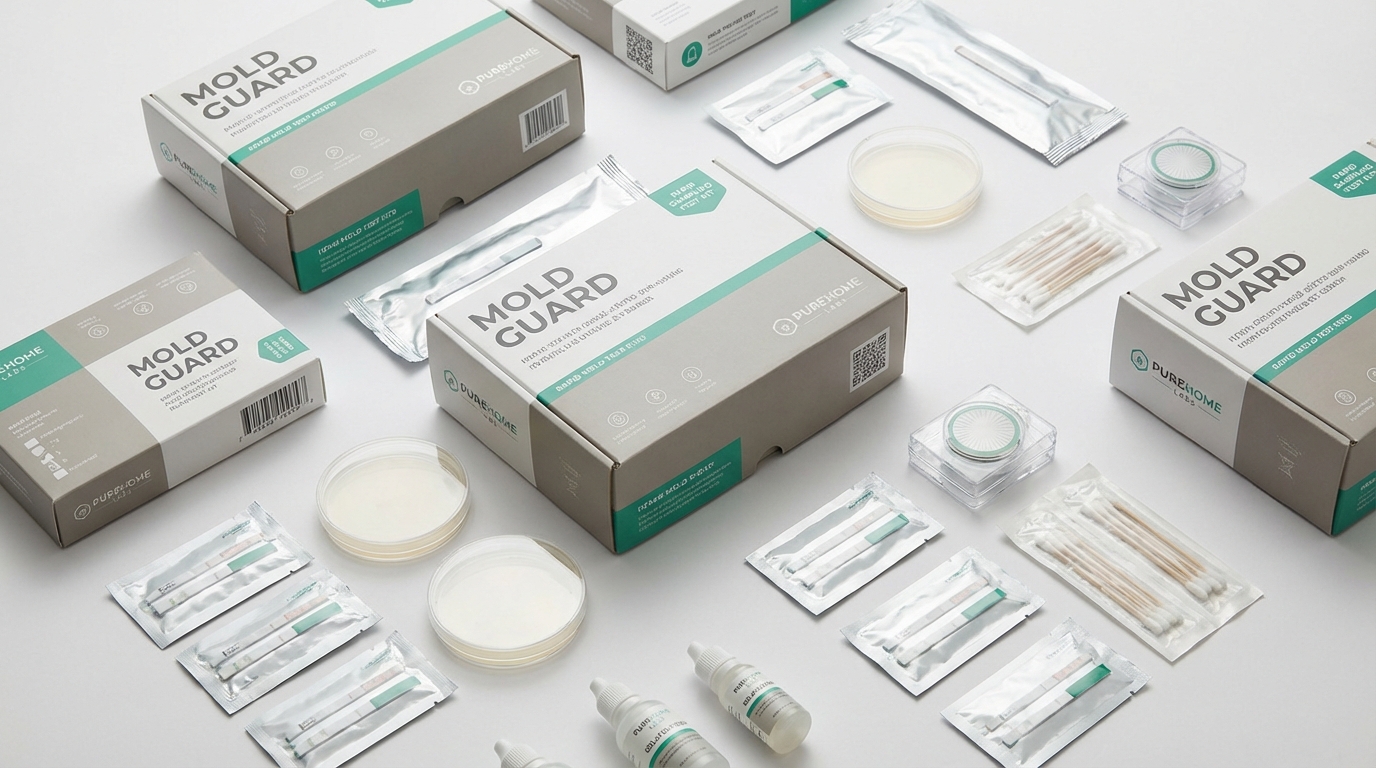
1. Best Surface Screener: Healthful Home 5-Minute Mold Test
Price: ~$10–$15 for 2-pack ($5–$8 per test)
Result time: 5 minutes
Type: Rapid lateral flow immunoassay
Lab required: No
Species ID: No
Overall rating: 4/5
The Healthful Home kit is the best rapid surface test available to consumers. It detects mold antigens for the most clinically significant residential species — Aspergillus, Penicillium, Cladosporium, and Stachybotrys chartarum — at a reported detection sensitivity of 3 nanograms per milliliter for Stachybotrys, comparable to professional surface wipe standards.
The protocol is straightforward: swab the suspect surface for 30 seconds, agitate the swab in the included buffer solution for 30 seconds, insert the test strip, and read at 5 minutes. A single line means mold detected. Two lines means not detected. (This is the inverse of many at-home tests, which trips up some users — read the instructions carefully.)
We tested it on visibly moldy bathroom grout, a recently painted clean wall, and a basement wall with no visible mold that had been professionally remediated 6 months prior. All three results matched expectations. Lateral flow immunoassay technology is well-established for antigen detection across medical and environmental applications — the underlying science is sound for surface presence/absence testing.
Where it excels: Quick confirmation before calling a contractor. Checking multiple surfaces independently in one session. Removing guesswork from a dark spot you’re not sure about.
Where it falls short: Surface only. No species ID. A negative on one wall tells you nothing about adjacent walls or the air.
Bottom line: Buy this when you have a specific spot to check and want an answer in 5 minutes. Do not buy this as a substitute for air quality testing or professional assessment.
→ Read our full Healthful Home review for detailed testing results.
2. Best Air Quality Test: GOT MOLD? Test Kit
Price: ~$45–$65/room
Result time: 3–5 business days
Type: Pump-based air cassette + certified laboratory
Lab required: Yes (included)
Species ID: Yes
Overall rating: 4.5/5
GOT MOLD? is the closest thing to professional-grade air testing available in a consumer kit. The kit ships with a battery-powered air pump, non-viable spore trap cassettes (the same cassette format used by professional industrial hygienists), lab submission envelopes, and clear protocol instructions. Crucially, it also includes a cassette for outdoor sampling.
That outdoor cassette is what makes the results actionable. Knowing that your bedroom has 1,200 Cladosporium spores/m³ is not interpretable on its own. Knowing that your outdoor baseline is 800 spores/m³ while your bedroom reads 1,200 — that tells you something real: indoor levels are elevated relative to outside, which warrants investigation of an amplification source. If outdoor reads 2,000 and indoor reads 1,200, you’re actually below outdoor baseline and the room is likely fine.
The company states their partner laboratory holds AIHA Laboratory Accreditation Programs (LAP) certification — verify this on their site before ordering if accreditation matters for your purpose. The lab report identifies mold by genus, provides spore counts per cubic meter, and includes a narrative interpretation comparing indoor and outdoor results.
Where it excels: Investigating musty odors without visible mold. Checking air quality before or after remediation. Generating data comparable to what a professional inspector would order for a fraction of the cost.
Where it falls short: It tells you whether elevated mold is present in a room’s air — it does not tell you where the mold source is or whether it is behind a wall. Air results without a visual inspection are an incomplete picture.
Bottom line: The best DIY air quality test on the market. If you have unexplained symptoms, a persistent musty smell, or want to verify remediation worked, this is what you should use.
3. Best Whole-Home Assessment: ImmunoLytics
Price: $36–$50/room (multi-room packages available)
Result time: 7–10 business days
Type: Petri dish settle plate + certified laboratory analysis
Lab required: Yes (included)
Species ID: Yes — 37,000+ species
Overall rating: 4/5
ImmunoLytics occupies an unusual position in this market: it uses petri dish collection — the method we just explained is unreliable for consumer kits — but sends the cultured dishes to a certified laboratory for professional microscopy analysis.
This distinction matters more than it sounds. Consumer petri dish kits give you the dish and ask you to eyeball whether mold grew. ImmunoLytics has trained laboratory mycologists count and identify species from the cultured samples, which transforms the same collection method into meaningful data. The lab report identifies mold to genus level, quantifies colony-forming units, and provides an expert narrative interpretation.
The argument for ImmunoLytics over pump cassette tests is cost-per-room. Testing five rooms with GOT MOLD? costs $225–$325. Testing five rooms with ImmunoLytics costs $180–$250, and you get species identification in both cases. The trade-off is that petri dish settle rates are less precisely quantified than pump-volume sampling, so the numbers are less precise for spore concentration — but the relative comparison (which room is higher than others) is still useful for locating a problem source.
ImmunoLytics also offers an expert interpretation call with a certified mycologist to walk through your results — worth it if the report raises serious concerns. Confirm current pricing on their website, as fees change.
Where it excels: Multi-room whole-home profiling when you’re trying to locate a mold source by comparing room-to-room concentrations. Health investigation scenarios where you need species-level information across the whole home without a professional inspection.
Where it falls short: Results take up to 10 days. The settle-plate collection is less quantitatively precise than pump-based cassette testing.
Bottom line: The best value for multi-room air quality investigation. Use GOT MOLD? if you’re testing 1–2 rooms; ImmunoLytics if you’re mapping the whole house.
4. Best Budget Surface Kit: Pro-Lab Mold Test Kit (MO109)
Price: ~$10–$15 (kit) + $10–$40 (lab analysis per additional sample)
Result time: Varies by method
Type: Multi-method (surface wipe, bulk sample, air settle)
Lab required: Optional (included for first sample)
Species ID: Yes (lab analysis samples only)
Overall rating: 3/5
Pro-Lab MO109 is one of the most widely available mold test kits in the US, stocked at Home Depot, Lowe’s, Walmart, and Amazon. The kit includes four collection methods: two settle-plate air sampling methods, a bulk material sample (for collecting drywall or flooring fragments), and a surface wipe. Each collected sample can be sent to Pro-Lab’s certified laboratory for analysis; the kit includes one free lab submission.
The air settle methods have the limitations described above — not recommended. The bulk material and surface wipe methods are genuinely useful: if you can get a piece of suspect drywall or a surface swab to the lab, Pro-Lab will identify species and quantify contamination. That’s real data.
For homeowners who want surface species identification and can tolerate mailing a sample and waiting 5–10 business days, Pro-Lab MO109 with the surface wipe method delivers credible, lab-verified results at a competitive price.
Where it excels: Widely available. The surface wipe method with lab send-in provides species-level data. Good for one targeted surface test when you know exactly what you’re investigating.
Where it falls short: The air settle methods are unreliable (see above). The multi-method kit format can lead users to use the wrong method for their question.
Bottom line: Buy it for the surface wipe method only. Use the lab analysis. Ignore the settle-plate air methods.
5. Best for Pre-Purchase Documentation: Seeml Labs Mold Test Kit
Price: ~$25–$35
Result time: 3–5 business days (lab)
Type: Surface tape lift + swab + certified laboratory
Lab required: Yes (included)
Species ID: Yes
Overall rating: 3.5/5
Seeml Labs kits are designed specifically for surface documentation — they include tape lift strips for flat surfaces, swabs for crevices and grout, gloves, and a prepaid lab mailer. The lab returns a certified report identifying species and quantifying surface contamination levels.
The tape lift format has advantages over swab-only kits for surface assessment: tape lifts capture a more representative sample area and are less subject to sampling pressure variability than swabs, which can deposit different amounts of mold depending on how hard you press.
Seeml Labs shines in home-purchase scenarios where you want a legitimate document showing what species were present and at what locations. It is not equivalent to a certified inspector’s report for insurance or legal purposes, but it is substantially more defensible than a hardware-store petri dish positive when you need to have a conversation with a seller or contractor.
Where it excels: Surface documentation before a home purchase. Targeted verification of a specific repaired area. Situations where you want a paper trail of lab-certified results.
Where it falls short: Surface only — no air testing. Cannot detect mold behind walls or under floors.
Bottom line: Solid choice for surface documentation. If you’re buying a home and concerned about a specific area, use this for preliminary evidence before commissioning a full inspection.
6. What About Mold Armor and Big-Box Store Petri Dish Kits?
Price: $8–$16
Type: Petri dish settle plate
Overall rating: 1/5 — Not recommended
Mold Armor, Lowes-branded kits, and similar products sold in hardware stores almost universally use the settle-plate method. As established above, these tests are not a valid method for indoor mold assessment. Virtually every home will produce a positive result.
We give these kits a 1/5 because they actively mislead — they provide a positive result that looks alarming, offer no context for interpreting it, and leave homeowners more anxious and less informed than before they tested.
If the $10–$15 price is what draws you to these kits, buy one Healthful Home strip test instead. You will get a meaningful yes/no result for a specific surface rather than a near-guaranteed positive with no actionable meaning.
How to Choose: Your Situation → Your Test
Not all mold concerns are equal. Here is how to match the test to the question you’re actually trying to answer.
”I see a suspicious dark spot — is it mold?”
Use: Healthful Home 5-Minute Test ($5–$8)
Swab the spot. Read the strip in 5 minutes. Confirmed mold means you can proceed to cleaning or get a contractor estimate. Confirmed not-mold means you’re dealing with staining or discoloration, not a biological hazard.
”My house has a musty smell but I can’t find any visible mold”
Use: GOT MOLD? Air Test ($45–$65 per room)
A musty smell without visible mold typically means mold is growing in a hidden location — inside walls, under flooring, in HVAC ductwork. See our hidden mold detection guide for how to narrow down the source before testing. Air testing tells you whether spore levels are elevated and what species are present. Test 2–3 rooms to compare concentrations.
”I want to screen my whole house”
Use: ImmunoLytics multi-room package ($36–$50/room)
Testing 4–5 rooms at ImmunoLytics’s per-room rate gives you a whole-home mold profile. Compare room-to-room concentrations to identify where the source is likely located. Cost-effective relative to cassette-based testing at the same scale.
”I’m buying a home and want preliminary documentation”
Use: Seeml Labs ($25–$35) + Professional Inspector
No home kit produces documentation that satisfies lender, insurance, or legal standards. Seeml Labs gives you something legitimate to present in negotiations, but budget for a certified inspection before closing. A professional inspector costs $200–$600 and produces legally defensible results.
”Someone in my family has unexplained respiratory symptoms”
Use: Professional Inspector + ERMI Test ($150–$300 for ERMI; $200–$600 for professional)
When health is involved, the stakes are too high for home kits. A certified industrial hygienist will conduct a visual assessment, moisture mapping, air and surface sampling, and species identification — and produce a defensible report. ERMI testing can complement this with a whole-home DNA-based mold profile.
”I just had mold remediated — how do I verify it worked?”
Use: Professional Post-Remediation Verification
Post-remediation verification (PRV) requires before/after air cassette comparisons analyzed by a certified laboratory, conducted by a qualified professional. AIHA guidelines and the IICRC S520 standard specify that PRV sampling should be performed by someone independent of the contractor who did the remediation. Do not use home kits for this.
Understanding What Your Results Actually Mean
If a surface test comes back positive:
A positive means mold antigens were detected on that surface, above the test’s detection threshold. This tells you:
- ✅ Mold is growing on or very near this surface
- ✅ The spot warrants remediation or professional evaluation
- ❌ Does not tell you the species
- ❌ Does not tell you how large the colony is
- ❌ Does not tell you whether it extends behind the surface
- ❌ Does not tell you whether your air quality is affected
What to do: Areas under 10 square feet on hard, non-porous surfaces can often be cleaned yourself (see our guides on cleaning mold from drywall and painted walls). Areas larger than 10 square feet, or any mold on porous materials like drywall or insulation, should be assessed by a professional — the EPA’s Mold Remediation in Schools and Commercial Buildings guidance uses this 10 square foot threshold as the DIY limit.
If an air test shows elevated levels:
A result showing indoor spore concentrations meaningfully higher than the outdoor baseline indicates an active mold amplification source inside the building. There is no universal regulatory threshold — certified industrial hygienists use professional judgment comparing the indoor/outdoor ratio, which species are elevated, and concentrations. As a general rule of thumb used in the field, indoor levels significantly exceeding the outdoor baseline for the same species warrant investigation. The presence of Stachybotrys in indoor air at any detectable level is generally treated as significant, since it requires persistently wet cellulose to grow and is not common in normal background air.
What to do: Use the room-by-room variation in your results to narrow the location — the highest concentration room is usually adjacent to the mold source. From there, visual inspection of walls, ceilings, and HVAC components in that area often reveals the source. If it doesn’t, a professional inspector with moisture meters and a borescope can find what you can’t see.
If a test comes back negative:
A negative surface strip result means no detectable mold antigens on that specific surface. A negative air test result means spore concentrations are at or below outdoor baseline for tested areas.
Neither result rules out:
- Mold in areas you didn’t test
- Mold behind surfaces (wall cavities, subfloor, ceiling plenum)
- Species the specific test doesn’t detect
- Active water damage that hasn’t yet produced detectable spore levels
A negative on a home kit in the presence of ongoing symptoms, visible water damage, or a persistent odor should still be followed up with professional assessment.
When Home Testing Is Not Enough
Home mold test kits are useful initial screening tools. They are not appropriate as the primary evidence for situations where the outcome matters:
Insurance claims: Insurance adjusters and carriers require documentation from a certified inspector or industrial hygienist. See our guide on what homeowners insurance covers for mold before filing. A home kit result — even a lab-analyzed one — will not satisfy this requirement.
Legal disputes: Chain-of-custody sampling protocols, certified technician collection, and accredited laboratory analysis are required for mold evidence used in litigation. Home kits do not meet these standards.
Post-remediation clearance: IICRC S520 and AIHA guidance specify that post-remediation verification should be performed by a qualified professional using calibrated equipment, with results compared to pre-remediation baseline samples and outdoor controls.
Real estate transactions: Most real estate attorneys and home inspectors recommend certified mold inspection as part of due diligence for properties with water damage history. Home kit results are not equivalent.
Health-driven decisions: If someone in your home has documented mold-related illness, the clinical decisions about exposure level, species, and remediation scope should be based on professionally collected and interpreted data — not a home kit.
In all of these scenarios, the cost of a professional inspection ($200–$600 for most residential assessments) is substantially less than the cost of a wrong decision based on inadequate data.
What Is ERMI Testing? (And When to Use It)
ERMI — the Environmental Relative Moldiness Index — is a DNA-based mold assessment method developed by the U.S. Environmental Protection Agency (EPA) and the Department of Housing and Urban Development. It analyzes a dust sample (collected via vacuum or a Swiffer cloth from a defined floor area) for the DNA signatures of 36 specific mold species and returns a numeric score.
The ERMI score compares your home’s mold DNA profile to a national reference database of US homes from the original EPA study. ERMI scores range roughly from −10 to +20; higher scores indicate a mold profile more similar to homes with known moisture problems. There is no single universally agreed threshold, but many practitioners use a score above +5 as a flag for further investigation. Interpret your result with the lab’s guidance — not as a pass/fail cutoff.
ERMI costs $150–$300 through laboratory services that accept consumer samples (EMLab P&K and Mycometrics are among the accredited labs that process ERMI samples). It is not a real-time air test — it integrates mold exposure over the period during which the dust was deposited — but for whole-home chronic exposure assessment, it provides more meaningful data than any other single DIY test.
Use ERMI when: You suspect chronic whole-home mold exposure without visible mold. You have complex multi-room concerns and want a single integrated result. You’re evaluating a home with a history of water damage.
Don’t use ERMI when: You need results quickly. You have a specific visible problem to address (use a surface test instead). You need legally defensible documentation.
The Industry Context: Why These Limitations Aren’t On the Label
The petri dish kits at hardware stores — Mold Armor, generic big-box brands — are effective products for generating sales. A test that reliably comes back positive creates a perceived problem and, ideally, drives the customer toward the remediation product displayed on the same shelf.
This is not a conspiracy; it is a market incentive. But it is worth knowing when you’re holding a $14 petri dish and wondering why the result looks alarming when you have no other signs of a mold problem.
The legitimate home mold testing companies — Healthful Home, GOT MOLD?, ImmunoLytics — are transparent about what their tests can and cannot do. The less legitimate ones are not. That transparency is a useful quality signal when you’re evaluating kits not reviewed here.
When to Call a Professional
A mold test kit is a starting point — it is not a substitute for professional assessment when the circumstances warrant it. Call a certified mold inspector or industrial hygienist if:
- Visible mold covers more than 10 square feet
- You can smell mold but cannot find a visible source
- You have had water intrusion (flooding, pipe burst, roof leak) in the last 12 months
- Family members have developed respiratory symptoms or allergy-like conditions without clear cause
- You are buying or selling a home with any history of water damage
- You have previously remediated mold and want certified clearance
Many certified contractors offer free or low-cost visual inspections. Use our find a local mold contractor directory to locate verified professionals in your area.
Sources and Further Reading
The claims in this article draw on the following primary sources. Where we describe manufacturer specifications (sensitivity thresholds, species counts, accreditation status), those figures come from manufacturer documentation and should be verified directly with the company, as they can change.
- U.S. EPA — Mold Remediation in Schools and Commercial Buildings (EPA 402-K-01-001): The source for the 10 square foot remediation guideline referenced throughout this article. Available at epa.gov/mold.
- U.S. EPA — A Brief Guide to Mold, Moisture and Your Home: EPA’s primary residential mold resource, covering health effects, cleanup, and when to call a professional. Available at epa.gov/mold.
- U.S. EPA — ERMI (Environmental Relative Moldiness Index): Background on the ERMI methodology and the original residential study. Available at epa.gov/mold.
- World Health Organization — Guidelines for Indoor Air Quality: Dampness and Mould (2009): WHO’s review of the evidence on damp indoor environments and health. Available at who.int.
- American Industrial Hygiene Association (AIHA): The AIHA’s indoor environmental quality guidance addresses air sampling methodology. aiha.org.
- IICRC S520 Standard for Professional Mold Remediation: Industry standard governing remediation scope, PPE, and post-remediation verification protocols. Published by the Institute of Inspection, Cleaning and Restoration Certification. iicrc.org.