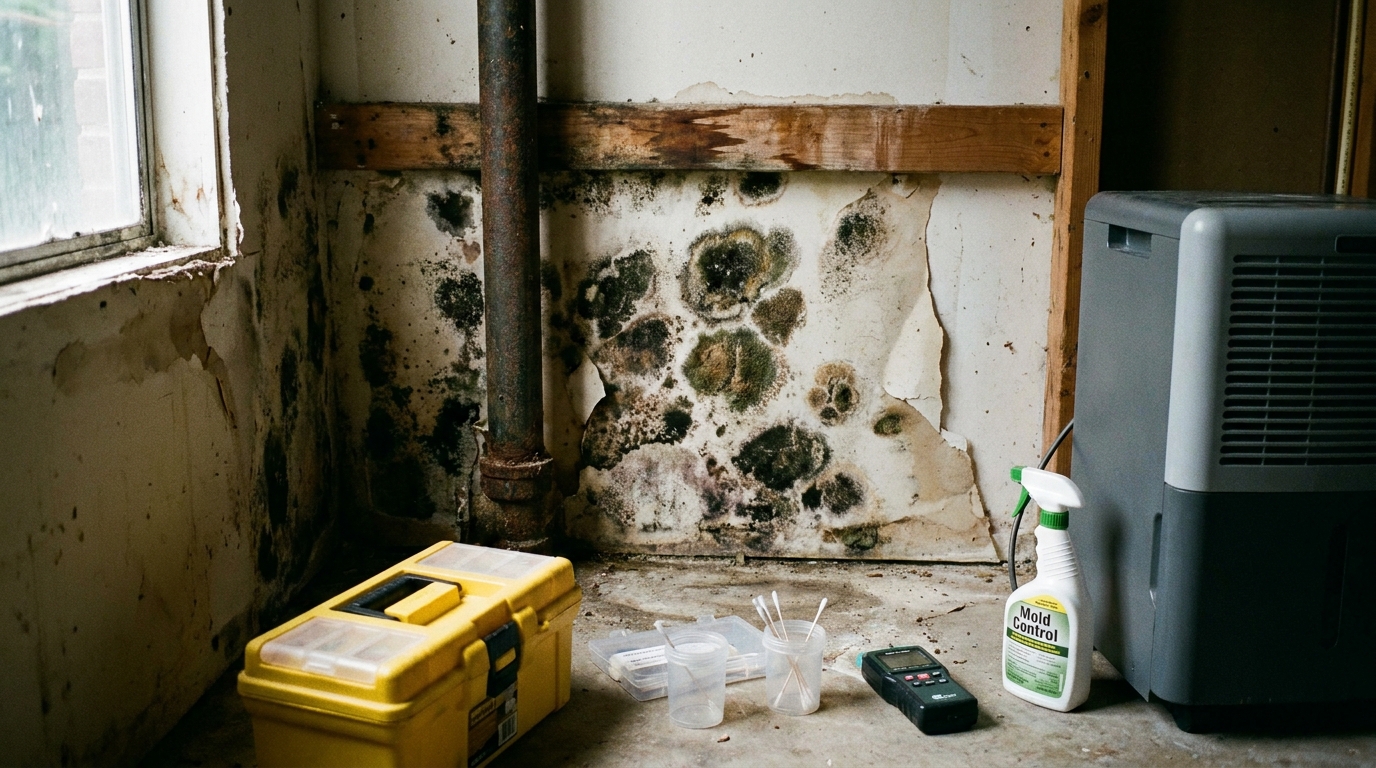
What Does Black Mold Look Like Up Close?
Mature Stachybotrys chartarum colonies typically appear as dark greenish-black patches with a slimy, wet texture when actively growing on damp surfaces.
When homeowners examine black mold up close, they’re often surprised by how different it looks from the dramatic stock photos online. Based on over 15,000 inspections, one remediation firm describes typical Stachybotrys as “dark greenish-black or pure black patches with a slimy, wet texture when actively growing” [Source: Bustmold]. But that description only captures one stage of growth. The appearance shifts depending on moisture, age, and the material it’s feeding on.
Texture: slimy vs. powdery vs. fuzzy
Texture is one of the first things people notice. In high humidity, Stachybotrys colonies look gelatinous and shiny, almost like a dark wet stain with dimension [Source: Bustmold]. When moisture decreases, the same colony can shift to a powdery, sooty, or dry appearance [Source: Bustmold]. EPA-aligned guidance notes that younger growth often looks powdery, while older growth may appear furry [Source: Upperrestoration]. This textural range is one reason online images of “black mold” look so wildly inconsistent.
Color variations within the same colony
Stachybotrys isn’t uniformly black. Colonies can appear greenish-black, gray, or brown rather than pure black [Source: Upperrestoration]. In early stages, colonies may start white or pale with darker centers as spores develop [Source: Bustmold]. Mature colonies filled with spores take on a deep black appearance that’s often noticeably darker than other common household molds [Source: Bustmold].
Growth pattern: how it spreads from a central point
On household surfaces, Stachybotrys forms irregular, spotty patches that follow moisture pathways, such as drips, wicking lines, and condensation trails [Source: Bustmold]. While the mold can form round colonies with concentric circles on laboratory plates, this pattern is rare on household surfaces. Instead, expect dark irregular patches several inches across that trace the shape of the underlying water damage.
Why Does Black Mold Have a Slimy Appearance?
Stachybotrys produces a gelatinous coating that helps it retain moisture, giving colonies their characteristic wet or shiny look even when surrounding surfaces feel dry to the touch.
This slimy quality is one of the more distinctive features homeowners notice when examining dark mold growth. It’s not just cosmetic. The coating serves a biological function, protecting the colony from desiccation and helping it survive short dry spells between moisture events.
The role of moisture in mold texture
Stachybotrys requires consistently high moisture to thrive. At humidity levels at or above 60%, colonies maintain their gelatinous, shiny appearance [Source: Bustmold]. When humidity drops or a leak is repaired, the colony’s surface dries out and becomes powdery or sooty. This is why the same mold patch can look dramatically different from week to week. If you notice a dark patch that was once glossy and is now dry and dusty, the moisture source may have stopped, but the mold hasn’t necessarily died.
How substrate (drywall vs. wood) affects appearance
On paper-backed drywall, Stachybotrys tends to look wetter and more cohesive because the paper facing absorbs and holds moisture against the colony. On wood, the mold often appears more textured, with growth following the grain pattern. Industry practitioners typically note that drywall supports faster, more visible Stachybotrys growth because its cellulose-rich paper backing is an ideal food source, while wood’s harder surface can produce thinner, more scattered colonies.
How Can You Tell Black Mold Apart from Other Dark Molds Up Close?
Stachybotrys has a dark greenish-black hue with slimy texture, while Cladosporium appears olive-brown and powdery, and Alternaria shows concentric ring patterns with a dry surface.
Here’s the critical caveat: color alone won’t tell you the type, severity, or health risks of any mold. As one OSHA-oriented guide states, “When it comes to identifying mold types, the color of the mold in your home won’t tell you anything… the color itself won’t be able to tell you the type, severity, or health risks” [Source: Upperrestoration]. That said, combining color with texture and growth pattern can help homeowners narrow down what they’re likely seeing.
| Feature | Stachybotrys (Black Mold) | Cladosporium | Alternaria | Aspergillus niger |
|---|---|---|---|---|
| Color | Dark greenish-black to deep black | Olive-green to brown-black | Dark brown to gray-green | True black with white/yellow edges |
| Texture | Slimy/wet when active, powdery when dry | Powdery, suede-like | Dry, velvety | Granular, powdery |
| Growth pattern | Irregular patches following moisture | Scattered spots, often on fabrics | Concentric rings, circular colonies | Dense circular colonies |
| Preferred surface | Drywall, ceiling tiles, cardboard | Wood, textiles, HVAC ducts | Window frames, damp surfaces | Walls, food, damp areas |
| Moisture need | Very high (chronically damp) | Moderate | Moderate | Moderate to high |
Cladosporium: the most common “black” mold impostor
Cladosporium is one of the most common indoor molds, and it frequently appears dark enough to be mistaken for Stachybotrys. Up close, the difference is in the texture. Cladosporium feels and looks powdery or suede-like, never slimy. Its color leans olive-green to brown-black rather than the deep greenish-black of Stachybotrys. It also tends to appear in scattered spots rather than the dense, irregular patches typical of true black mold.
Alternaria: ring patterns and brown tones
Alternaria colonies often display concentric ring patterns visible even without magnification. The color skews brown or gray-green rather than black, and the texture is dry and velvety. Homeowners often find Alternaria around window frames and in bathrooms. If the dark growth you’re examining shows visible rings and feels dry to the touch, Alternaria is a more likely candidate than Stachybotrys.
Aspergillus niger: true black but different texture
Aspergillus niger can appear genuinely black, sometimes darker than Stachybotrys. The distinguishing feature up close is its granular, powdery texture and the presence of lighter-colored edges (white or yellow) around the colony perimeter. It also doesn’t require the extreme moisture levels that Stachybotrys demands, so finding deep black mold in a moderately damp area may point toward Aspergillus rather than Stachybotrys.
What Do the Edges of Black Mold Colonies Reveal?
Active Stachybotrys colonies show lighter, fuzzy edges where new growth is occurring, while older centers appear darker and more consolidated with visible spore masses.
The edges of a mold colony are where the action is. Black mold begins growing within 24 to 48 hours after spores land on damp materials [Source: Bustmold]. Under optimal indoor conditions of 70 to 80°F and humidity at or above 60%, colonies can expand at roughly one square inch per day [Source: Bustmold]. Within one to two weeks, a small water stain can progress to several square feet of contamination [Source: Bustmold].
Active growth vs. dormant colonies
An actively growing colony has a noticeable gradient from its center outward. The perimeter appears lighter, sometimes white or pale gray, with a fuzzy or filamentous texture. This is the hyphal front, where the mold is actively colonizing new material. A dormant colony, by contrast, looks uniformly dark with crisp, defined edges and no fuzzy fringe. Dormant doesn’t mean dead. It means the colony is waiting for moisture to return.
Why the center looks different from the perimeter
The center of a Stachybotrys colony is the oldest part. It’s where spore production is most concentrated, giving it a deeper black color and denser appearance. In early stages, the center may have started pale and gradually darkened as spores developed [Source: Bustmold]. If you see a dark patch with a clearly darker core and lighter edges, you’re likely looking at an actively expanding colony.
Can You Identify Black Mold from a Photo?
Photos can suggest Stachybotrys based on color and texture cues, but visual identification alone cannot confirm species. Laboratory testing is required for definitive identification.
This is where many homeowners get stuck. They snap a close-up photo, compare it to images online, and try to match what they see. While that instinct is understandable, species cannot be reliably identified by the naked eye alone [Source: Upperrestoration]. Definitive identification requires microscopic or culture-based laboratory analysis from surface or air samples, interpreted by a qualified professional [Source: Upperrestoration].
What photos can and cannot tell you
A good close-up photo can show color, texture, growth pattern, and the relationship between the mold and its substrate. These details help narrow down the likely genus. What a photo cannot reveal is whether the mold is producing mycotoxins, how deeply it has penetrated the material, or whether airborne spore counts are elevated. Photos are a useful starting point for a conversation with a professional, not a diagnostic endpoint.
When visual clues are sufficient for action
Here’s a practical reality: the CDC does not recommend testing mold to determine its species before taking action. Their guidance treats all visible mold the same, emphasizing removal and moisture control regardless of color or type. If you can see mold and smell musty odors, that’s enough information to act. You don’t need a species name to begin remediation.
The limitations of smartphone macro photography
Modern smartphone cameras can capture impressive close-up detail, but they introduce distortions. Flash can make dry mold look shiny (mimicking the slimy texture of Stachybotrys), and color accuracy varies between devices. If you’re sending photos to a professional for remote consultation, use natural lighting, include a reference object for scale (a coin works well), and take shots from multiple angles. But understand that even the best photo is no substitute for in-person inspection by a certified industrial hygienist.
What Does Black Mold Look Like on Different Surfaces?
On drywall, black mold appears as dark patches penetrating the paper facing. On wood, it follows grain patterns. On fabric, it creates irregular staining accompanied by musty odor.
Drywall and paper-backed materials
Drywall is Stachybotrys’s preferred habitat. The paper backing provides cellulose for food, and the gypsum core retains moisture. Up close, mold on drywall often looks like it’s part of the surface rather than sitting on top of it. The paper fibers darken and soften, and the mold may extend behind the visible surface. If pressing gently on the drywall causes it to feel soft or spongy, the mold has likely penetrated deeper than what’s visible.
Wood and porous surfaces
On wood, Stachybotrys colonies tend to be thinner and more surface-oriented unless the wood has been chronically saturated. The growth often follows the wood grain, creating linear dark streaks rather than the irregular blotches seen on drywall. Staining from mold on wood can persist even after the mold is removed, which makes visual assessment of remediation success more difficult.
Non-porous surfaces (tile, metal, plastic)
Stachybotrys rarely colonizes non-porous surfaces directly. When dark mold appears on tile, metal, or plastic, it’s usually feeding on a thin layer of organic material (soap scum, dust, adhesive residue) rather than the surface itself. These colonies tend to wipe away more easily and are often a different species, such as Cladosporium or Aspergillus. True Stachybotrys on non-porous surfaces is uncommon and typically indicates extreme moisture conditions.
Does Black Mold Always Look Wet?
No. Black mold can dry out and appear powdery or crusty when moisture sources are removed, but it remains viable and can resume slimy growth when moisture returns.
This is a common source of confusion. Homeowners who fix a leak may notice the mold patch drying out and assume the problem is solved. A dried Stachybotrys colony looks sooty, almost like dark dust or soot on the surface [Source: Bustmold]. It can still release spores when disturbed, and it can reactivate if moisture returns. The shift from slimy to powdery is a change in moisture status, not a change in risk.
What Visual Signs Indicate Black Mold Is Producing Toxins?
No visual characteristics reliably indicate mycotoxin production. Toxin presence requires laboratory analysis, as appearance alone cannot determine whether a Stachybotrys colony is producing trichothecenes.
This is perhaps the most important point for homeowners examining dark mold up close. There is no color, texture, pattern, or visual feature that signals toxin production. A slimy, dark colony might be producing mycotoxins. An identical-looking colony might not be. Toxin production depends on environmental conditions, nutrient availability, and microbial competition, none of which are visible [Source: Medicalnewstoday]. The Poison Control organization emphasizes that “black mold” and “toxic mold” are largely misnomers, and that mold-related health effects depend on exposure amount and individual susceptibility rather than species identification.
When Does Visual Inspection Require Professional Follow-Up?
Professional assessment is warranted when dark mold covers more than 10 square feet, appears in HVAC systems, follows water damage, or causes health symptoms regardless of visual appearance.
Size thresholds that trigger professional remediation
The EPA’s guidance uses 10 square feet (roughly a 3-by-3-foot patch) as a general threshold. Below that, informed homeowners can often handle cleanup themselves with proper protective equipment. Above that, or when mold is in HVAC systems, professional remediation is strongly recommended. Given that colonies can expand at roughly one square inch per day under optimal conditions [Source: Bustmold], a patch that looks small today can exceed the threshold within weeks.
Hidden growth indicators (smell without visible mold)
A persistent musty or earthy odor without visible mold is one of the strongest indicators of hidden growth behind walls, under flooring, or inside HVAC ducts. If you smell mold but can’t see it, visual inspection has reached its limit. A certified mold inspector can use moisture meters, thermal imaging, and air sampling to locate and assess hidden contamination.
When testing is worth the cost vs. immediate remediation
The CDC’s position is clear: testing to identify mold species is generally unnecessary. Time and money spent on species identification is often better spent on removal and moisture control. Testing makes sense in specific scenarios, such as when health symptoms persist after remediation, when insurance claims require documentation, or when litigation is involved. For most homeowners, the practical question isn’t “what species is this?” but “how do we remove it and stop the moisture?”
If close examination reveals slimy, dark greenish-black growth covering more than a small patch, or if you’re experiencing health symptoms, consult a certified mold inspector for species testing and remediation guidance rather than relying on visual identification alone.
Frequently Asked Questions
Below are answers to the questions homeowners most commonly ask when examining dark mold growth up close.
Is all black-colored mold Stachybotrys?
No. Several common indoor molds appear black or near-black, including Cladosporium, Aspergillus niger, and Alternaria. Color alone cannot identify mold species [Source: Upperrestoration]. A slimy texture and dark greenish-black color suggest Stachybotrys, but confirmation requires laboratory analysis.
Can I touch black mold to check its texture?
We don’t recommend touching mold with bare skin. Disturbing a colony can release spores into the air, increasing inhalation exposure. If you need to assess texture, wear nitrile gloves and an N95 respirator. Better yet, observe texture visually, noting whether the surface appears wet, powdery, or fuzzy.
How fast does black mold spread after it first appears?
Under optimal conditions of 70 to 80°F and humidity at or above 60%, Stachybotrys colonies can expand at roughly one square inch per day. A small water stain can become several square feet of contamination within one to two weeks [Source: Bustmold].
Does dried-out black mold still pose a health risk?
Yes. Dried Stachybotrys colonies can still release spores when disturbed, and the mold can reactivate when moisture returns [Source: Bustmold]. Drying out changes the appearance but does not eliminate the organism or its potential health effects. A physician should be consulted if health symptoms are present.
Should I get mold tested before starting cleanup?
In most cases, no. The CDC does not recommend species testing before remediation. All visible mold should be removed and the moisture source corrected regardless of type. Testing is most useful when health symptoms persist after cleanup, when insurance documentation is needed, or when legal disputes are involved.
Can a smartphone photo help a professional identify my mold?
A clear, well-lit photo can help a professional assess the likely genus and recommend next steps. Use natural lighting, include a coin for scale, and photograph from multiple angles. However, definitive species identification still requires physical sampling and laboratory analysis [Source: Upperrestoration].
What’s the difference between black mold and mildew?
Mildew is a general term for surface-level fungal growth that’s typically white, gray, or light brown and powdery. It wipes away easily and stays on the surface. Stachybotrys penetrates porous materials, appears darker, and has a slimy or gelatinous texture when actively growing. Mildew is common in bathrooms and rarely causes structural damage, while Stachybotrys indicates chronic moisture problems that need professional attention.
At what size should I stop trying to clean mold myself?
The EPA’s general guideline is 10 square feet. Below that threshold, homeowners with proper protective equipment (N95 respirator, gloves, eye protection) can often handle cleanup. Above 10 square feet, or if mold is inside HVAC systems or behind walls, professional remediation is recommended.