What Is Dried Black Mold?
Dried black mold is dormant fungal growth that has lost moisture but remains viable. It can release spores when disturbed and reactivate if water returns.
Homeowners often discover dried black mold weeks or months after a leak repair, a dehumidifier installation, or a seasonal shift in humidity. The dark patches on drywall, ceiling tiles, or subflooring look inactive. They might even appear harmless. But “dried” does not mean “dead,” and the distinction matters for every person living in that home. According to the EPA, dead mold can still cause allergic reactions, so simply killing or drying it is not enough. It must be removed.
How Mold Dries Out
Mold requires four things to grow: moisture, oxygen, temperatures between 40 and 100°F, and a cellulose-containing food source like drywall or wood. [Source: Cleveland Clinic]. Remove any one of those factors, and growth slows or stops. In most residential cases, the moisture disappears first. A plumber fixes a pipe, a roof gets patched, or indoor humidity drops below 60%. The colony stops expanding, and its surface begins to dry.
Dried vs. Dead: The Critical Difference
This is the core misconception. When mold dries out, spores may become dormant rather than dead. According to the EPA, even fully dead spores can still be allergenic and irritant. Dormant spores go a step further: they can reactivate when moisture returns. Think of dried mold as a colony in hibernation, not a colony that’s been eliminated.
What Dried Mold Looks Like
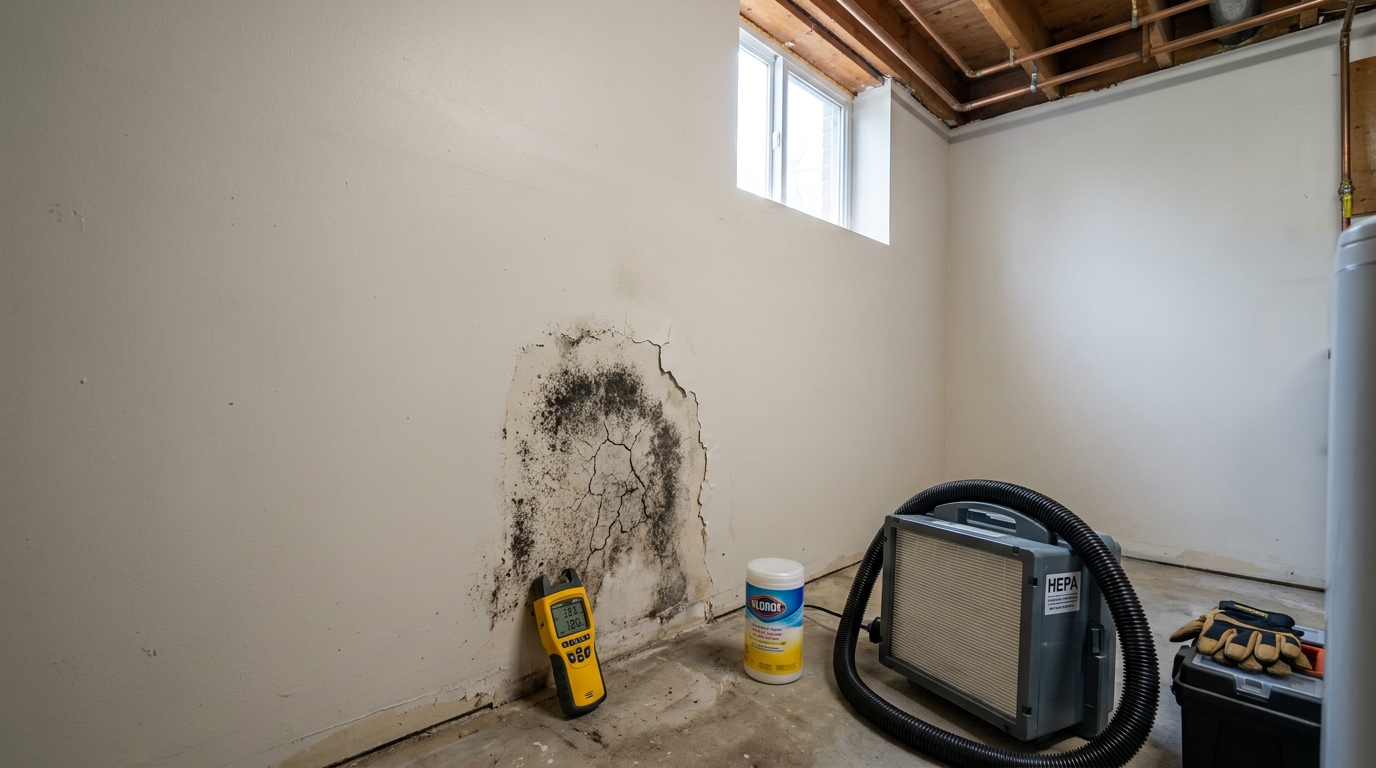
Dried black mold typically appears flat, powdery, or crusty on surfaces. It may look like a dark stain with a slightly dusty texture. Active mold, by contrast, tends to be fuzzy, slimy, or raised. The powdery quality of dried mold is actually what makes it more dangerous when disturbed, because those loose particles become airborne easily.
Is Dried Black Mold Still Dangerous?
Yes. Dried mold retains allergenic proteins and can release spores when disturbed, posing respiratory risks even without active growth.
The CDC states that any indoor mold, regardless of type, should be removed because health effects vary by person and cannot be predicted by species or color. Harvard Library’s preservation guidelines are even more direct: “Mold poses the same potential health hazard whether active or dormant.” [Source: Harvard Library]
Why Dormant Mold Still Poses Health Risks
Dried mold retains structural proteins on spores and fragments that provoke immune responses in sensitized people. Some mold species, including those often called “black mold,” produce mycotoxins during growth, and these compounds can remain on building materials after growth stops. [Source: MoldSci]. The EPA emphasizes that mold, alive or dead, can cause allergies and asthma in susceptible individuals. [Source: EPA]
What Happens When You Disturb Dried Mold
Scrubbing, sweeping, or even walking near dried mold can send spores into the air. Once colonies dry, they become powdery, and normal activities, cleaning, or HVAC airflow can dislodge particles into breathable air. [Source: MoldSci]. This is why proper removal technique matters so much, as we explain in our mold removal guide.
Who Is Most at Risk
Cleveland Clinic reports that black mold exposure can cause coughing, sneezing, nasal congestion, post-nasal drip, itchy eyes, and asthma exacerbations in sensitized individuals. [Source: Cleveland Clinic]. Children are particularly vulnerable. An analysis of over 40,000 U.S. children found that about 11% of children in mold-exposed homes had asthma, compared with 7% of children not exposed to mold, a roughly 57% higher prevalence. [Source: Harvard Health]. People with weakened immune systems or existing lung disease face the greatest risk of serious fungal infections, though such outcomes are very rare. Anyone with persistent symptoms should consult a physician.
Can Dried Mold Release Spores?
Dried mold releases spores more readily than active mold when disturbed. Vibration, air currents, or physical contact can aerosolize dormant spores into breathable air.
The Science of Spore Release from Dried Colonies
Active mold colonies hold spores in a moist matrix. When that matrix dries, the bond weakens. The result is a powdery surface where spores sit loosely, ready to detach at the slightest disturbance. The EPA notes that mold spores are always present in indoor air and house dust, and disturbed dried colonies add significantly to this burden. [Source: EPA]
How Disturbance Triggers Spore Dispersal
Common household activities can trigger dispersal: vacuuming without a HEPA filter, sanding a wall, removing baseboards, or even strong HVAC airflow across a dried colony. This is why remediation professionals mist dried mold with water before touching it. The moisture temporarily re-binds spores to the surface, reducing what becomes airborne during removal.
Does Dried Mold Mean the Problem Is Solved?
No. Dried mold indicates the moisture source stopped, but the colony remains and will reactivate within 24 to 48 hours if humidity or water returns.
Why Drying Alone Doesn’t Eliminate Mold
Epidemiologic data report a 30 to 50% increase in respiratory problems in people exposed to dampness and mold. [Source: FilterKing]. Even after drying, the allergenic material persists. The EPA recommends that after cleanup, homeowners should expect a background level of mold spores to remain, but those spores will not grow if moisture problems are corrected. [Source: EPA]. The key phrase is “after cleanup,” not “after drying.”
The Reactivation Risk
Mold starts growing on damp surfaces within 24 to 48 hours after water exposure. [Source: EPA]. A dried colony that encounters a new leak, condensation from a cold pipe, or a spike in humidity can resume growth within that same window. Leaving dried mold in place is essentially leaving a colony ready to reactivate the moment conditions allow.
What Causes Black Mold to Dry Out?
Mold dries when relative humidity drops below 60% or the water source is removed. This commonly happens after leak repairs, improved ventilation, or seasonal humidity changes.
Environmental Conditions That Halt Growth
The EPA and Cleveland Clinic both recommend keeping indoor relative humidity between 30% and 50% to prevent mold growth. [Source: Cleveland Clinic]. Mold grows in temperatures between 40 and 100°F, so temperature alone rarely stops it in a conditioned home. Moisture control is the primary lever.
Why Dried Mold Often Appears After Repairs
A common scenario: a homeowner fixes a slow bathroom leak, and weeks later notices dark patches behind the vanity. The mold grew while the leak was active, then dried out once the water stopped. The repair solved the moisture problem but left the colony in place. This is manageable, but it requires removal, not just observation.
How Do You Remove Dried Black Mold Safely?
Mist dried mold with water to prevent spore release, then clean with detergent or remove affected materials. Areas over 10 square feet require professional remediation per EPA guidelines.
The Misting Technique: Why It Matters
Before touching dried mold, lightly mist the area with water from a spray bottle. This suppresses loose dried mold spores and prevents them from becoming airborne during cleaning. It’s a simple step that dramatically reduces exposure risk.
DIY Removal for Small Areas
For areas under 10 square feet, homeowners can typically handle removal themselves. Wear an N95 respirator, gloves, and eye protection. After misting, scrub hard surfaces with detergent and water. Porous materials like drywall or carpet padding that show mold growth usually need to be cut out and discarded. Bag contaminated materials in heavy plastic before carrying them through the home. For more detailed steps, see our step-by-step mold removal instructions.
When to Call a Professional
The EPA recommends professional remediation when mold covers more than 10 square feet, when it’s inside HVAC systems, or when the homeowner has health conditions that make exposure risky. [Source: EPA]. A certified mold remediation professional will use containment barriers, negative air pressure, and HEPA filtration to prevent cross-contamination during removal.
Can You Just Paint Over Dried Mold?
No. Painting over dried mold traps spores and allergenic material beneath the surface, allows reactivation under paint if moisture returns, and violates most building codes for remediation.
Why Encapsulation Fails
Paint does not kill mold or neutralize its allergenic proteins. It simply covers them. The spores, mycotoxins, and allergenic fragments remain on the surface beneath the paint film. Even “mold-resistant” paint is designed to prevent new mold growth on the paint surface, not to remediate existing colonies underneath.
What Happens When Moisture Returns
If the original moisture source recurs, or if condensation forms behind the painted surface, the dormant colony can reactivate beneath the paint. The paint may bubble, peel, or discolor as mold grows underneath. At that point, the homeowner faces a larger remediation project than the original one. One analysis estimated that a visible mold issue could reduce the resale price of a typical U.S. house by about $99,000. [Source: MyChemicalFreeHouse]. Painting over mold doesn’t eliminate that risk.
How Long Does Dried Mold Stay Dangerous?
Dried mold spores remain viable and allergenic indefinitely. Studies show dormant spores can survive years and still trigger immune responses when inhaled or reactivated.
Spore Viability Over Time
Mold spores are among the most resilient biological structures found in indoor environments. Industry practitioners typically note that spores can remain dormant for decades under dry conditions and germinate when moisture returns. There is no expiration date on a dried mold colony.
Allergen Persistence in Dried Colonies
Even if every spore in a colony were confirmed dead, the allergenic proteins would persist. The EPA is explicit: “Dead mold may still cause allergic reactions in some people, so it is not enough to simply kill the mold, it must also be removed.” [Source: EPA]. WHO-linked data suggest that about 21% of asthma cases in the USA are associated with dampness and mold, and removing dampness can reduce asthma symptoms by 25 to 45%. [Source: MyChemicalFreeHouse]
What’s the Difference Between Dried Mold and Active Mold?
Active mold appears fuzzy or slimy and grows visibly. Dried mold looks flat, powdery, or crusty and remains dormant until moisture returns.
Visual and Textural Differences
| Characteristic | Active Mold | Dried (Dormant) Mold |
|---|---|---|
| Texture | Fuzzy, slimy, or raised | Flat, powdery, or crusty |
| Color | Dark green, black, sometimes with white edges | Dark gray to black, may appear faded |
| Moisture | Damp to the touch or on a wet surface | Dry surface, no visible moisture |
| Odor | Strong musty or earthy smell | Faint or no odor |
| Spore release | Continuous during growth | Released when physically disturbed |
| Health risk | Active exposure risk | Same potential hazard as active mold |
| Growth | Expanding colony edges | Static, no visible expansion |
Harvard Library states plainly: “Mold poses the same potential health hazard whether active or dormant.” [Source: Harvard Library]. The visual differences help homeowners identify what they’re dealing with, but they don’t change the need for removal.
Growth Patterns and Moisture Dependency
Active mold spreads outward from its original colonization point, often showing lighter-colored edges where new growth is occurring. Dried mold has fixed boundaries. If you notice a colony expanding, moisture is still present somewhere, even if you can’t see it. A NIOSH-based analysis estimates 47% of buildings in the USA have a mold problem. [Source: MyChemicalFreeHouse]
Should You Test Dried Mold Before Removing It?
Testing dried mold is optional for small areas under 10 square feet. Focus on safe removal instead, but testing helps if health symptoms persist or the extent is unclear.
When Testing Adds Value
Testing makes sense in a few specific situations: when mold is hidden behind walls and you need to confirm its presence, when occupants have unexplained respiratory symptoms, or when a real estate transaction requires documentation. The Minnesota Department of Health advises that knowing specific mold types does not change what should be done to clean up and fix moisture problems. [Source: Minnesota Dept. of Health]
Why Removal Often Matters More Than Identification
The CDC and NIOSH do not recommend routine air sampling for mold, noting that thorough visual inspections are more reliable than air sampling. [Source: CDC/NIOSH]. Indoor sampling studies show Stachybotrys (often called black or toxic black mold) in 16% of all indoor air samples tested, while the Penicillium/Aspergillus group appears in 38%. [Source: BustMold]. Only 12% of tested indoor air samples showed no mold presence at all. The point is that mold is everywhere. What matters is removing visible colonies and fixing the moisture source, not identifying the exact species.
If dried mold covers more than 10 square feet, appears in HVAC systems, or returns after cleaning, consult a certified mold remediation professional to assess the extent and ensure safe removal.
Frequently Asked Questions
These are the most common questions homeowners ask after discovering dried black mold in their homes.
Is dried mold dangerous if you don’t touch it?
Yes. Even undisturbed dried mold can release spores through normal air currents and HVAC operation. The EPA states that dead mold still causes allergic reactions and must be removed. [Source: EPA]
Can dried black mold make you sick years later?
Dried mold spores and allergenic proteins persist indefinitely. As long as the material remains in the home, it can trigger respiratory symptoms in sensitized individuals. Consult a physician if you experience ongoing symptoms.
Does bleach kill dried black mold?
Bleach can kill surface mold on non-porous materials but does not penetrate porous surfaces like drywall or wood. More importantly, killing mold is not enough. The EPA emphasizes that dead mold must still be physically removed because it remains allergenic.
How can you tell if black mold is dried or active?
Active mold feels damp, looks fuzzy or slimy, and often has a strong musty odor. Dried mold appears flat, powdery, or crusty, sits on a dry surface, and has little to no smell. If the colony edges are expanding, moisture is still present.
Will dried mold spread to other rooms?
Dried mold won’t actively spread through growth, but its spores can travel through air ducts and on clothing to settle in other areas. If those areas have sufficient moisture, new colonies can establish within 24 to 48 hours.
Is it safe to vacuum dried mold?
Only with a vacuum equipped with a HEPA filter. A standard vacuum will blow mold spores back into the air through its exhaust, increasing exposure. Even with HEPA filtration, mist the area first to suppress loose spores.
Does homeowner’s insurance cover dried mold removal?
Coverage varies widely by policy and cause. Many policies cover mold resulting from a sudden, covered event like a burst pipe but exclude mold from long-term neglect or maintenance issues. Check your specific policy language and consult your insurer.
How much does professional dried mold remediation cost?
Industry practitioners typically report costs ranging from a few hundred dollars for small, contained areas to several thousand for larger projects involving structural materials. The scope depends on the affected area’s size, the materials involved, and whether containment is needed. Getting multiple quotes from certified professionals is advisable.