What Causes a Musty Smell When There’s No Visible Mold?
Musty odors without visible mold typically indicate hidden mold growth behind walls or under floors, high humidity creating mildew, or bacterial growth in damp materials.
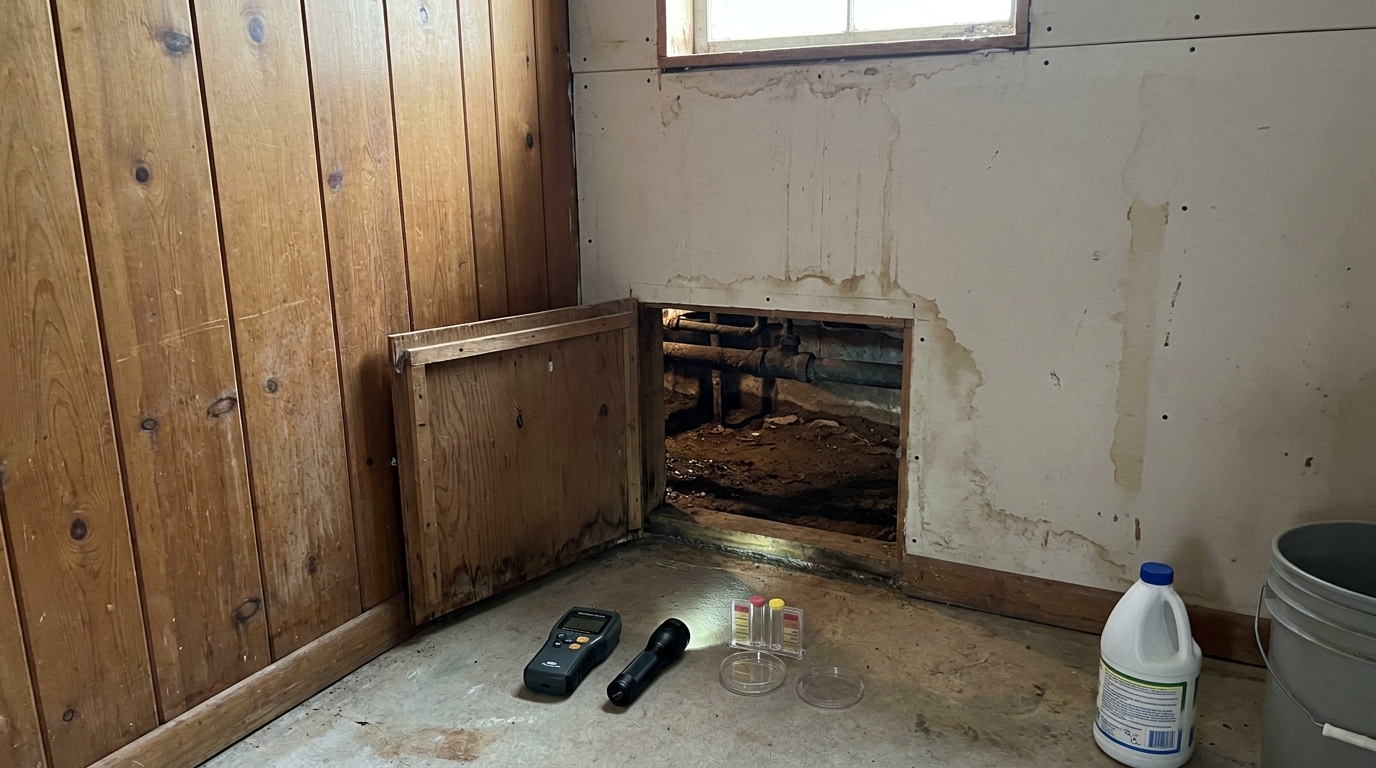
A persistent musty smell no visible mold situation is more common than most homeowners realize. The odor itself comes from microbial volatile organic compounds (MVOCs), chemical byproducts released by fungi and bacteria as they consume organic materials. According to HomePro Mold, “the presence of a musty odor strongly suggests active mold growth somewhere in your home, even when no visible signs exist.” If you can smell it, something is growing, even if you can’t see it.
Hidden mold in wall cavities and enclosed spaces
Mold thrives on cellulose-based materials like drywall paper, wood framing, and insulation. When a slow plumbing leak or condensation wets the interior of a wall cavity, mold colonies can establish themselves on surfaces you’ll never see without removing drywall. According to Breathe Better Air, “a musty odor forms when moisture sits too long on surfaces like carpet, drywall, clothing, furniture, or inside your HVAC system,” even where no mold is visible. The smell travels through gaps around electrical outlets, baseboards, and light fixtures long before the colony becomes large enough to stain a surface.
Mildew versus mold: understanding the difference
Mildew is a surface-level fungal growth that typically appears as a flat, powdery white or gray patch on bathroom grout, window sills, or shower curtains. Mold, by contrast, penetrates deeper into porous materials and often appears fuzzy, green, black, or brown. Both produce musty odors, but mildew is generally easier to clean with household products. When you smell mustiness but see neither mildew nor mold, the growth is almost certainly hidden inside a wall, under flooring, or within ductwork.
Bacterial growth and biofilm on damp surfaces
Not every musty smell comes from fungi. Bacteria form biofilms on chronically damp surfaces like HVAC drain pans, washing machine gaskets, and condensation lines. These biofilms produce their own set of odorous compounds. According to Panasonic IAQ, high humidity combined with stagnant air and dust can create a musty, earthy scent even without visible mold colonies.
Trapped moisture in building materials
Building science literature generally treats wood above approximately 16 to 18% moisture content and drywall that has remained above fiber saturation for 24 to 48 hours as at risk for microbial growth, even if it does not yet show visible mold. According to Breathe Better Air, repeated wetting from mopping, minor overflows, or condensation can keep the top few millimeters of porous materials at moisture levels high enough for microbial activity. Old water damage that “looks dry” on the surface may still harbor enough moisture in subfloor or padding to produce odors for months.
HVAC system contamination
Your HVAC system circulates air through every room. If mold or bacteria colonize the evaporator coil, drain pan, or ductwork, the musty smell can appear in multiple rooms simultaneously, making it nearly impossible to pinpoint by location alone. Dust and organic debris inside ducts provide food for microbial growth, and condensation on cooling coils provides the water.
Where Is Hidden Mold Most Likely Growing?
Hidden mold most commonly grows behind drywall near plumbing leaks, under flooring after water damage, inside HVAC ducts, beneath carpets, and in crawl spaces or attics.
Behind walls near bathrooms and kitchens
Plumbing supply lines and drain pipes run through wall cavities in bathrooms and kitchens. Even a pinhole leak or a slow drip at a fitting can saturate drywall and framing over weeks. Look for subtle clues: paint bubbling, baseboards that feel soft, or a musty smell that intensifies when you stand near a specific wall.
Under flooring and carpet padding
Carpet padding acts like a sponge. After any water event, from a spill to a minor flood, padding can retain moisture long after the carpet surface feels dry. According to Dry Nest Lab, condensation and leaks leave moisture in drywall, carpet edges, and under floors, creating “damp zones that smell musty” without obvious growth.
Inside HVAC systems and ductwork
Evaporator coils, drain pans, and flex duct interiors are prime locations. If the musty smell appears only when the system runs, HVAC contamination is a strong suspect. A visual inspection of accessible ductwork and the air handler can sometimes reveal dark staining or visible growth on insulation.
Crawl spaces and attics
Crawl spaces with exposed soil and no vapor barrier can introduce significant moisture into a home. Attics with inadequate ventilation trap warm, humid air that condenses on roof sheathing during cool nights. Both spaces are out of sight and often go uninspected for years. Our guide to crawl space repair and restoration covers what to look for and how the fix works.
Behind appliances and furniture
Refrigerators, washing machines, and dishwashers all have water connections that can develop slow leaks. Furniture pushed against exterior walls can trap condensation between the wall surface and the back of the piece, creating a microclimate where mold can grow undetected.
How Do You Locate the Source of a Musty Smell?
Locate musty smell sources by following your nose to the strongest odor area, checking for water stains, using a moisture meter on walls and floors, and inspecting common problem areas systematically.
The smell-tracking method: following odor intensity
Start in the room where the odor is strongest. Close interior doors and wait 30 minutes, then open each door and sniff. The room with the most concentrated smell after being sealed is your primary search zone. Within that room, get close to walls, floors, and corners. Odor intensity increases as you approach the source.
Visual inspection for water damage indicators
Look for water stains on ceilings and walls, peeling or bubbling paint, warped baseboards, discolored grout, and rust stains around pipe penetrations. These signs often accompany hidden moisture problems even when mold itself isn’t visible.
Using moisture meters to detect hidden dampness
A pin-type or pinless moisture meter costs $25 to $60 and can detect elevated moisture behind drywall and under flooring. According to Prospective Home Inspections, a basic digital hygrometer should be used to monitor rooms, with ideal indoor humidity levels between 30 and 50%. Place hygrometers in the smelliest room, the basement or crawl space, and a “normal” room as a control. If the odor area shows significantly higher relative humidity (for example, 65 to 70% versus 45% elsewhere), you’ve identified a moisture problem zone.
Checking HVAC vents and returns
Hold your nose near supply vents and return grilles while the system runs. If the musty smell is strongest at a specific vent, the contamination may be localized to that duct run. Also check the air handler’s drain pan and evaporator coil for standing water or visible biofilm.
When to remove baseboards or access panels
If moisture meter readings are elevated behind a wall but no visual damage is present, carefully removing a baseboard or cutting a small inspection hole in drywall (behind furniture or in a closet) can confirm hidden mold. This is a reasonable DIY step before committing to a professional inspection.
Can a Musty Smell Be Harmful Even Without Visible Mold?
Musty smells indicate microbial volatile organic compounds from mold or bacteria, which can cause respiratory irritation, headaches, and allergic reactions even when growth is hidden.
What microbial volatile organic compounds (MVOCs) are
MVOCs are gases produced by mold and bacteria during their metabolic processes. They’re what your nose detects as “musty” or “earthy.” Common MVOCs include 1-octen-3-ol (often called “mushroom alcohol”) and geosmin. These compounds are real, measurable chemicals, not imagined. If you smell mustiness but others in your household dismiss it, your perception is valid. Some people are simply more sensitive to MVOCs than others.
Health effects of mold exposure without direct contact
According to HomePro Mold, respiratory symptoms can increase by up to 40% in homes with persistent dampness and musty smells. HomeAirCheck notes that even if you cannot see mold, any musty smell means you “need to be aware of it” because of effects on eyes, skin, nose, throat, and lungs. Symptoms commonly reported include coughing, wheezing, difficulty breathing, skin and eye irritation, headaches, and fatigue.
When to consult a physician about symptoms
If household members experience persistent respiratory symptoms, unexplained headaches, or worsening allergies that improve when away from home, a physician should be consulted. Mention the musty odor and the possibility of hidden mold exposure. A doctor can order allergy testing or pulmonary function tests to help determine whether mold is a contributing factor.
Vulnerable populations at higher risk
Children, elderly adults, people with asthma, and immunocompromised individuals face greater risk from MVOC and mold spore exposure. The World Health Organization has noted that a significant proportion of childhood asthma cases can be attributed to mold and indoor dampness exposure, according to HomePro Mold. If vulnerable individuals live in the home, err on the side of professional assessment rather than extended DIY investigation.
What Moisture Conditions Create Musty Smells Without Visible Growth?
Relative humidity above 60%, poor ventilation, condensation on cold surfaces, slow water leaks, and damp building materials create conditions for musty odors without visible mold colonies.
The 60% relative humidity threshold
According to Solution One Inspectors, indoor humidity frequently above approximately 55 to 60% increases mold risk and associated musty odor. The CDC recommends keeping indoor humidity at 50% or lower specifically to reduce mold and odor risk. The table below summarizes the risk zones.
| Indoor Relative Humidity | Risk Level | Recommended Action |
|---|---|---|
| Below 30% | Too dry (comfort issues) | Add humidification if needed |
| 30% to 50% | Ideal range | Maintain current conditions |
| 50% to 55% | Caution zone | Monitor closely, improve ventilation |
| 55% to 60% | Elevated risk | Run dehumidifier, check for moisture sources |
| Above 60% | High risk for hidden mold and musty odor | Dehumidify immediately, investigate moisture sources |
How poor ventilation concentrates moisture
Bathrooms without exhaust fans, kitchens without range hoods, and rooms with no air circulation allow moisture from cooking, showering, and breathing to accumulate. According to Panasonic IAQ, relative humidity over 50% creates an environment where mold and bacteria thrive and persistent odors occur. Stagnant air makes the problem worse by preventing moisture from dispersing.
Condensation versus active water intrusion
According to Dry Nest Lab, when warm indoor air hits cold walls or windows, moisture forms and is absorbed into drywall and carpet edges, producing a musty smell while the surface may not appear wet. This is different from an active leak but equally capable of supporting microbial growth. A simple DIY test: tape a piece of aluminum foil to a suspect wall for 24 hours. Condensation on the back (wall side) indicates moisture migrating through the wall.
Seasonal humidity fluctuations
Many homeowners notice musty smells only during certain seasons. Summer humidity in warm climates can push indoor RH above 60% without air conditioning. In colder climates, winter condensation on poorly insulated walls creates seasonal dampness. Tracking humidity with a hygrometer across seasons helps identify patterns and determine whether the problem is chronic or periodic.
Should You Test for Mold if You Smell It but Can’t See It?
Professional mold testing is recommended when musty odors persist despite visible inspection, when health symptoms occur, or before purchasing a home with unexplained odors.
When DIY mold test kits are useful versus misleading
Settle-plate DIY test kits (the kind you leave open on a counter) will almost always grow mold because mold spores are present in every home. These kits tell you very little about whether you have a hidden mold problem. They can be useful for comparing spore counts between rooms (a room with significantly more growth than others may have a source), but they lack the precision of professional testing. For guidance on understanding different testing approaches, see our overview of mold testing options.
Professional air sampling versus surface testing
Professional air sampling captures a measured volume of air and identifies both the types and concentrations of mold spores present. By comparing indoor samples to an outdoor baseline, an inspector can determine whether indoor spore levels are abnormally elevated. Surface testing (tape lifts or swab samples) identifies what’s growing on a specific material but requires access to the suspected growth.
Moisture mapping and thermal imaging
Infrared thermal cameras detect temperature differences in walls and ceilings that indicate moisture accumulation. This non-destructive method can reveal hidden wet areas without cutting into walls. Combined with a moisture meter for confirmation, thermal imaging provides a clear picture of where moisture problems exist.
Cost-benefit analysis of testing versus remediation
Professional mold inspections typically cost between $300 and $700, depending on home size and the number of samples taken. If the inspection confirms hidden mold, remediation costs vary widely based on the extent of growth. However, skipping the inspection and jumping straight to remediation can mean paying to treat the wrong area. For homeowners weighing costs, our guide to mold remediation costs provides detailed breakdowns.
How Do You Eliminate Musty Smells Caused by Hidden Moisture?
Eliminate musty smells by fixing moisture sources first, improving ventilation, using dehumidifiers to maintain 30 to 50% humidity, and addressing hidden mold growth through professional remediation if confirmed.
Source control: fixing leaks and moisture intrusion
No amount of dehumidification or air purification will solve a musty smell if the moisture source remains active. Fix plumbing leaks, repair roof flashing, redirect gutter downspouts away from the foundation, and seal cracks in basement walls. According to Certified Water and Fire, musty smells from hidden moisture are eliminated by finding and drying all damp materials, keeping indoor humidity around 30 to 50%, and improving ventilation.
Dehumidification strategies for different spaces
According to Oreate AI, multiple expert sources recommend a target of 30 to 50% relative humidity for indoor air. Basements and crawl spaces often need dedicated dehumidifiers rated for the square footage. Whole-home dehumidifiers integrated into the HVAC system work well for homes in humid climates where the problem is pervasive.
Ventilation improvements that actually work
Exhaust fans in bathrooms and kitchens should vent to the exterior, not into the attic. Running bathroom fans for at least 20 minutes after showering removes significant moisture. In crawl spaces, encapsulation with a vapor barrier and a dedicated dehumidifier is more effective than passive venting in most climates.
When DIY cleaning is sufficient versus when professionals are needed
If you find a small area of mold (less than about 10 square feet) on a non-porous surface, DIY cleaning with detergent and water is generally sufficient, consistent with EPA guidance. Call professionals when: the affected area exceeds 10 square feet, mold is inside wall cavities or HVAC systems, the home has experienced significant water damage, or occupants have health symptoms potentially related to mold exposure.
Preventing recurrence after remediation
After remediation, ongoing moisture monitoring is essential. Keep hygrometers in previously affected areas. Maintain HVAC systems with regular filter changes and annual coil cleaning. Address any new water intrusion immediately, within 24 to 48 hours, before mold can establish itself.
What Are Common Mistakes When Dealing With Musty Smells?
Common mistakes include masking odors with air fresheners instead of addressing sources, ignoring intermittent smells, over-relying on surface cleaning, and delaying professional inspection when DIY efforts fail.
Why air fresheners and odor eliminators don’t solve the problem
Air fresheners mask MVOCs without eliminating their source. The microbial growth continues, potentially spreading and causing more structural damage. Odor-neutralizing sprays may temporarily reduce the smell, but if the musty odor returns within days, the underlying moisture and microbial problem remains active.
The danger of ignoring seasonal or intermittent odors
A musty smell that appears only during humid months or after rain is not a minor nuisance. It indicates a moisture pathway that activates under certain conditions. These intermittent problems tend to worsen over time as building materials degrade and microbial colonies expand. Addressing the issue during the “off season” when materials are drier is often easier and less expensive.
Surface cleaning versus addressing hidden growth
Scrubbing visible mildew off a bathroom wall while ignoring the moisture that caused it guarantees recurrence. Similarly, cleaning carpet surfaces without checking the padding underneath misses the actual reservoir of microbial growth. Always investigate what’s behind or beneath the surface you’re cleaning.
Waiting too long to call professionals
Many homeowners spend weeks or months trying DIY solutions before calling a professional. During that time, hidden mold can spread significantly. A reasonable decision framework: if you’ve checked humidity levels, inspected common problem areas, fixed any visible moisture sources, and the musty smell persists for more than two to three weeks, professional inspection is warranted.
If musty odors persist after addressing visible moisture sources and improving ventilation, consider professional mold inspection with moisture mapping and air quality testing to identify hidden growth before it becomes a larger problem.
Frequently Asked Questions
These are the questions homeowners most commonly ask when they notice a musty smell but can’t find any visible mold growth.
Can a house smell musty without actually having mold?
Yes, but it’s uncommon. Bacterial biofilms, chronically damp building materials, and stagnant water in drain traps can all produce musty odors without fungal growth. However, according to HomePro Mold, a persistent musty odor is treated by many inspectors as presumptive evidence of a moisture or mold problem. Investigating the moisture source is always the right first step.
What does hidden mold smell like compared to mildew?
Hidden mold typically produces an earthy, damp, stale odor, sometimes compared to wet cardboard or rotting wood. Mildew tends to smell sharper and more sour. Both smells indicate microbial activity, but a persistent earthy odor that doesn’t go away with surface cleaning suggests deeper, hidden growth.
How quickly can mold grow behind walls after a leak?
Mold can begin colonizing damp materials within 24 to 48 hours under favorable conditions. Building science practitioners generally consider wood above 16 to 18% moisture content at risk for microbial growth, according to Breathe Better Air. A small leak left unaddressed for even a week can produce enough growth to generate a noticeable musty odor.
Is it safe to stay in a house that smells musty?
Short-term exposure to musty odors is unlikely to cause serious harm for most healthy adults. However, according to HomePro Mold, respiratory symptoms can increase by up to 40% in homes with persistent dampness and musty smells. People with asthma, allergies, or compromised immune systems should consult a physician and prioritize finding the source quickly.
Do air purifiers remove musty smells?
HEPA air purifiers capture airborne mold spores but do not eliminate MVOCs, which are gases. Activated carbon filters can adsorb some MVOCs and reduce the smell temporarily. Neither type of purifier addresses the moisture source or stops microbial growth. They’re a supplemental measure, not a solution.
Should I buy a home that has a musty smell?
A musty smell during a home showing is a red flag that warrants professional mold inspection before closing. The cost of an inspection ($300 to $700) is minor compared to potential remediation costs if hidden mold is extensive. Include a mold inspection contingency in your offer if possible.
What humidity level should I maintain to prevent musty odors?
According to Prospective Home Inspections, ideal indoor humidity is between 30 and 50%. Above 60%, mold risk increases significantly. A digital hygrometer in each problem area helps you monitor conditions and respond before odors develop.
Can musty smells come from the HVAC system even if ducts look clean?
Yes. Mold and bacteria can grow on evaporator coils, inside drain pans, and on the interior surfaces of ductwork that aren’t visible during a basic inspection. If the musty smell appears or intensifies only when the HVAC system is running, have the system professionally inspected, including the air handler and coil assembly.