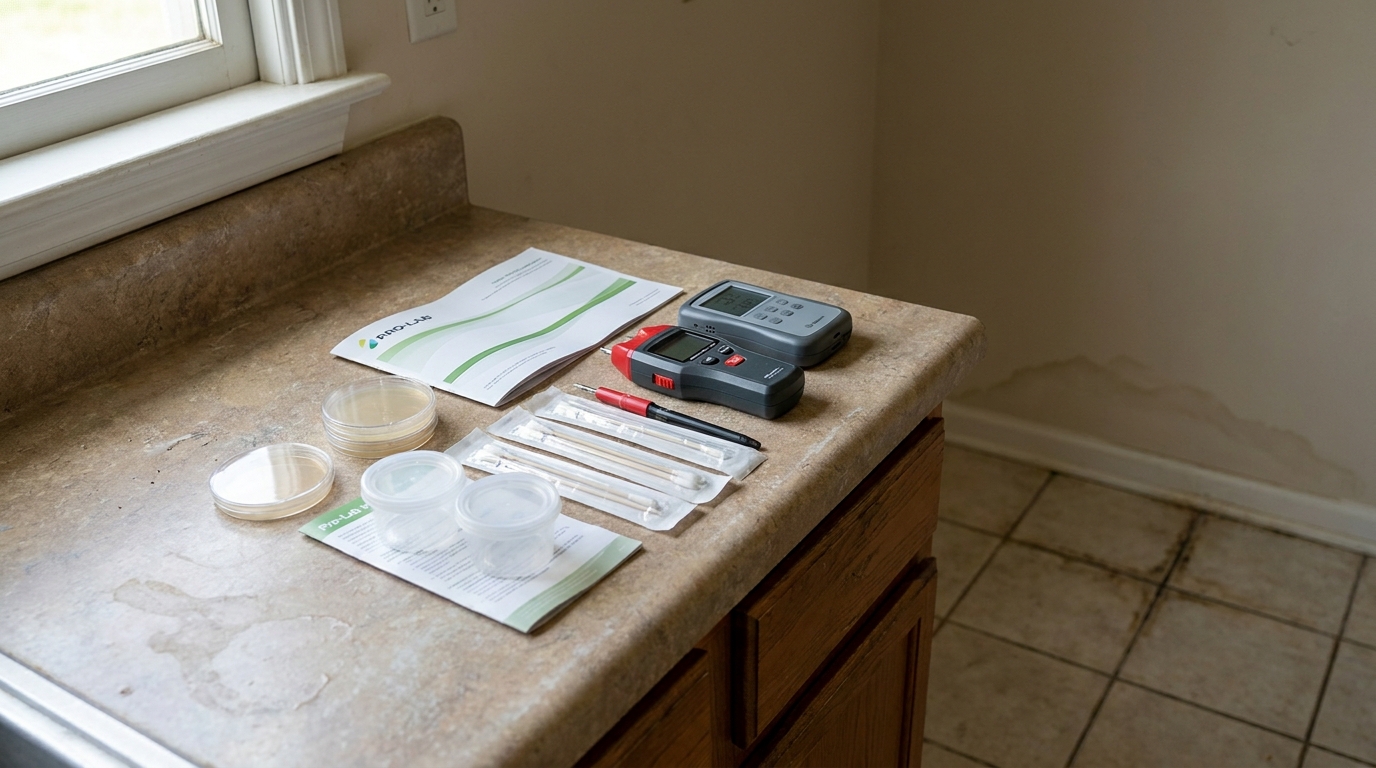
What Are Pro-Lab Mold Test Kits and How Do They Work?
Pro-Lab kits collect air or surface samples that homeowners mail to a certified lab for species identification and spore count analysis, with results typically returned in 3 to 7 business days.
The PRO-LAB® Mold Test Kit is a consumer DIY screening kit sold through major retailers including Home Depot, Lowe’s, and Amazon. According to Pro-Lab’s product documentation, the kit is designed to screen for elevated or hidden mold levels in homes and small buildings and, if desired, determine the type of mold via laboratory analysis. When reading pro-lab mold test kit reviews, the most important distinction to understand is the difference between the kit itself and the optional lab analysis that follows.
Types of Pro-Lab Kits Available
Pro-Lab offers kits that cover both air and surface sampling. The primary product, the MO109 Mold Detection Test Kit, is marketed specifically as an “Air and Surfaces” kit. According to Pro-Lab Inc., the kit provides four sampling methods, including two air sampling methods aimed at detecting hidden or elevated mold problems. The kit itself retails for approximately $10 to $15 at big-box stores. [Source: Amazon]
The Lab Analysis Process
After collecting a sample, homeowners mail it to Pro-Lab’s AIHA-accredited laboratory. The optional lab analysis costs $40 per sample for standard processing or $60 for express results. [Source: Prolabtestkits] The lab identifies mold to the genus level, which tells you the general category of mold present but not the exact species. This is an important nuance: genus-level identification can distinguish between Aspergillus and Stachybotrys, for example, but won’t differentiate between individual species within those groups.
What You Get in Your Results Report
Pro-Lab states that reports provide a “clear readout on the presence (or absence) of mold.” [Source: Amazon] Some users report receiving detailed genus identification, while others describe the reports as more generic. The report does not include remediation instructions or health risk assessments. For homeowners needing help interpreting results, our guide on mold testing options provides additional context on what different test types reveal.
How Accurate Are Pro-Lab Mold Test Kits?
Pro-Lab uses AIHA-accredited labs for analysis, but accuracy depends heavily on proper sample collection and placement by the homeowner.
The question of pro-lab mold test accuracy comes up constantly in homeowner forums, and the answer is more nuanced than a simple yes or no. The lab analysis itself can be reliable. The weak link is usually the sampling process.
Lab Certification and Testing Standards
Pro-Lab advertises that its laboratory holds AIHA (American Industrial Hygiene Association) accreditation. [Source: Prolabinc] AIHA accreditation means the lab has passed proficiency testing and follows standardized analytical procedures. This is the same accreditation standard used by labs that process samples for professional mold inspectors. The lab step itself, when it receives a properly collected sample, can produce reliable genus-level identification.
Real-World Accuracy Limitations
Amazon review analysis shows that approximately 80% of customers find the kit confirms mold presence when mold is suspected. [Source: Amazon] However, independent reviewers note the kit “does not detect toxins or spore counts,” which limits how actionable the results are. [Source: Amazon] The settling plate method used for air sampling captures whatever lands on the plate during the exposure window, which may not represent the full range of mold present in a space.
How Sampling Errors Affect Results
The biggest accuracy variable is the homeowner. Placing a plate in a drafty area, near an open window, or in direct sunlight can all skew results. Touching the growth medium, failing to seal the sample properly for mailing, or exposing the plate for too long can introduce contaminants. A contaminated sample doesn’t produce a “wrong” result per se. It produces a result that doesn’t reflect the actual conditions in your home, which is arguably worse.
Pro-Lab Air Test Kit: What We Found
The Pro-Lab air test captures airborne spores using a settling plate method over 48 hours, identifying species and concentration levels but missing mold hidden in walls or under surfaces.
Pro-Lab’s air sampling methods can indicate a mold problem in as little as 48 hours based on visible growth on the medium. [Source: Pro-Lab Kit Instructions] Users are instructed to check again at 72 and 96 hours for additional growth. [Source: Amazon]
How the Air Test Works
You open the petri dish in the room you want to test and leave it exposed for a set period. Airborne spores settle onto the growth medium. After the exposure period, you close the dish and observe it over 48 to 96 hours. If mold colonies appear, you have a visual indication of mold presence. For genus-level identification, you mail the plate to Pro-Lab’s lab.
What the Results Tell You
On Walmart’s listing, the Pro-Lab Mold Detection Test Kit for Air and Surfaces holds a 4.1 out of 5 star rating from 161 reviews. [Source: Home Depot] Ease of use is the most consistent positive theme across review sources. The air test can confirm that mold spores are present in a room’s air and, with lab analysis, identify the general type. Pro-Lab recommends comparing indoor versus outdoor samples for meaningful context.
When Air Testing Isn’t Enough
Settling plate tests have a fundamental limitation: they only capture spores that are actively airborne and happen to land on the plate. Mold growing inside wall cavities, behind baseboards, or in HVAC ductwork may not release enough spores during the test window to register on the plate. Professional air sampling uses calibrated pumps that draw a measured volume of air through a cassette, providing quantitative spore counts per cubic meter. The settling plate method cannot replicate this precision.
Pro-Lab Surface Test Kit: Performance and Use Cases
Pro-Lab surface kits use tape or swab samples to identify visible mold species, providing confirmation of what’s growing but not measuring airborne spore levels or hidden contamination.
Surface Sampling Methods
Surface testing involves pressing tape against or swabbing a visible mold colony, then sealing the sample and mailing it to the lab. This method is straightforward and less prone to the environmental variables that affect air sampling. eBay review data shows 75% of reviewers would recommend the product and rate it as “good value.” [Source: eBay]
Best Situations for Surface Testing
Surface testing works well when you can see mold growth and want to know what it is. Common use cases include identifying whether bathroom mold is a common Cladosporium or a more concerning genus like Stachybotrys, documenting mold type for insurance claims, and confirming that a remediation effort removed the target organism.
What Surface Tests Don’t Reveal
A surface test tells you what’s growing on a specific spot. It doesn’t tell you whether spores have spread to other areas, whether mold is growing behind the wall where you sampled, or how much mold is in the air you’re breathing. For a broader understanding of mold assessment approaches, our mold inspection guide explains how professionals evaluate the full picture.
What Do Pro-Lab Test Results Actually Tell You?
Pro-Lab reports identify mold genus and confirm presence or absence, but don’t diagnose health risks or provide remediation instructions, which require professional interpretation.
Understanding Your Lab Report
Pro-Lab’s marketing states that lab results identify “what type of mold it is.” [Source: Amazon] In practice, the report typically confirms mold present versus not detected at the sampling location and provides a genus-level identification. Some users report receiving “very good and accurate” readouts, while others describe the reports as “very generic” and note that results “didn’t tell them how much or the spore count.” [Source: Amazon]
Spore Count Interpretation
Multiple reviewers emphasize that Pro-Lab reports do not include quantitative spore counts. [Source: Amazon] This is a significant gap. Without spore counts, you can’t compare indoor levels to outdoor baseline levels in a meaningful, quantitative way. Professional reports typically include spores per cubic meter, which allows an industrial hygienist to determine whether indoor levels are elevated relative to the outdoor environment.
What Results Don’t Include
Pro-Lab results do not include health risk assessments, remediation plans, moisture source identification, or recommendations for next steps. The report tells you what is there but not why it’s there, how dangerous it might be, or what to do about it. Homeowners with health concerns should consult a physician, and those with significant contamination should contact a certified mold inspector for professional assessment.
How Long Does Pro-Lab Testing Take?
Pro-Lab lab analysis takes 2 to 7 business days after sample arrival, plus mail transit time each way, totaling roughly 7 to 14 days from sample collection to receiving results.
Timeline Breakdown
According to Pro-Lab’s own documentation, the timeline breaks down as follows [Source: Pro-Lab Kit Instructions]:
-
Sample exposure: 48 to 96 hours for air samples (visual growth check)
-
Mail transit to lab: 2 to 5 days via standard mail
-
Standard lab processing: 7 business days after receipt ($40 fee)
-
Express lab processing: 2 to 3 business days after receipt ($60 fee)
-
Results delivery: Notification sent when sample is received and when results are ready
Factors That Delay Results
Some reviewers report significant delays or no results at all even after weeks of waiting. [Source: Amazon] Delays can stem from samples arriving damaged, improperly sealed containers, incomplete payment for lab fees, or high lab volume during peak seasons (spring and fall tend to see more mold testing).
Rush Processing Options
Pro-Lab’s express option reduces lab turnaround to 2 to 3 business days for a $20 surcharge (total $60) when the standard lab fee is already included with the kit. [Source: Pro-Lab Kit Instructions] Even with express processing, mail transit time still applies. Homeowners who need results urgently may find that a local professional inspector can provide same-day or next-day results.
Pro-Lab vs Professional Mold Inspection: Cost and Value Comparison
Pro-Lab kits cost $50 to $105 all-in per test versus $300 to $800 for professional inspection, but professionals include visual assessment, moisture mapping, and remediation guidance that DIY kits cannot provide.
According to Trusted Mold Testing, a Pro-Lab mold test kit typically costs about $90 to $105 all-in per testing event when you factor in the kit price plus lab fees. Professional mold inspections run $300 to $800 or more per visit, with national averages around $450 to $670.
Cost Breakdown by Test Type
| Cost Component | Pro-Lab DIY Kit | Professional Inspection |
|---|---|---|
| Initial purchase / visit fee | $10–$15 | $150–$400 |
| Lab analysis (per sample) | $40 standard / $60 express | Included or $30–$75 per sample |
| Typical total (one test event) | $50–$105 | $300–$800 |
| Visual inspection | Not included | Included |
| Moisture mapping | Not included | Included |
| Remediation plan | Not included | Typically included |
[Source: Trusted Mold Testing] [Source: Fast Mold Testing]
What Professional Inspection Includes
A professional mold inspector conducts a visual assessment of the entire property, uses moisture meters and thermal imaging to find hidden water intrusion, collects calibrated air and surface samples, and provides a written report with remediation recommendations. The inspector’s training and experience in identifying moisture sources is arguably more valuable than the lab results themselves.
When DIY Testing Makes Sense
Pro-Lab kits deliver lab results comparable to professional testing at roughly 20 to 40% of the cost. [Source: Trusted Mold Testing] DIY testing makes sense when you want to confirm whether visible growth is mold, need baseline data before calling a professional, or are documenting conditions for insurance or legal purposes. It does not make sense as a substitute for professional assessment when health symptoms are present, contamination appears extensive, or you suspect mold in hidden locations.
How Does Pro-Lab Compare to Other Mold Test Kits?
Pro-Lab uses certified lab analysis like MycoMetrics and Immunolytics, offering genus-level identification with longer wait times and higher total cost than basic screening tests.
Pro-Lab vs Instant Test Kits
Instant mold test kits (like those using color-change indicators) provide results in minutes but only confirm whether mold is present. They don’t identify the type. Pro-Lab’s lab analysis provides genus-level identification, which is significantly more informative. The tradeoff is time and cost.
Pro-Lab vs Other Lab-Based Kits
Several competing products also use AIHA-accredited labs. My Mold Detective, for example, retails for approximately $100 with lab fees included. [Source: My Mold Detective] The key differences are in sampling method, report detail, and turnaround time.
Accuracy and Price Comparison
| Feature | Pro-Lab MO109 | My Mold Detective | Immunolytics |
|---|---|---|---|
| Kit price | $10–$15 | ~$100 (lab included) | ~$30–$40 |
| Lab fee (per sample) | $40 standard | Included | $33–$40 |
| Total cost (one sample) | $50–$55 | ~$100 | $63–$80 |
| Lab accreditation | AIHA | AIHA | AIHA |
| Sampling method | Settling plate / swab | Cassette (pump-based) | Settling plate / swab |
| Spore counts provided | No (genus only) | Yes | Limited |
| Standard turnaround | 7 business days | 3–5 business days | 5–7 business days |
| Ease of use | Very easy | Moderate (pump setup) | Easy |
Note: Prices reflect typical retail and lab fee combinations. Industry practitioners report that pump-based cassette sampling (like My Mold Detective uses) generally provides more quantitative data than settling plate methods.
What Common Problems Do Homeowners Report with Pro-Lab Kits?
Homeowners most frequently report confusion interpreting results without professional context, contaminated samples from improper handling, and frustration when results confirm mold but don’t indicate severity or next steps.
Sample Collection Errors
The most common collection errors include opening the petri dish in the wrong location, exposing it for too long or too short a period, and contaminating the sample during sealing or mailing. Because the settling plate method relies on passive spore collection, even small environmental changes (opening a window, running a fan) during the test can dramatically alter results.
Result Interpretation Challenges
Perceived hidden cost is the most consistent negative theme in reviews. [Source: eBay] Homeowners purchase the kit expecting a complete answer, then discover they need to pay $40 more for lab analysis, and even then the report may only confirm mold presence without quantifying severity. Pro-Lab’s companion app has a 1.3-star rating from 14 reviews on Google Play, with complaints about usability. [Source: Home Depot]
Customer Service and Support Issues
Some reviewers report significant delays in receiving lab results, with at least one documented case of waiting two months with no report despite obvious mold growth on the sample. [Source: Amazon] Others describe difficulty reaching customer support for status updates. These experiences appear to be in the minority, as 60% of eBay reviewers gave 5 stars [Source: eBay], but they represent a real risk.
Who Should Use Pro-Lab Mold Test Kits?
Pro-Lab kits work best for homeowners who need species confirmation of visible mold, want baseline data before hiring a professional, or are documenting mold for insurance or legal purposes.
Best Use Cases for Pro-Lab Testing
-
Confirming visible mold: You see something growing and want to know what genus it is before deciding on next steps.
-
Pre-professional baseline: You want data in hand before calling an inspector so you can have an informed conversation.
-
Documentation: Insurance claims or landlord-tenant disputes sometimes require evidence of mold presence and type.
-
Post-remediation spot check: After professional cleanup, a quick test can confirm whether the target organism is still present.
When to Skip DIY and Hire a Professional
Skip the DIY kit and go straight to a certified mold inspector if anyone in the household is experiencing respiratory symptoms, if the suspected mold area exceeds 10 square feet (the EPA’s threshold for professional remediation), if you suspect mold in HVAC systems or wall cavities, or if you’ve had recent water damage. A certified industrial hygienist can assess conditions that no mail-in kit can evaluate.
Situations Where Pro-Lab Adds Value
Pro-Lab occupies a useful middle ground. At $50 to $105 total, it’s significantly cheaper than a $300 to $800 professional inspection. For homeowners who need a data point rather than a full assessment, it delivers genus-level identification from an AIHA-accredited lab. The key is understanding what you’re getting and, more importantly, what you’re not.
If Pro-Lab results show elevated mold levels or species of concern, consult a certified mold inspector or industrial hygienist to assess the full scope of contamination and develop a remediation plan. DIY testing provides data, but professionals provide context and solutions.
Frequently Asked Questions
These are the questions homeowners ask most often when evaluating Pro-Lab mold test kits for their homes.
Does Pro-Lab detect black mold specifically?
Pro-Lab’s lab analysis identifies mold to the genus level, which means it can identify Stachybotrys (commonly called “black mold”) if present in the sample. However, many mold genera appear dark or black in color, so visual appearance alone is not diagnostic. The lab report will specify the genus name rather than simply labeling something “black mold.”
Are Pro-Lab results accepted by insurance companies?
Some insurance companies accept lab results from AIHA-accredited laboratories, which Pro-Lab uses. However, many insurers prefer or require results from a professional inspection that includes visual assessment and moisture documentation. Homeowners should check with their specific insurer before relying solely on a DIY kit for claims purposes.
How much does Pro-Lab mold testing cost in total?
The kit retails for approximately $10 to $15 at major retailers. Lab analysis adds $40 for standard results or $60 for express processing. Total cost per sample typically runs $50 to $75, or about $90 to $105 when factoring in shipping and multiple samples. [Source: Trusted Mold Testing]
Is one Pro-Lab test enough for a whole house?
One test covers one location. Mold conditions can vary significantly between rooms, floors, and areas with different moisture levels. Industry practitioners typically recommend testing at least the suspected problem area plus one control location (outdoors or a room with no suspected mold) for comparison. Testing a whole house thoroughly would require multiple kits and lab fees.
Can Pro-Lab kits detect mold inside walls?
Not directly. The settling plate air test captures spores that are already airborne in a room. Mold growing inside a sealed wall cavity may not release enough spores into the room air to register on the plate. Professional inspectors use moisture meters, thermal imaging, and sometimes invasive sampling to detect hidden mold that DIY kits miss.
How reliable is the Pro-Lab mold test compared to professional testing?
The lab analysis itself uses the same AIHA-accredited standards as professional labs. The difference is in sampling quality. Professionals use calibrated equipment and standardized protocols that reduce sampling error. Pro-Lab’s settling plate method is simpler but less precise. Approximately 75% of reviewers rate Pro-Lab as “good quality,” but independent sources note that professional tests provide “much more accurate” and actionable information. [Source: eBay]
What happens if my Pro-Lab sample shows no mold growth?
A negative result means no mold grew on the plate during the incubation period. This does not guarantee your home is mold-free. The sample may have been placed in a low-spore area, the exposure time may have been insufficient, or mold may be present in hidden locations that the settling plate couldn’t reach. If you still suspect mold despite a negative result, a professional assessment is the logical next step.
Does Pro-Lab provide spore counts in their reports?
Multiple reviewers report that Pro-Lab results do not include quantitative spore counts. [Source: Amazon] The settling plate method identifies genus and confirms presence, but it cannot measure spores per cubic meter the way calibrated pump-based sampling can. Homeowners who need spore count data should consider pump-based DIY kits or professional air sampling.