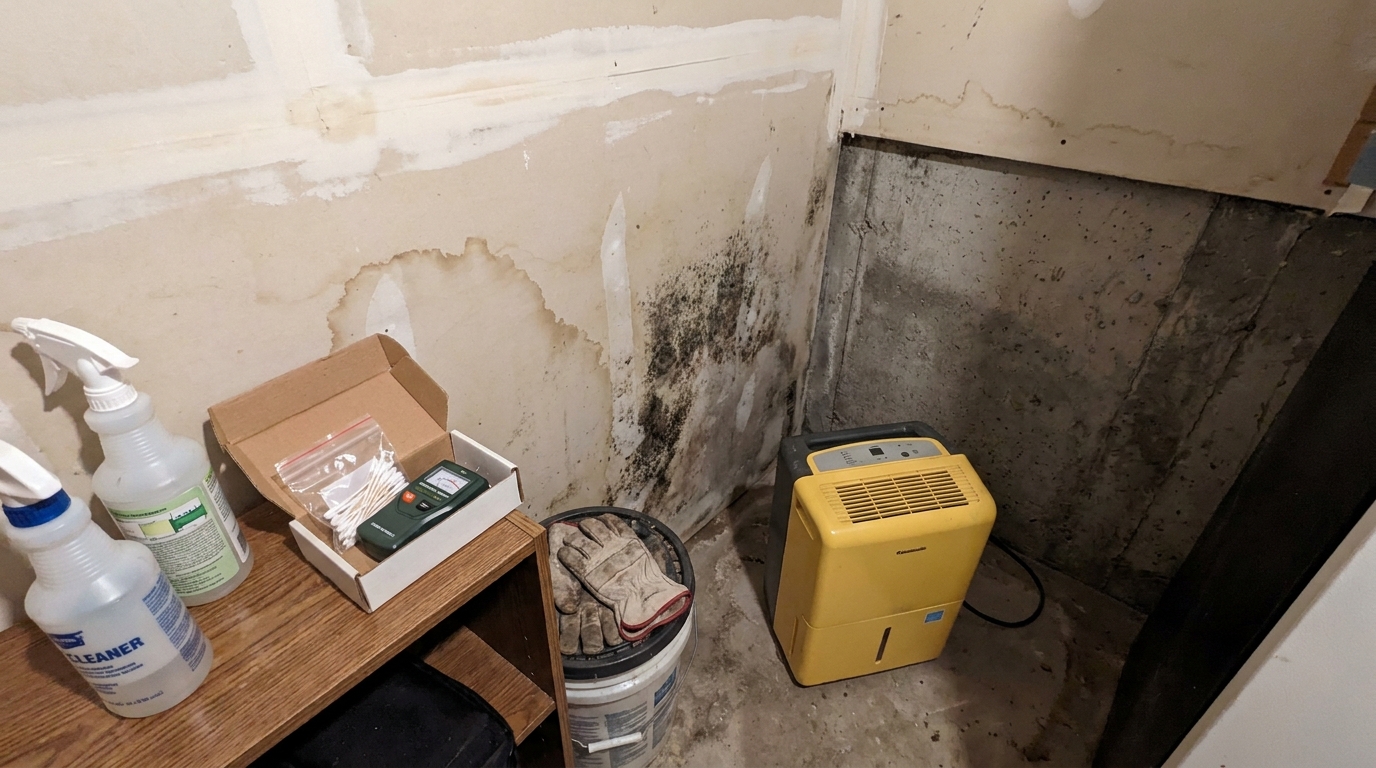
What Are Black Mould Bugs?
Black mould bugs are tiny creatures, primarily mould mites, psocids (booklice), and fungus gnats, that feed on fungal spores and decomposing organic matter found in damp areas of homes.
The term “black mould bugs” is a household nickname, not a scientific classification. Homeowners use it to describe any small arthropod they spot crawling near dark mould patches on walls, ceilings, or baseboards. Ironically, the bugs themselves are rarely black. Most are translucent, white, or tan. They earn the name simply because they congregate where black mould (Stachybotrys chartarum or other dark-pigmented fungi) grows. According to Pure Maintenance UK, mould mites are “tiny arachnids, barely visible to the naked eye” that “thrive in environments where mould is present.”
The three most common insects found near black mould
While dozens of species can show up in damp environments, three groups account for the vast majority of sightings:
-
Mould mites (Tyrophagus putrescentiae and related species). These are arachnids, not insects. Dr. Ronald Ochoa, a USDA research entomologist, explains that “mold mites are a general term for many species that have the ability to feed on fungi and grow large populations in a very short period.” [Source: Family Handyman]
-
Psocids (booklice). Soft-bodied insects, 1 to 2mm long, that feed on microscopic mould growing on paper, cardboard, and damp plaster. According to BPCA, “Booklice feed on mould caused by damp conditions.”
-
Fungus gnats. Small flying insects that breed in damp soil and mouldy organic matter. They’re common around overwatered houseplants and poorly ventilated bathrooms.
Why these bugs appear where mould grows
Mould is food. Mould mites consume fungal spores, hyphae, bacteria, and algae. Psocids eat microscopic mould on paper and glue. Fungus gnats lay eggs in moist organic material colonized by fungi. According to pest control specialists at Pegasus Pest Control, high humidity, stagnant moisture, and decaying organic materials “simultaneously nurture mould growth and attract a diverse range of insect species.”
What black mould bugs look like (size, color, behavior)
| Creature | Size | Color | Key Behavior |
|---|---|---|---|
| Mould mites | 0.3–1mm | White, translucent, or tan | Appear as moving “dust” on mouldy surfaces |
| Psocids (booklice) | 1–2mm | Pale gray, yellowish, or brown | Crawl quickly across damp paper, walls, and windowsills |
| Fungus gnats | 2–5mm | Dark gray or black | Fly weakly near soil, drains, and damp surfaces |
Mould mites are often invisible individually. Homeowners typically notice them only when populations are large enough to appear as a powdery, shifting film on a mouldy surface. If you’re unsure whether you’re looking at mould mites or dust, a mold test kit can help confirm active fungal growth in the area, which in turn confirms the bugs have a food source.
Do Mould Mites Bite Humans?
Mould mites do not bite humans, but they can trigger skin irritation and allergic reactions through contact with their bodies, shed hairs, and waste products.
Skin reactions versus actual bites
What many homeowners describe as “mould mite bites” are actually contact dermatitis or allergic skin reactions. True biting mites, such as chiggers, bird mites, and rat mites, puncture skin to feed on blood or tissue fluid. Mould mites lack the mouthparts for this. According to ABC Home & Commercial Services, mould mites are non-biting, and the itching or small bumps people experience are more consistent with allergic exposure than true bites.
Allergic responses to mould mite proteins
Mould mite bodies, feces, and shed exoskeletons contain proteins that can trigger immune responses in sensitive individuals. Symptoms include itching, small raised bumps, sneezing, coughing, watery eyes, and asthma-like breathing difficulty. According to Pure Maintenance UK, roughly one in three people can experience an allergic reaction to mould, which can easily be mistaken for a bite-like skin reaction.
When to see a doctor about skin symptoms
A physician should evaluate any persistent skin irritation, breathing difficulty, or worsening asthma symptoms in a home with known mould. A healthcare provider can distinguish between mite-related allergic dermatitis and other conditions. This is especially important for immunocompromised individuals, who face higher risks from fungal exposure.
What Attracts Bugs to Black Mould?
Bugs are attracted to black mould because it provides a direct food source and thrives in the same high-humidity environments that insects and mites need to survive and reproduce.
The relationship between humidity, mould, and insect reproduction
Indoor mould typically begins growing at relative humidity around 70% at temperatures as low as 60°F (about 15.5°C). According to Yes Pest Pros, mould thrives when humidity exceeds 60% and temperatures sit between 68–86°F, and these same conditions are “highly attractive to various insect species.” Psocids, for example, thrive at 75–90% relative humidity and temperatures of 77–86°F, the exact range that accelerates mould colonization. [Source: BPCA]
Why mould-eating insects prefer dark, damp spaces
Bathrooms, basements, crawl spaces, and poorly ventilated closets share three features mould-feeding creatures need: persistent moisture, limited airflow, and organic material (drywall paper, wood, cardboard) that fungi colonize. Pest specialists describe these areas as “perfect breeding grounds” for cockroaches, silverfish, centipedes, and mould mites alike. [Source: Pegasus Pest Control]
How quickly bug populations grow in mouldy environments
Dr. Ronald Ochoa notes that mould mites “grow large populations in a very short period.” [Source: Family Handyman] Industry practitioners typically report that a warm, humid room with extensive mould can go from no visible mites to thousands within days to weeks once food and moisture are consistently available. This rapid reproduction is why homeowners often feel blindsided: the mould may have been growing quietly for weeks before the mite population became large enough to notice.
Does the Presence of Bugs Mean the Mould Problem Is Severe?
Bug activity indicates active mould growth with enough moisture and food to sustain reproducing populations, which strongly suggests a persistent moisture problem worth investigating further.
What bug populations reveal about moisture levels
Visible mould-feeding insects are a biological humidity gauge. If mould mites or psocids are reproducing, indoor humidity is almost certainly above 60%, and likely above 70% in the affected area. According to Family Handyman, keeping humidity below 60% is recommended to control mould mite populations. Seeing active colonies means that threshold has been exceeded for a sustained period.
The difference between surface mould and hidden growth
A 2022 systematic review of 39 studies on indoor mould found that visible mould and dampness are consistently associated with increased respiratory and other symptoms in occupants, regardless of which mould species is present. [Source: NIH/PMC] Surface patches you can see may represent only a fraction of total growth. Mould frequently colonizes the back side of drywall, inside wall cavities, and beneath flooring where moisture accumulates undetected.
It’s worth noting that Cleveland Clinic states black mould is not more dangerous than other indoor moulds and that serious illness from typical household exposure is rare. [Source: Cleveland Clinic] The concern with bug presence isn’t toxicity. It’s the moisture problem the bugs reveal.
When bug activity signals hidden water damage
If you see mould mites or psocids in areas without visible mould, such as along baseboards, near window frames, or around HVAC vents, suspect hidden growth behind the surface. Bugs don’t appear without a food source. Their presence in seemingly clean areas often means mould is growing inside a wall cavity, beneath carpet padding, or within ductwork. This is a strong signal to investigate further, potentially with a professional mold inspection.
Can You Get Rid of the Bugs Without Removing the Mould?
Eliminating bugs without removing mould is a temporary fix at best. Insects will return as long as their fungal food source and favorable humidity conditions remain in place.
Why insecticides alone don’t solve the problem
Spraying insecticide on mould mites or psocids kills the individuals present but does nothing about the mould they eat or the moisture that sustains both organisms. Within days to weeks, surviving eggs hatch, new mites migrate from adjacent areas, and the population rebuilds. The mould itself continues producing spores, which are both an allergen for occupants and a food supply for the next generation of bugs.
The cycle of reinfestation when mould remains
A practical example illustrates the point. One homeowner dealing with mould mites reported running a dehumidifier at 45–50% relative humidity for about two weeks, combined with alcohol spraying and vacuuming. After one week the problem “had diminished by a lot,” and after around two weeks, approximately 95% of the mites had disappeared or died. [Source: Reddit r/pestcontrol] The critical factor was humidity reduction, not chemical treatment. Without that humidity drop, the mites would have returned.
What happens when you treat symptoms instead of causes
Treating bugs without addressing mould and moisture creates a frustrating loop: spray, temporary relief, reinfestation, spray again. Meanwhile, the underlying mould continues to grow, potentially spreading into wall cavities and HVAC systems. The longer this cycle continues, the more extensive and expensive the eventual remediation becomes.
How Do You Eliminate Both Mould and the Bugs It Attracts?
Eliminate both by fixing moisture sources, removing mould following EPA protocols, reducing indoor humidity below 50%, and improving ventilation to prevent regrowth and reinfestation.
Step 1: Identify and repair water sources
Cleveland Clinic advises fixing any water leaks before dealing with mould removal. [Source: Cleveland Clinic] Check for leaking pipes under sinks, condensation on cold water lines, roof leaks, poor grading that directs rainwater toward the foundation, and failed caulking around tubs and showers. Until the water source is eliminated, any cleaning is temporary.
Step 2: Remove mould growth safely
For small areas (under 10 square feet), the EPA permits homeowner cleanup with proper precautions: an N95 respirator, gloves, eye protection, and containment to prevent spore spread. One expert source notes that undiluted white vinegar can kill about 82% of mould species when sprayed generously and left to sit for at least an hour. [Source: YouTube] Porous materials like drywall and carpet padding that are heavily colonized generally need to be removed and replaced rather than cleaned.
Step 3: Control humidity and improve airflow
Damp and mould specialists recommend maintaining indoor relative humidity near 40–55% to prevent black mould from returning. A dehumidifier rated for the room size is essential in basements, bathrooms, and crawl spaces. Running exhaust fans during and after showering or cooking removes moisture at the source. The Frigidaire FAD704DWD, for example, can pull significant moisture from basement air and help maintain the below-50% humidity threshold that starves both mould and mite populations.
Step 4: Monitor for reinfestation signs
After remediation, check previously affected areas weekly for several months. Look for returning discoloration, musty odors, or the reappearance of tiny crawling organisms. A hygrometer (available for under $15 at most hardware stores) provides ongoing humidity readings. If humidity creeps back above 50% or bugs reappear, revisit moisture sources. An air purifier with a HEPA filter, such as GermGuardian models designed for mould spore capture, can reduce airborne spore counts during and after the remediation period.
What Are Mould Mites and How Do You Identify Them?
Mould mites are microscopic arachnids measuring 0.3 to 1mm, appearing as white or tan moving dust on mouldy surfaces, typically visible only when populations are large.
Physical characteristics and size
Individual mould mites are nearly impossible to see without magnification. They have eight legs (distinguishing them from six-legged insects), soft translucent bodies, and fine hair-like setae. The best-documented species, Tyrophagus putrescentiae, is described by MGK (a pest-control manufacturer) as “a widely distributed species of mite commonly found in soil, homes and buildings.” [Source: Family Handyman]
Where mould mites typically appear in homes
Mould mites congregate wherever fungal growth provides food: dank basements, bathroom walls and ceilings, air-conditioning systems, stored food, and pet food storage areas. They also colonize damp cardboard boxes, old books, and any porous material with microscopic mould growth.
How to distinguish mould mites from other household pests
Mould mites differ from dust mites (which feed on skin flakes and live in bedding/upholstery), bird mites (which bite and are associated with nesting birds), and grain mites (which infest dry food stores). The key identifier: mould mites cluster directly on or immediately adjacent to visible mould growth. If you see a powdery, slightly moving film on a mouldy patch, those are almost certainly mould mites.
Are Psocids (Booklice) Dangerous When Found Near Mould?
Psocids are not dangerous to humans or building structures, but their presence signals humidity above 50% and active mould growth that needs moisture control.
What psocids eat and why they appear
According to BPCA, booklice “feed on mould caused by damp conditions” and on microscopic moulds growing on glue, damp cardboard, damp food, and damp plaster. Penn State Extension adds that indoors, they live “in humid, damp, generally dark areas where they feed on fungi and mold.” They don’t bite, sting, or transmit disease.
The humidity threshold that supports psocid populations
Psocids thrive at 75–90% relative humidity and temperatures of 25–30°C (77–86°F). [Source: BPCA] Dropping humidity below 50% eliminates the microscopic mould they depend on, effectively starving them out. This is why dehumidification alone often resolves a psocid problem without any pesticide.
Why psocids are considered indicator species
Pest professionals treat psocids as living moisture meters. As one specialist puts it, “Humidity breeds mould and mould breeds psocids.” Finding them in a room that appears dry on the surface often means hidden dampness exists behind walls or under flooring. Their presence is diagnostic, not dangerous.
When Should You Call a Professional for Mould-Related Bug Problems?
Call a professional when bug populations are large, mould covers more than 10 square feet, growth returns after cleaning, or you suspect hidden mould inside walls or HVAC systems.
Signs the problem exceeds DIY capability
The Western Australia Department of Health classifies mould as requiring professional help when growth is larger than approximately 10 square feet (about 1 square meter), present in multiple rooms, recurring despite cleaning, or located in HVAC systems or building cavities. [Source: WA Health] Cleveland Clinic warns that attempting to remove black mould yourself can aerosolize spores and spread them to other areas of your home. [Source: Cleveland Clinic]
What mould remediation professionals assess
Certified mould inspectors evaluate the extent of visible growth, test for hidden mould in wall cavities and ductwork, identify moisture sources using thermal imaging and moisture meters, and develop a remediation plan that includes containment, removal, and prevention. Professional remediation involves sealing the affected area, removing damaged building materials, disinfecting surfaces, and running HEPA air filtration. Workers wear protective suits and N95 masks.
The role of entomologists versus mould specialists
In nearly all cases, a mould remediation specialist is the right call, not an exterminator. The bugs are a symptom. Eliminating the mould and moisture eliminates the bugs. An entomologist might be helpful in rare situations where the insect identification is uncertain, such as distinguishing mould mites from bird mites or other biting species that require different treatment.
If you’re seeing bugs near mould growth, the insects are signaling a moisture problem that requires attention. Start by measuring your indoor humidity. If it’s above 50%, you have conditions supporting both mould and the insects it attracts. For growth covering more than a few square feet or recurring infestations, consult a certified mould inspector to identify hidden moisture sources.
Frequently Asked Questions
Below are answers to the most common questions homeowners ask about black mould bugs, their risks, and how to deal with them.
Are black mould bugs harmful to humans?
Most black mould bugs, including mould mites and psocids, are nuisance pests. They don’t bite, sting, or transmit disease. However, mould mite proteins can trigger allergic reactions such as itching, sneezing, and asthma-like symptoms in sensitive individuals. According to Pure Maintenance UK, roughly one in three people may experience an allergic reaction to mould exposure. Consult a physician if symptoms persist.
Can mould mites infest my entire house?
Mould mites can spread to any area with sufficient humidity and mould growth. They’re most common in bathrooms, basements, kitchens, and around leaking pipes. Reducing whole-house humidity below 50% with a dehumidifier limits their ability to establish populations in new areas.
How fast do mould mite populations grow?
Dr. Ronald Ochoa notes that mould mites “grow large populations in a very short period.” [Source: Family Handyman] In warm, humid conditions with ample mould, populations can go from undetectable to thousands within days to weeks.
What humidity level kills mould mites?
Dropping indoor humidity below 50% significantly reduces mould mite populations. One homeowner reported that maintaining 45–50% humidity for two weeks eliminated approximately 95% of mites. [Source: Reddit r/pestcontrol] The underlying mould should still be removed to prevent reinfestation if humidity rises again.
Do I need an exterminator for bugs near mould?
In most cases, no. A mould remediation specialist is more appropriate because the bugs exist only because the mould exists. Removing the mould and controlling moisture eliminates the food source, and the bug population collapses on its own. Insecticides provide only temporary relief.
Is black mould more dangerous than other types of indoor mould?
Cleveland Clinic states that black mould is not more dangerous than other indoor moulds and that serious illness from typical household exposure is rare. [Source: Cleveland Clinic] All indoor mould in occupied spaces warrants remediation, regardless of color.
Can I use vinegar to kill mould and get rid of the bugs?
Undiluted white vinegar can kill about 82% of mould species when applied generously and left for at least an hour. [Source: YouTube] This works for small surface patches, but porous materials with deep mould penetration typically need to be removed. Vinegar alone won’t fix the moisture source driving both mould and bug problems.
Should I worry if I see bugs but no visible mould?
Yes, investigate further. Mould mites and psocids don’t appear without a food source. If you see these bugs in areas without visible mould, hidden growth may exist behind walls, under flooring, or inside HVAC ductwork. A professional mould inspection can locate concealed growth using moisture meters and thermal imaging.