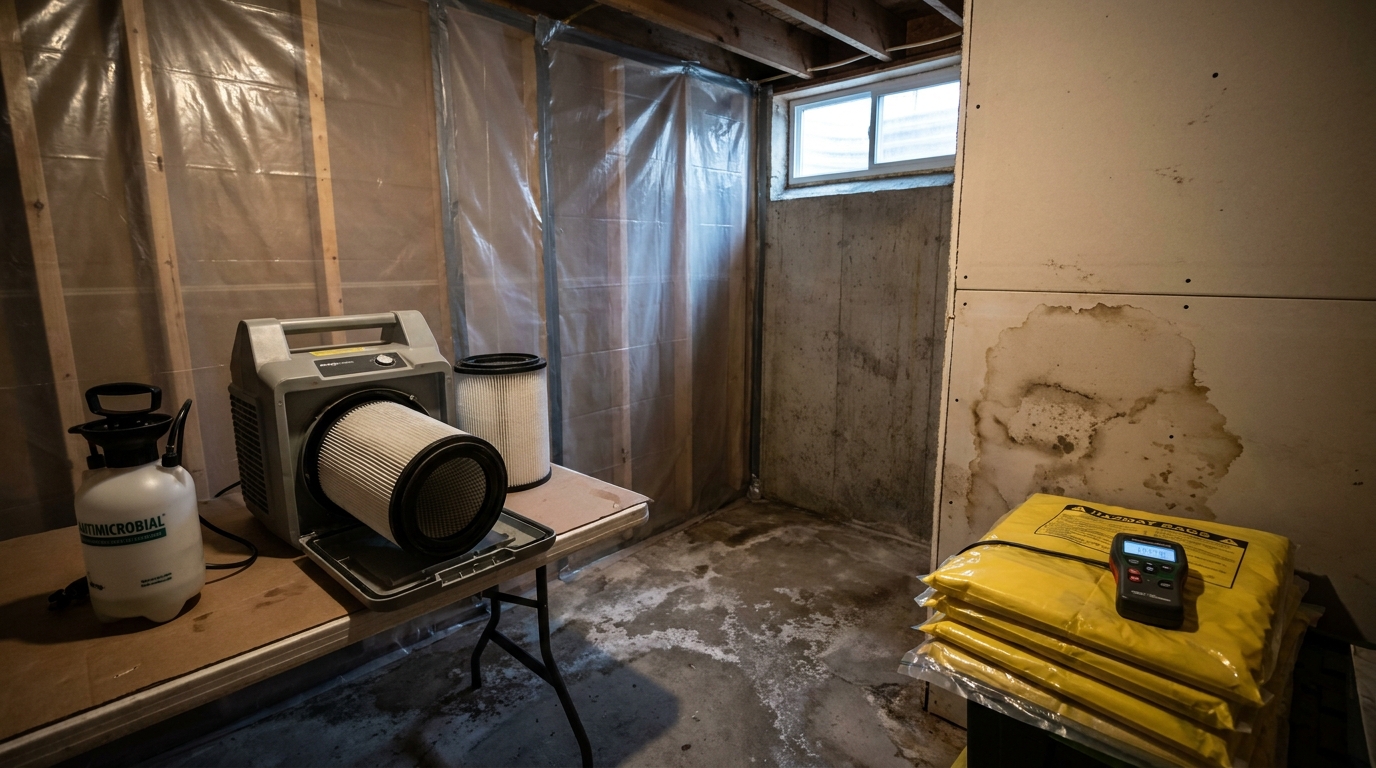
What Do Mold Remediators Actually Do?
Mold remediators contain affected areas, remove contaminated materials, clean surfaces with antimicrobials, dry the space, and address moisture sources to prevent recurrence.
Many homeowners assume that spraying bleach or a “mold-killing” product on visible growth solves the problem. It doesn’t. Professional remediators follow a structured, multi-step process designed to physically remove mold, not just treat surfaces. The distinction matters because mold spores penetrate deep into porous materials where topical sprays can’t reach. According to the VerifiedRemediation guide, a separate remediator follows a defined protocol and does the physical work of eliminating contamination.
Containment and Air Filtration
Before any material gets touched, mold remediation professionals set up engineering controls to prevent spores from spreading to clean areas of the home. This involves installing plastic sheeting barriers and zip walls around the work zone, sealing off HVAC registers in the containment area, and running HEPA air scrubbers to capture airborne spores. Negative air pressure is created so that air flows into the work zone and exhausts outside through ducting, rather than pushing contaminated air into the rest of the house. Source: VerifiedRemediation
Material Removal and Disposal
This is the most visible stage. Porous materials like drywall, carpet, padding, insulation, and ceiling tiles are typically cut out, double-bagged, and removed when visibly contaminated. The EPA specifically notes that porous materials such as ceiling tiles and carpet may have to be thrown away because mold can grow into crevices that cleaning cannot reach. Source: VerifiedRemediation
Surface Cleaning and Treatment
Non-porous and semi-porous surfaces, including structural framing, concrete, tile, and metal, are HEPA-vacuumed, scrubbed with detergent or specialized cleaning solutions, and then treated with antimicrobials. This is where the “mold-killing spray” myth falls apart: spraying alone doesn’t remove the biomass. A certified mold remediator physically removes contamination first, then treats surfaces as a secondary measure.
Moisture Control and Prevention
Mold returns if moisture returns. Remediators use dehumidifiers, exhaust fans, and open ventilation to dry the space thoroughly. They also identify the moisture source, whether it’s a leaking pipe, condensation issue, or poor drainage, and either address it directly or recommend a licensed contractor for structural repairs.
How Are Remediators Different from Mold Inspectors?
Inspectors assess and test for mold presence while remediators physically remove it. Most states require these to be separate companies to avoid conflicts of interest.
This separation exists for a good reason. If the same company inspects your home and then performs the remediation, there’s a financial incentive to overstate the problem. According to National Mold Remediation Authority, some state frameworks require the roles to be separate, especially for assessment and inspection versus remediation work. VerifiedRemediation notes that the independent-assessor premium is typically $50 to $100 more than using a single dual-role contractor, but it often saves thousands on remediation by preventing overscoping. Source: VerifiedRemediation
Think of it this way: the inspector writes the diagnosis, and the remediator performs the surgery. If you need help understanding when and how to get mold testing done, start with an independent inspector before contacting mold removal specialists.
What Certifications Should a Mold Remediator Have?
Look for IICRC Applied Microbial Remediation Technician (AMRT) certification, state licensing where required, and liability insurance with mold coverage of at least $1 million.
IICRC Certification: The Industry Standard
The IICRC’s AMRT credential is the most widely recognized hands-on remediation certification in the United States. It requires completion of the Water Damage Restoration Technician (WRT) course as a prerequisite, followed by an in-person AMRT course and a proctored exam. The governing standard for AMRT-level work is the IICRC S520 Standard for Professional Mold Remediation. Source: IICRC
A 2026 industry guide identifies the AMRT plus WRT combination as the “strongest combination” of credentials for mold remediators in practice, labeling AMRT as the “industry standard for remediators” and WRT as the foundational credential covering the water damage that drives most mold issues. Source: IICRC
State Licensing Requirements
Licensing requirements vary significantly by state. Some states, like Texas, Florida, and New York, have specific mold remediation licensing laws. Others have no state-level requirements at all. Homeowners should check with their state’s contractor licensing board to determine what applies locally. Even in states without licensing mandates, IICRC certification remains the de facto industry benchmark.
Insurance and Bonding
A legitimate certified mold remediator carries general liability insurance with a mold-specific endorsement. Industry practitioners typically recommend a minimum of $1 million in coverage. Ask for a certificate of insurance and verify it’s current. Workers’ compensation coverage is equally important, as it protects homeowners from liability if a worker is injured on the property.
When Do You Actually Need a Professional Remediator?
Hire a remediator when mold covers more than 10 square feet, affects HVAC systems, follows sewage backup, or when occupants have health conditions worsened by mold.
The EPA’s longstanding guidance uses 10 square feet (roughly a 3-by-3-foot patch) as the threshold for professional intervention. Below that, a handy homeowner can often handle cleanup on hard surfaces with proper protective equipment. Above that threshold, the risk of cross-contamination and inadequate removal increases substantially.
According to industry guidance compiled by MoldGuides, HVAC, attic, and foundation contamination are situations where professional help is typically necessary. Mold inside ductwork can distribute spores throughout the entire house, turning a localized problem into a whole-home issue. Crawl spaces, basements, and attics in humid regions also warrant professional assessment due to hidden spread and access difficulties. Source: MoldGuides
How Much Does Mold Remediation Cost?
Small projects under 10 square feet cost $500 to $1,500. Medium projects of 10 to 100 square feet run $1,500 to $5,000. Large projects over 100 square feet typically cost $5,000 to $30,000 depending on extent and location.
According to HomeAdvisor, the national average is $2,367 per project, with a typical range of $1,223 to $3,756. Angi reports similar figures: $10 to $25 per square foot of affected area. Source: Angi
| Project Size | Estimated Cost Range | Typical Duration |
|---|---|---|
| Small (under 10 sq ft) | $500–$1,500 | 1–2 days |
| Medium (10–100 sq ft) | $1,500–$5,000 | 3–5 days |
| Large (100+ sq ft) | $5,000–$10,000+ | 1–2 weeks |
| Whole-house / severe | $10,000–$30,000+ | 2+ weeks |
| Attic | $1,000–$4,000 | 2–5 days |
| Basement | $500–$3,000 | 2–5 days |
Sources: Source: SERVPRO, Source: Modernize, Source: HomeAdvisor. Costs tend to be higher in coastal and humid states where mold prevalence is greater.
Cost Factors That Drive Price Up
-
Location within the home: Crawl spaces and attics cost more due to limited access. WorkWave reports $15 to $30 per square foot for basements, attics, and crawl spaces. Source: WorkWave
-
Type of mold: Certain species require more aggressive containment protocols.
-
Extent of material damage: More drywall, insulation, or flooring to remove means higher disposal and replacement costs.
-
HVAC involvement: Duct cleaning and system decontamination add significant cost.
-
Geographic region: Coastal and high-humidity states typically see higher pricing due to demand.
What’s Included in a Remediation Quote
A thorough quote should itemize containment setup, material removal, HEPA vacuuming, antimicrobial treatment, drying, and waste disposal. It should also specify whether post-remediation verification testing is included or billed separately. Many reputable companies recommend that an independent inspector, not the remediator, perform clearance testing.
What Questions Should You Ask Before Hiring?
Ask about certifications, insurance, their containment process, disposal methods, post-remediation verification, warranty terms, and whether they address the underlying moisture problem.
Here’s a practical checklist to use when interviewing mold removal specialists:
-
“What certifications do your technicians hold?” Look for IICRC AMRT and WRT at minimum.
-
“Can I see your certificate of insurance with mold endorsement?” Verify it’s current.
-
“How do you set up containment?” They should describe plastic sheeting, negative air pressure, and HEPA filtration.
-
“What happens to removed materials?” Proper disposal involves double-bagging and transport to approved facilities.
-
“Who performs post-remediation verification?” The answer should be an independent third-party inspector.
-
“Do you offer a warranty, and what does it cover?” Reputable companies stand behind their work for a defined period.
-
“Will you address the moisture source?” If not, they should clearly explain what needs to happen next.
What Does the Remediation Process Look Like?
Remediators set up containment barriers, use negative air machines, remove affected materials, HEPA-vacuum surfaces, apply antimicrobials, dry the area, and conduct post-remediation verification testing.
Day 1: Assessment and Containment Setup
The crew reviews the remediation protocol (ideally written by an independent assessor), documents existing conditions with photos, and builds the containment zone. Plastic sheeting goes up, HVAC registers get sealed, and air scrubbers start running. Furniture and belongings near the affected area are either relocated or protected.
Days 2–3: Removal and Cleaning
Contaminated porous materials are cut out, bagged, and removed. Structural surfaces are HEPA-vacuumed and scrubbed. Antimicrobial treatments are applied to cleaned surfaces. Dehumidifiers and fans run continuously to bring moisture levels down to acceptable thresholds, typically below 60% relative humidity.
Final Day: Verification and Clearance
Once the space is dry and cleaned, an independent inspector (not the remediation company) should perform post-remediation verification. This typically involves visual inspection and air or surface sampling to confirm spore counts have returned to normal background levels. Only after clearance should reconstruction begin.
What Are the Red Flags When Vetting Companies?
Avoid companies that offer free inspections before remediation, guarantee mold will never return, use scare tactics, lack proper insurance, or refuse to provide written protocols.
Specific warning signs to watch for:
-
“Free mold inspection with remediation” signals a conflict of interest. The company has a financial incentive to find problems.
-
“We guarantee mold won’t come back” is impossible to promise. Mold spores exist everywhere naturally. What matters is controlling moisture.
-
Pressure to sign immediately or claims that your home is “dangerously toxic” without testing data.
-
No written scope of work. Legitimate remediators provide detailed protocols before starting.
-
No proof of insurance. If they can’t produce a current certificate, walk away.
-
Unusually low bids. A quote far below the $1,223 to $3,756 typical range for a mid-size project may indicate corners will be cut on containment or disposal. Source: HomeAdvisor
Do Remediators Fix the Moisture Problem Too?
Most remediators identify moisture sources but refer structural repairs like roof leaks, foundation cracks, and plumbing issues to licensed contractors. Some offer moisture control as an add-on service.
Remediation without moisture control is temporary. If the water source isn’t fixed, mold will return, sometimes within weeks. A good remediator will document the moisture source in their report and either fix minor issues (like improving ventilation or adjusting a downspout) or provide a clear referral for larger repairs. Homeowners should budget for both remediation and the underlying repair when planning costs. For more on identifying and addressing moisture issues, see our guide on moisture control for mold prevention.
How Long Does Remediation Take?
Small projects take 1 to 2 days. Medium projects require 3 to 5 days. Large or complex projects can take 1 to 2 weeks depending on drying time and extent of material removal.
Several factors influence the timeline:
-
Drying time: Materials must reach target moisture levels before clearance testing. High humidity or poor ventilation extends this phase.
-
Extent of demolition: Removing large sections of drywall, flooring, or insulation adds days.
-
HVAC involvement: Duct cleaning and system decontamination require specialized equipment and additional time.
-
Clearance testing: Lab results for air and surface samples typically take 24 to 48 hours, which can add a day or two to the overall timeline.
-
Reconstruction: Rebuilding removed walls, floors, or ceilings is a separate phase, often handled by a general contractor rather than the remediation company.
Homeowners should plan for the space to be off-limits during active remediation. In some cases, temporary relocation may be advisable, particularly for households with young children, elderly residents, or anyone with respiratory conditions.
If you’re dealing with mold growth beyond 10 square feet, affecting HVAC systems, or causing health symptoms, contact a certified remediator for an assessment. Request proof of IICRC certification, state licensing, and mold-specific insurance before signing any contract.
Frequently Asked Questions
Below are answers to the most common questions homeowners ask when considering hiring mold remediation professionals.
Can I remove mold myself instead of hiring a remediator?
For small areas under 10 square feet on hard, non-porous surfaces, DIY cleanup with proper protective equipment (N95 mask, gloves, goggles) is generally considered safe. Beyond that threshold, or when mold affects porous materials, HVAC systems, or hidden spaces, professional remediation is strongly recommended. A physician should be consulted if anyone in the household has respiratory conditions.
How much does a typical mold remediation project cost?
The national average is approximately $2,367 per project, with most homeowners paying between $1,223 and $3,756 according to HomeAdvisor. Costs range from $500 for small jobs to $30,000 or more for severe, whole-house contamination. Source: HomeAdvisor
Does homeowners insurance cover mold remediation?
Coverage depends on the cause. If mold results from a covered peril like a burst pipe, insurance may pay for remediation. If mold stems from long-term neglect, deferred maintenance, or flooding (without separate flood insurance), it’s typically excluded. Review your policy and contact your insurer before starting work.
What is the IICRC S520 standard?
The IICRC S520 is the Standard for Professional Mold Remediation. It establishes procedures for assessment, containment, removal, cleaning, and post-remediation verification. Certified remediators holding the AMRT credential are trained to follow this standard. Source: IICRC
Should the same company inspect and remediate?
No. Using the same company for both creates a conflict of interest, as the company benefits financially from finding more mold. Many state frameworks require these roles to be separate. The independent-assessor premium is typically $50 to $100 more, but it often saves thousands by preventing overscoping. Source: VerifiedRemediation
Will mold come back after remediation?
Mold can return if the underlying moisture source isn’t fixed. Remediation removes existing contamination, but ongoing moisture from leaks, condensation, or high humidity will create conditions for regrowth. Any company that “guarantees” mold will never return is making a promise they cannot keep.
What does post-remediation verification involve?
An independent inspector (not the remediation company) performs a visual inspection and collects air or surface samples. Lab analysis confirms that spore counts have returned to normal background levels. This step is critical for confirming the work was done properly and is often required by insurance companies.
How do I find a certified mold remediator near me?
The IICRC maintains a directory of certified professionals at iicrc.org. Homeowners can also check with their state’s contractor licensing board. Get at least three quotes, verify certifications and insurance independently, and ask every company the questions outlined in this article before making a decision.