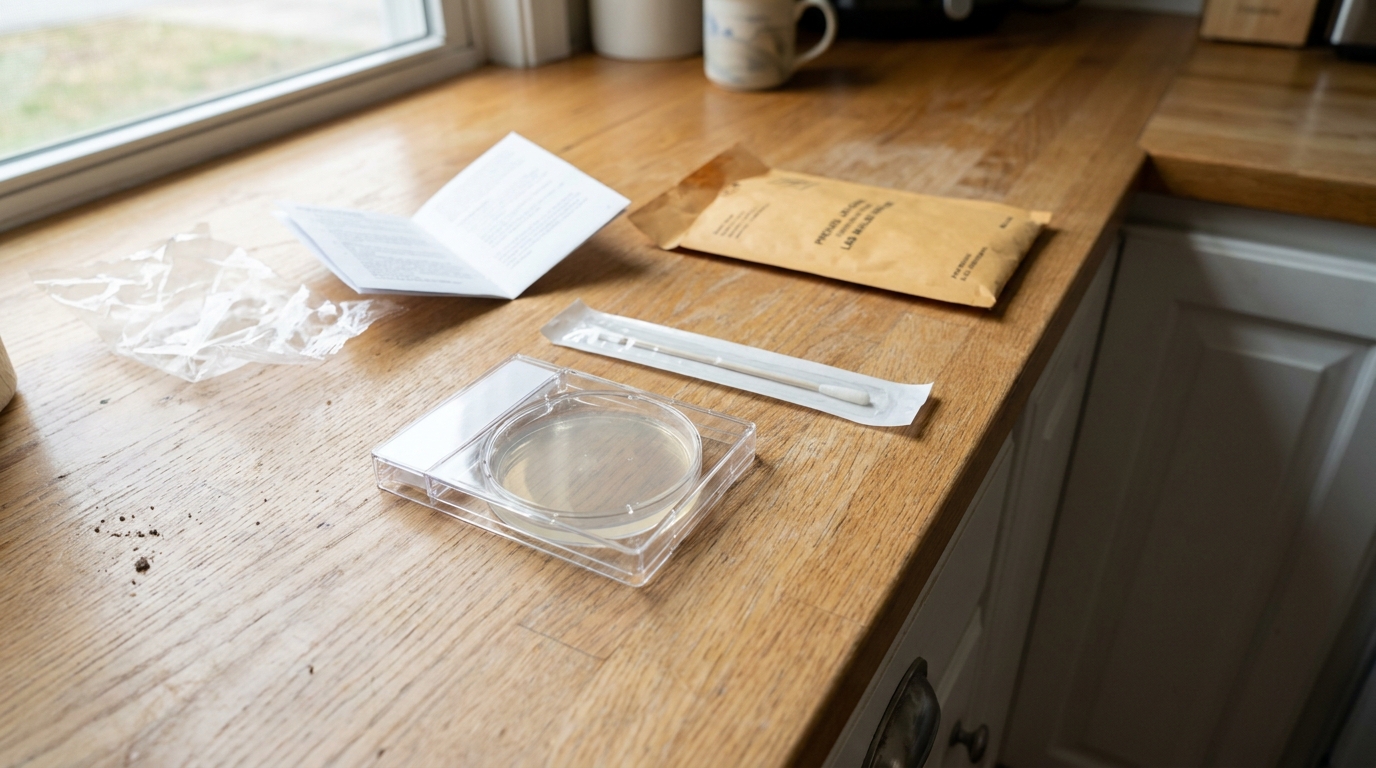
What Is the Pro Lab Mold Test Kit and How Does It Work?
Pro Lab’s kit uses settle plates to collect airborne spores over 48 to 96 hours, then ships samples to a lab for genus-level identification at an additional fee.
The Pro Lab mold test kit is one of the most widely sold DIY mold sampling products in the United States, available at Home Depot, Lowe’s, and Amazon. This pro lab mold test kit review breaks down exactly what you get, what the results mean, and whether the kit delivers enough actionable information to justify its cost. Pro Lab states it has been in environmental testing for over 20 years. [Source: Prolabtestkits]
What’s Included in the Pro Lab Kit
The kit includes a petri dish with a growth medium, a swab for surface sampling, step-by-step instructions, and a prepaid mailer for sending samples to Pro Lab’s laboratory. Pro Lab advertises four sampling methods on its website, while some retailer listings describe three methods, suggesting contents or descriptions vary by version. [Source: Prolabtestkits]
The Collection and Lab Analysis Process
For air sampling, you open the petri dish and leave it exposed for about 1 hour, then close it and incubate it for approximately 48 hours. Some instructions advise re-checking at 72 and 96 hours for slower-growing mold. [Source: Prolabtestkits] For surface testing, you swab visible mold and transfer it to the agar medium. If mold grows, you mail the sample for optional lab analysis, which Pro Lab lists at a $40 lab fee per sample. [Source: Lowes]
What the Lab Report Actually Tells You
The lab report identifies the genus name of the mold detected. It does not identify the specific species, does not provide a clinical health interpretation, and does not include remediation recommendations. Pro Lab product pages specifically describe the output as genus-name identification rather than a more detailed clinical interpretation. [Source: Prolabtestkits]
How Accurate Is the Pro Lab Mold Test Kit?
Pro Lab’s lab analysis is reliable for identifying spores that land on the plate, but the settle plate collection method captures far fewer spores than professional calibrated air pumps.
This is the central tension of pro lab mold test accuracy: the lab itself isn’t the problem, the sampling method is. Professional mold assessments typically measure spores per cubic meter using calibrated air pumps, while DIY settle-plate kits do not provide comparable airborne concentration data. [Source: Inspectandtest]
Lab Analysis Quality vs. Collection Method Limitations
The amount of growth on a settle plate depends heavily on how long the plate was left open and where it was placed, so the result can reflect exposure time more than actual indoor air quality. [Source: Inspectandtest] Without an outdoor control sample, it’s hard to know whether indoor counts are elevated or just reflect normal ambient spores. Pro Lab states that two test kits are required for air sampling so you can compare indoor versus outdoor results. [Source: Prolabtestkits]
What Independent Testing Shows About Detection Rates
Consumer Reports rated home mold test kits “Not Recommended” in its evaluation, including a Pro Lab kit, citing issues such as leaking media, a moldy unopened kit, and lack of useful toxicity interpretation. [Source: Inspectandtest] Independent review material notes that consumer mold kits can identify the genera detected, but this usually does not place the result in a reliable health context because there is no federal standard for acceptable indoor mold levels.
Comparison to Professional Air Sampling Results
Professional testing provides spore counts per cubic meter, species-level identification, and outdoor baseline comparison, none of which DIY kits generally match. [Source: Mymolddetective] A guide comparing DIY kits with professional testing confirms that professional assessments measure spores per cubic meter, which consumer kits cannot do. [Source: Inspectandtest]
What Do Pro Lab Test Results Look Like?
Pro Lab reports list mold genera detected and a genus-name identification, but do not identify specific species or provide remediation guidance.
Sample Lab Report Breakdown
Standard lab results are typically delivered within 7 business days after Pro Lab receives the sample, with a $40 lab fee per sample. Express results arrive within 3 business days at a $60 lab fee per sample. Customers receive email and text notifications when the sample is received and again when results are ready. Results can also be printed or viewed online. [Source: Prolabtestkits]
How to Interpret Spore Count Numbers
Here’s the challenge: Pro Lab’s settle plate method does not produce the calibrated spores-per-cubic-meter data that professional air pumps generate. The report may include a rough quantity estimate, but there is no federal “safe” indoor mold threshold to compare it against. [Source: Inspectandtest] That means “mold detected” is often expected rather than decisive, since mold spores are common in both indoor and outdoor air.
What the Risk Categories Mean
Some users report that the lab report includes a general assessment of the findings, but Amazon review summaries note complaints that the report can be “useless,” “generic,” or missing key details such as spore count. [Source: Amazon] One customer review summary on Lowe’s describes results as sometimes “thorough and informative” but also notes drawbacks including “inconclusive” results. [Source: Lowes]
Does the Pro Lab Kit Detect Hidden Mold?
No. Pro Lab’s settle plates only capture airborne spores in the immediate test area and cannot detect mold hidden inside walls, under flooring, or in HVAC ductwork.
Pro Lab states its air sampling methods can “indicate a hidden or elevated mold problem in as little as 48 hours.” [Source: Prolabtestkits] That phrasing is important: “indicate” is not the same as “detect.” The kit can suggest elevated spore levels in a room, but it cannot pinpoint the source. Consumer kits usually test a single location, so they can miss mold hidden in walls, under floors, in ducts, or other concealed areas. [Source: Inspectandtest]
Amazon’s summary of customer feedback confirms this limitation, noting users were dissatisfied because the kit did not provide spore counts or complete results. [Source: Amazon] A YouTube demonstration found no visible growth after 48 to 96 hours in one trial, illustrating that a negative result is possible even when mold may be present elsewhere in the home.
What Are the Biggest Limitations of Pro Lab Testing?
Pro Lab cannot identify mold species, misses mold that isn’t actively releasing spores, requires 7 to 10 days for lab results, and costs $40 to $50 per test location before the lab fee.
Species Identification Gap
The lab identifies mold to the genus level only. That means you might learn you have Aspergillus or Penicillium, but not which of the hundreds of species within those genera is present. This distinction matters because toxicity and health risk vary significantly by species. A physician or certified mold inspector can provide the species-level identification that insurance companies and medical professionals typically require.
Surface Mold Detection Failure
Settle plates capture spores that are airborne and happen to land on the dish during the exposure window. Mold growing on a surface that isn’t actively releasing spores may not appear in the results at all. Sources warn that these kits can produce misleading positive or negative results, especially when used without a careful sampling plan and visual inspection. [Source: Inspectandtest]
Turnaround Time Issues
Standard results take 7 business days after Pro Lab receives the sample. Factor in 48 to 96 hours of incubation, mailing time, and lab processing, and homeowners often wait 2 to 3 weeks from start to finish. For anyone dealing with active water damage, that timeline is far too slow. Express results at $60 per sample cut the lab portion to 3 business days but don’t eliminate incubation and shipping time. [Source: Prolabtestkits]
Cost Per Location Adds Up Quickly
Pro Lab recommends testing multiple rooms and including an outdoor control sample. At roughly $80 per location (kit plus lab fee), testing three rooms plus an outdoor control costs $320 before shipping. At that price, you’re approaching the cost of a professional inspection that provides far more detailed data.
How Does Pro Lab Compare to Other Mold Test Kits?
Pro Lab offers better lab analysis than instant color-change kits but costs more and takes longer, while professional-grade kits like My Mold Detective provide air-sampling data closer to what a certified inspector would collect.
| Feature | Pro Lab (~$80 all-in) | Mold Armor FG500 (~$50-$80) | My Mold Detective (~$150-$200) | Professional Inspection ($300-$800) |
|---|---|---|---|---|
| Sampling Method | Settle plate | Petri dish | Calibrated air sampling | Calibrated air pump + visual |
| Identification Level | Genus only | Genus only | Genus + some species | Full species ID |
| Spore Count Data | No | No | Yes | Yes (spores/m³) |
| Outdoor Control Included | Requires 2nd kit | Requires 2nd kit | Yes | Yes |
| Result Turnaround | 7-10 business days | 48 hrs to 7-10 days | 3-5 days | 2-5 days |
| Accepted for Insurance Claims | Rarely | No | Sometimes | Yes |
[Source: Mymolddetective], [Source: Greenbuildingsupply]
Pro Lab vs. Instant Color-Change Kits
Instant kits give a yes/no answer within minutes but provide zero identification data. Pro Lab’s lab analysis is a meaningful upgrade because it at least tells you the genus. Top Ten Reviews calls Pro Lab “one of the most affordable kits” and notes it offers four different testing methods. [Source: Greenbuildingsupply]
Pro Lab vs. Professional-Grade Home Kits
My Mold Detective uses air sampling with certified lab analysis and includes an outdoor control, which makes results more actionable for indoor-air questions. Bob Vila’s testing gave My Mold Detective a perfect 5/5 for accuracy, though it scored a lower 3.7/5 for value due to its higher price and setup complexity. [Source: Mymolddetective]
Pro Lab vs. Hiring a Certified Inspector
A review on Black Mold Guide states that professional tests are “much more accurate” and provide “a lot more useful information” than DIY kits. [Source: Black-mold-guide] Professional testing typically costs $300 to $800, but it includes calibrated air sampling, species-level identification, source identification, and a written report suitable for insurance or legal purposes. [Source: Mymolddetective]
When Does Pro Lab Testing Make Sense?
Pro Lab is most useful for confirming suspected airborne mold in a specific room after remediation or as a preliminary screen when professional inspection costs exceed your immediate budget.
Post-Remediation Verification Scenarios
After a remediation company finishes work, a Pro Lab kit can serve as a basic check to see whether spores are still elevated in the treated area. This is one of the narrowest, most defensible use cases for the product. If the settle plate shows significant growth post-remediation, that’s a signal to call the remediation company back before paying the final invoice.
Pre-Purchase Home Screening
Green Building Supply describes the kit as “especially useful in older homes before you buy or rent,” positioning it as a screening tool rather than a substitute for a comprehensive inspection. [Source: Greenbuildingsupply] If you’re evaluating a property and want a quick data point before committing to a $400+ professional inspection, a single Pro Lab test in the basement or a suspect room can flag obvious problems.
When Visual Inspection Isn’t Enough
If you smell something musty but can’t see any mold, a Pro Lab kit can confirm whether airborne spore levels appear elevated. Keep in mind that a negative result doesn’t rule out hidden mold. It only means spores didn’t land on the plate during the exposure window. For a deeper look at signs of mold in your house, visual and olfactory cues remain the most reliable first indicators.
When Should You Skip Pro Lab and Call a Professional?
Skip Pro Lab if you see visible mold, smell persistent musty odors, have respiratory symptoms, experienced flooding, or need documentation for insurance or legal purposes.
The EPA’s longstanding position, as summarized in multiple mold guidance documents, is to clean visible growth and fix the moisture source rather than buy a test kit. [Source: Inspectandtest] There is no federal “safe” indoor mold threshold, so a positive consumer kit result does not by itself prove a home is hazardous.
-
Visible mold covering more than 10 square feet: Remediate immediately. Testing only delays action.
-
Health symptoms: Consult a physician first. A genus-level report won’t help your doctor determine whether mold is causing your symptoms.
-
Active water damage or flooding: Time is critical. Mold can begin growing within 24 to 48 hours of water exposure. Spend the $80 on dehumidification, not a test kit.
-
Insurance or legal claims: Insurers and attorneys require professional documentation with species-level identification and calibrated spore counts.
-
Suspected mold in walls or HVAC systems: A settle plate in one room cannot assess what’s behind drywall or inside ductwork. A certified industrial hygienist can.
What Do Real Users Report About Pro Lab Results?
User reviews are sharply divided. Many praise the kit’s ease of use, while a significant portion report confusing results, unexpected costs, and missed mold.
Turnaround Time Experiences
Pro Lab advertises results within 7 business days of receiving the sample. Top Ten Reviews characterizes the lab turnaround as “up to five days,” which it calls quicker than most other companies. [Source: Greenbuildingsupply] However, one Amazon reviewer reported that the app showed “received” and “analyzed” but provided no results even after two months of checking. [Source: Amazon]
Report Clarity and Usefulness
Home Depot reviews show a substantial spread: 128 five-star, 33 four-star, 18 three-star, 16 two-star, and 89 one-star ratings on the listed page. [Source: Homedepot] Amazon reviews are similarly mixed: some users describe the report as “very good and accurate,” while others call it “very generic” and criticize the product’s accuracy. [Source: Amazon]
Detection Accuracy Complaints
The product has approximately 2,000 reviews and a 4.2/5 average rating across platforms, suggesting broad consumer use but also mixed experience. [Source: Black-mold-guide] On eBay, one reviewer explicitly calls the product a “major rip off” because you must send samples to the lab and pay more after setup. Lowe’s customer review summaries note “unclear sample-collection instructions,” “lab-handling issues,” and “inconclusive or insufficiently detailed results.” [Source: Lowes]
How Much Does Pro Lab Testing Actually Cost?
Pro Lab kits cost $40 to $50 per test location, with most homes requiring 2 to 4 tests ($80 to $200 total), plus potential retest costs if initial results are unclear.
Per-Kit Pricing Breakdown
The kit itself retails for approximately $40. The lab analysis fee is an additional $40 for standard results or $60 for express (3-business-day) results. That puts the all-in cost at roughly $80 per sample before shipping. [Source: Lowes]
Multi-Room Testing Costs
Pro Lab recommends an outdoor control sample plus indoor tests. Testing a basement, bathroom, and bedroom with one outdoor control requires four kits at approximately $320 total. At that price point, a professional inspection at $300 to $500 provides species-level identification, calibrated spore counts, and a written report. [Source: Mymolddetective]
Hidden Costs and Retest Scenarios
If your first test is inconclusive, or if you didn’t include an outdoor control, you’ll need to retest. Another Amazon reviewer of a Pro Lab-related test kit reported that results could not be released without a $99 appointment, illustrating that users sometimes encounter additional costs beyond the advertised purchase price. [Source: Amazon]
What Are Better Alternatives to Pro Lab for Most Homeowners?
For visible mold, skip testing entirely and remediate. For hidden mold concerns, hire a certified inspector with professional air sampling equipment for $300 to $500, or use a professional-grade home kit like My Mold Detective.
A home-testing article cautions that when mold is already visible, an at-home test is not necessary or even recommended by the EPA or CDC. In that case, moisture control and remediation matter more than testing. [Source: Mymolddetective]
-
My Mold Detective ($150 to $200): Uses air sampling with certified lab analysis and includes an outdoor control. Bob Vila’s testing gave it a 5/5 for accuracy. Best for homeowners who want professional-style data without hiring an inspector.
-
Airthings 4200 House Kit (~$300): Tracks mold risk, humidity, VOCs, and temperature continuously. Better for prevention and ongoing monitoring than a one-time screen.
-
Professional inspection ($300 to $800): Provides calibrated spore counts, species identification, source identification, and documentation accepted by insurers and attorneys.
If you’ve already identified visible mold or experienced water damage, testing won’t change what you need to do next. Focus on remediation first. If you’re still uncertain whether mold is present, compare professional inspection costs in your area before investing in multiple test kits.
Frequently Asked Questions
These are the most common questions homeowners ask when evaluating whether the Pro Lab mold test kit is worth purchasing.
Is the Pro Lab mold test kit accurate?
The lab analysis accurately identifies mold genera that land on the plate. The limitation is the collection method, not the lab. Settle plates capture fewer spores than professional calibrated air pumps, so the kit may miss mold that’s present. According to Inspectandtest, the result can reflect exposure time more than actual indoor air quality.
How much does Pro Lab mold testing cost in total?
Expect to pay approximately $80 per sample: $40 for the kit and $40 for standard lab analysis. Express results cost $60 for the lab portion. Testing multiple rooms with an outdoor control can reach $240 to $320 before shipping. According to Lowes, the $40 lab fee is required for standard results.
How long does it take to get Pro Lab results?
Standard lab results arrive within 7 business days after Pro Lab receives the sample. Express results take 3 business days. Factor in 48 to 96 hours of incubation plus mailing time, and the total process typically takes 2 to 3 weeks from start to finish.
Can Pro Lab detect black mold?
Pro Lab identifies mold to the genus level, not the species level. It might identify Stachybotrys (the genus commonly called “black mold”), but it cannot confirm the specific species or toxicity. A certified industrial hygienist can provide species-level identification when toxicity is a concern.
Does Pro Lab work for mold inside walls?
No. The settle plate only captures spores floating in the room’s air during the exposure window. Mold growing behind drywall, under flooring, or inside HVAC ducts may not release enough spores into the test area to register on the plate. Professional inspection with moisture meters and borescope cameras is more effective for hidden mold.
Is Pro Lab better than hiring a mold inspector?
For a quick, low-cost screening of one room, Pro Lab can be a reasonable first step. For anything beyond that, professional inspection provides calibrated spore counts, species identification, source detection, and documentation suitable for insurance claims. According to Black Mold Guide, professional tests are “much more accurate” and provide “a lot more useful information.”
Should I test for mold if I can already see it?
No. The EPA recommends cleaning visible mold and fixing the moisture source rather than spending money on testing. A Pro Lab kit won’t change the remediation steps you need to take. Save the $80 and put it toward fixing the underlying moisture problem.
What’s the best alternative to Pro Lab for most homeowners?
My Mold Detective ($150 to $200) is the strongest upgrade for homeowners who want lab-analyzed air sampling data without hiring a professional. For ongoing monitoring, the Airthings 4200 House Kit tracks humidity and mold risk continuously. For high-stakes situations involving health symptoms, insurance, or legal claims, hire a certified mold inspector.