What Makes a Mask Effective Against Black Mold?
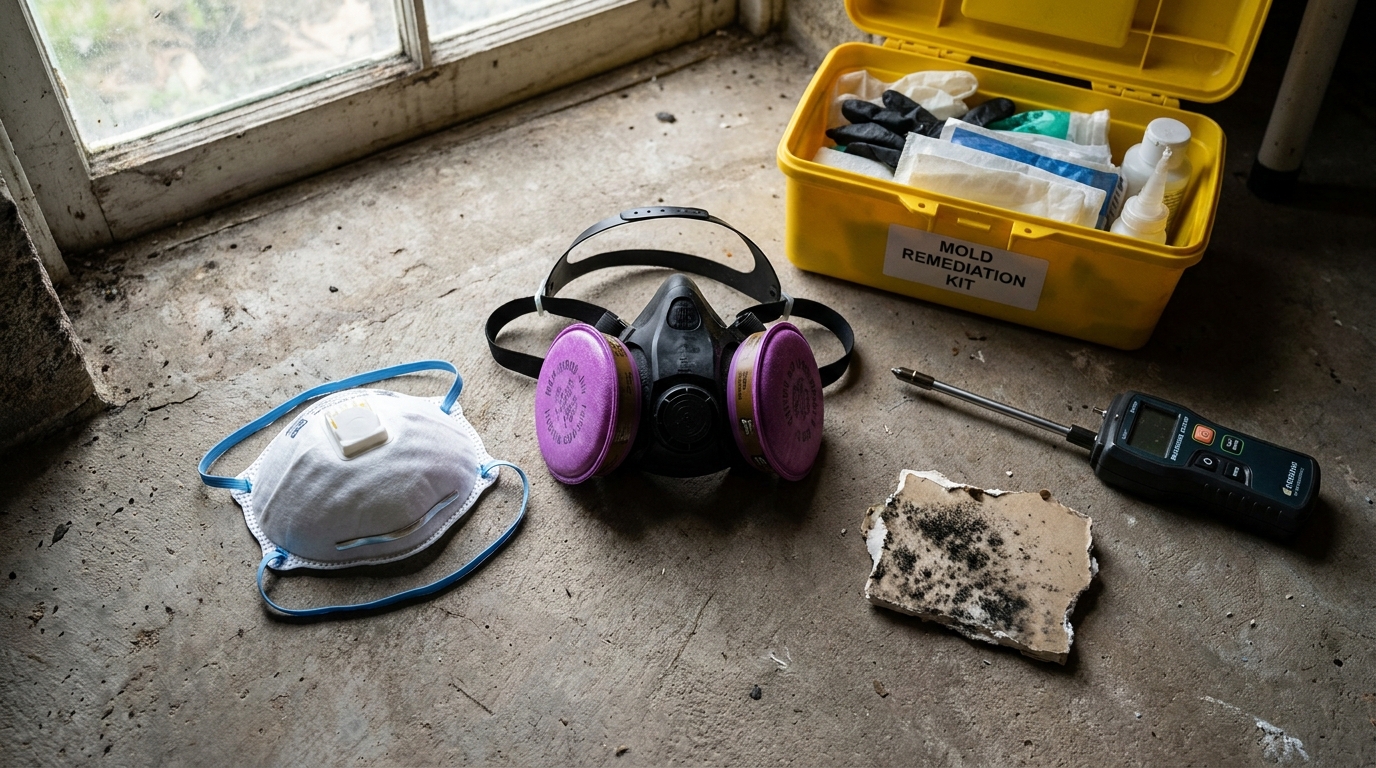
Effective mold masks must filter particles down to 0.3 microns, achieve a proper facial seal, and carry a NIOSH N95, P100, or equivalent rating.
Finding the best mask for black mold starts with understanding what you’re actually breathing in. Black mold spores, specifically Stachybotrys chartarum, range from roughly 1 to 30 microns in diameter. According to Wellwhisk, these spores are well above the 0.3-micron test particle that NIOSH uses for certification, meaning any properly fitted, NIOSH-approved respirator will physically capture them. The real danger isn’t that spores slip through the filter media. It’s that air leaks around the edges of a poorly sealed mask, carrying spores directly into your lungs.
Mold Spore Size and Filtration Requirements
NIOSH tests respirators against particles at 0.3 microns, the hardest size to capture due to physics (too small for impaction, too large for diffusion). Since mold spores are 3 to 100 times larger than this test particle, filtration efficiency for spores is actually higher than the rated percentage. According to Harmony Lab & Safety Supplies, N95 masks filter at least 95% of particles at 0.3 microns, while P100 filters capture 99.97%, essentially HEPA-grade performance. For mold spores specifically, both ratings perform even better than their label suggests.
NIOSH Ratings Explained: N95, N99, P95, P100
The letter indicates oil resistance: “N” means not oil-resistant, “R” means somewhat resistant, and “P” means oil-proof. The number is the minimum filtration percentage. For mold remediation involving bleach, biocides, or mold-inhibiting sprays, the “P” designation matters. According to Wellwhisk, N95 filters can degrade rapidly when exposed to oil-based cleaning agents, while P100 filters maintain their 99.97% filtration in those environments. Construction Informer notes that the EPA recommends N95 as the minimum for mold work, with P95 and P100 options for more severe hazards. Harmony Lab & Safety Supplies confirms this tiered approach.
Why Cloth Masks and Surgical Masks Don’t Work
Cloth and surgical masks are designed for droplet control, not fine particulate filtration. According to Harmony Lab & Safety Supplies, these masks have low, unspecified filtration efficiency and are classified as inadequate for mold spores. They don’t seal to the face, they aren’t NIOSH-certified, and they provide no reliable protection during any mold disturbance activity. A bandana or dust mask from the hardware store falls into the same category. If it doesn’t have a NIOSH approval number printed on it, don’t use it for mold work.
Do You Need N95 or P100 for Black Mold?
N95 masks filter 95% of particles and suffice for light mold inspection. P100 respirators filter 99.97% and are recommended for active remediation or heavy contamination.
The gap between these two ratings is larger than it appears. According to MoldActionPlan, P100 allows roughly 150 times less particle penetration than N95 under ideal test conditions, letting through just 0.03% of particles compared to 5%. That difference matters when you’re scraping drywall in a confined crawlspace for hours.
When N95 Protection Is Sufficient
For small, brief cleanups under 10 square feet, a NIOSH-approved N95 meets EPA and OSHA-aligned minimum guidance. According to Apollo Safety, N95 masks are suitable for light inspections and minor cleanups, and homeowners should discard them after use. Think of tasks like checking behind a bathroom vanity or wiping a small patch of surface mold with detergent. If you can see the entire affected area and it fits within a 3-by-3-foot square, N95 is generally acceptable.
When to Upgrade to P100
Once the affected area exceeds 10 square feet, or you’re disturbing materials like drywall, insulation, or ceiling tiles, P100 becomes the appropriate choice. According to a 3M technical bulletin for professional mold remediators, areas over 100 square feet call for full-facepiece respirators with 100-level filters (N100, R100, or P100). For areas between 10 and 100 square feet, half-mask respirators with particulate filters are recommended. If you’re using bleach or chemical biocides, the oil-proof “P” rating provides an additional margin of safety.
What Professional Remediators Use
Professional mold remediation crews almost universally work with P100 half-face or full-face respirators. According to Harmony Lab & Safety Supplies, for heavy black mold remediation, a P100 or full-face respirator is preferred. Many professionals also add organic vapor cartridges to address VOCs produced by mold growth and the chemicals used to treat it. If you’re hiring a crew, verify they’re wearing at minimum P100-rated protection. For more on what professional remediation involves and costs, we’ve covered that separately.
3M 8511 N95 Respirator: Best for Light Mold Inspection
The 3M 8511 offers NIOSH N95 filtration with a Cool Flow valve, suitable for brief mold inspections or low-exposure tasks under one hour.
According to the 3M 8511 spec sheet, this respirator meets 42 CFR 84 N95 requirements and carries an Assigned Protection Factor (APF) of 10 under OSHA, meaning it’s rated for environments up to 10 times the permissible exposure limit. 3M explicitly states the 8511 “can also help reduce inhalation exposures to certain airborne biological particles (examples: mold, Bacillus anthracis, Mycobacterium tuberculosis)” but “cannot eliminate the risk of contracting infection, illness or disease.”
Filtration Performance and Fit
The 8511 filters a minimum of 95% of solid and liquid aerosols that do not contain oil. It features an adjustable M-noseclip and braided headband straps for a customizable seal. The 3M technical bulletin for mold remediators specifically lists the 8511 as an acceptable N95 option for mold-affected areas under 100 square feet. [Source: 3M Technical Bulletin]
Comfort and Breathability
3M reports the atmosphere inside a respirator with the Cool Flow valve is on average 7.5°F cooler than a comparable non-valved product. [Source: 3M] That temperature difference matters in attics, basements, and bathrooms where humidity is already high.
Limitations and When to Avoid
The 8511 is not oil-resistant, so it’s a poor choice when using oil-based cleaning agents or mold-inhibiting sprays. It’s disposable, intended for single use, and offers no eye protection. For anything beyond a quick visual inspection of a small area, step up to a P100 respirator.
3M 6502QL Half-Facepiece with P100 Filters: Best for Active Remediation
The 3M 6502QL reusable half-mask with 60923 OV/AG/P100 filters provides 99.97% filtration, replaceable cartridges, and a secure silicone seal for multi-hour mold cleanup.
According to 3M’s product page, this combination is specifically engineered and labeled for “professional removal of mold and lead-based paints, sprays from coatings, sealants, and adhesives.” The 60923 cartridges provide P100 particulate filtration plus organic vapor and acid gas protection, addressing both spores and the chemical fumes from bleach or biocides.
Why P100 Matters for Remediation
When you’re tearing out moldy drywall or scrubbing ceiling joists, spore counts in the air spike dramatically. The 99.97% filtration of P100 provides the highest level of air-purifying protection available in a half-mask format. The oil-proof rating means the filters won’t degrade when you’re working around cleaning chemicals. For homeowners tackling black mold removal in areas between 10 and 100 square feet, this is the appropriate protection level.
Reusability and Long-Term Cost
The 6502QL facepiece itself lasts for years with proper cleaning. Replacement 60923 cartridge pairs typically cost $12 to $18 and last through multiple remediation sessions. Over a multi-day project, the cost per use drops well below disposable N95s. The Quick Latch mechanism lets you drop the facepiece away from your face without removing the headband, useful for quick water breaks.
Fit Testing and Seal Check
The silicone facepiece conforms to facial contours better than rigid disposable masks. Before each use, perform a positive and negative pressure seal check (covered in detail below). The 6502QL comes in small, medium, and large sizes. Choosing the wrong size negates the filtration advantage entirely.
Honeywell RU8500 N95 Disposable: Best Budget Option
Honeywell RU8500 N95 masks cost under $2 per unit, meet NIOSH standards, and work for single-use mold inspections but lack exhalation valves.
Performance vs. Price
According to Apollo Safety, N95 masks filter 95% of particles at 0.3 microns, capturing most mold spores, and are suitable for light inspections and minor cleanups. The RU8500 delivers this baseline protection at a fraction of the cost of valved alternatives. For homeowners who need a mask for a single inspection visit, the economics make sense.
When Disposable Makes Sense
If you’re checking a suspected mold spot behind a washing machine or peeking into a crawlspace for five minutes, a disposable N95 is practical. Use it once, dispose of it, and move on. There’s no cleaning, no filter replacement, and no storage to worry about.
Drawbacks Compared to Valved Models
Without an exhalation valve, heat and moisture build up inside the mask quickly. Breathing resistance is noticeably higher during physical activity. For anything beyond a brief, passive inspection, the discomfort encourages users to adjust or remove the mask, which defeats the purpose entirely.
GVS Elipse P100 Half-Mask: Best for Extended Wear
The GVS Elipse P100 weighs approximately 130 grams with filters installed, features low-profile P100 filters, and offers superior comfort for remediation projects lasting multiple hours or days.
According to MoldActionPlan, the Elipse weighs less than half of many competing half-face respirators, reducing neck fatigue during overhead work in attics and ceilings. Wirecutter (NYT) describes the Elipse P100 as “exceptionally comfortable even when worn all day,” noting testers could wear it for hours doing hard work without feeling smothered.
Lightweight Design and Comfort
The hypoallergenic thermoplastic elastomer facepiece stays flexible even in cold conditions. According to MoldActionPlan, users consistently report no face markings or creases after hours of wear, suggesting lower pressure points compared with larger rigid masks. The low-profile filter design sits close to the face, reducing snagging in tight spaces like crawlspaces and between rafters.
Filter Replacement Schedule
GVS states filters should be replaced when breathing resistance increases noticeably. Industry practitioners typically recommend changing P100 filters after approximately 40 hours of use or when visibly soiled. The integrated filter design means you replace the entire filter housing rather than individual cartridges.
Compatibility with Safety Glasses
The compact profile leaves more clearance for safety glasses or goggles than bulkier half-masks. During mold remediation, eye protection is important since spores can irritate eyes on contact. The Elipse’s low-profile design reduces the interference between respirator and eyewear that causes fogging and discomfort.
Moldex 2300 N95: Best for Glasses Wearers
The Moldex 2300 N95 includes a foam nose cushion and adjustable straps that reduce fogging for eyeglass wearers during mold inspection.
According to the Moldex 2300 data sheet, this is a NIOSH-approved N95 filtering facepiece respirator under 42 CFR 84, featuring a built-in exhalation valve and metal-free molded cup design. The manufacturer markets it for dust, mold, and other particulates.
Anti-Fog Features
The exhalation valve directs warm, moist breath downward rather than upward across lenses. The foam nose cushion creates a tighter seal at the bridge, which is the primary leak point that causes fogging. A clinical study published in PMC found that eyeglass fogging had only 71% sensitivity and 46% specificity for predicting a failed N95 fit test, meaning fogging alone isn’t a reliable indicator of poor seal. Still, reducing fog improves comfort and discourages mask removal.
Fit for Different Face Shapes
The Moldex 2300’s cup shape and adjustable straps accommodate a wider range of face shapes than flat-fold designs. The metal-free construction avoids the pressure points that rigid nose clips can create on the bridge of the nose, particularly relevant for glasses wearers who already have frames pressing on that area.
Durability for Multiple Uses
While classified as disposable, the rigid cup shape holds up better than flat-fold N95s across a few uses. Industry practitioners typically suggest disposable N95s can be reused 3 to 5 times if not visibly soiled and if elastic straps remain intact. Store between uses in a breathable paper bag, not a sealed plastic bag where moisture can accumulate.
How Do These Masks Compare Side by Side?
Comparison scores reflect filtration level, comfort, reusability, cost per use, and suitability for different mold exposure scenarios.
| Model | NIOSH Rating | Filtration % | Reusable | Approx. Cost per Use | Best For | Score (/10) |
|---|---|---|---|---|---|---|
| 3M 8511 | N95 | ≥95% | No | $2–$3 | Light inspection (<10 sq ft) | 7.5 |
| 3M 6502QL + 60923 | OV/AG/P100 | ≥99.97% | Yes | $1–$2 (after initial purchase) | Active remediation (10–100 sq ft) | 9.5 |
| Honeywell RU8500 | N95 | ≥95% | No | Under $2 | Budget single-use inspection | 6.5 |
| GVS Elipse P100 | P100 | ≥99.97% | Yes | $1–$2 (after initial purchase) | Extended wear, multi-day projects | 9.0 |
| Moldex 2300 | N95 | ≥95% | No | $2–$3 | Glasses wearers, light inspection | 7.0 |
How Did We Evaluate These Masks?
Masks were scored on NIOSH certification, filtration efficiency, seal integrity, breathability during physical work, cost per use, and user fit reports.
Filtration Efficiency (30% Weight)
P100 masks received full marks. N95 masks received proportional credit. According to Harmony Lab & Safety Supplies, the New York State Department of Health rates N95 masks 95% effective against mold spores and dust during mold work, while P100 achieves 99.97%.
Seal and Fit (25% Weight)
Reusable silicone and elastomer facepieces scored higher than disposable masks because they conform better to facial contours. No mask protects if it doesn’t seal. Fit testing is non-negotiable.
Comfort and Breathability (20% Weight)
Valved masks and lightweight designs scored higher. The GVS Elipse’s 130-gram weight and the 3M 8511’s Cool Flow valve (7.5°F cooler internal temperature) earned top marks in this category.
Cost and Reusability (15% Weight)
Reusable respirators cost more upfront ($25 to $40 for the facepiece, plus $12 to $18 per cartridge pair) but drop below $2 per use within a few sessions. Disposable N95s cost $2 to $3 each with no reuse potential beyond a handful of wears.
Real-World User Feedback (10% Weight)
We reviewed user reports on fit across different face shapes, durability of straps and valves, and ease of performing seal checks. Products with consistent complaints about strap breakage or poor nose-bridge sealing were penalized.
Which Mask Should You Choose?
For brief inspections, use N95 disposables. For active cleanup, invest in a P100 half-mask respirator. For professional-grade remediation, P100 is non-negotiable.
Best for Quick Inspections
The 3M 8511 N95 handles short visual inspections of small areas. If you’re checking behind drywall or looking at a suspect stain for a few minutes, this is adequate and affordable.
Best for DIY Remediation
The 3M 6502QL with 60923 P100 cartridges is the strongest overall pick. It filters 99.97% of particles, handles chemical vapors from cleaning agents, and pays for itself over multiple uses. The GVS Elipse P100 is an equally strong alternative if comfort during long sessions is the priority.
Best for Professional Use
Professional remediators should use P100 half-face respirators at minimum, upgrading to full-face respirators with P100 filters for areas exceeding 100 square feet. According to the 3M technical bulletin, full-facepiece respirators with 100-level filters are recommended for large-area remediation.
What to Avoid
Cloth masks, surgical masks, and unrated dust masks from the hardware store. If the packaging doesn’t show a NIOSH approval number (TC-84A-XXXX format), it’s not a respirator. Also avoid any mask that doesn’t seal to your face, regardless of its rating.
How Do You Fit Test Your Mold Mask?
Perform a positive pressure check by exhaling sharply with hands covering the mask. If air leaks at the edges, adjust straps or try a different size.
Positive Pressure Seal Check
Put the mask on and tighten the straps. Cover the exhalation valve (or the entire front of a non-valved mask) with your hands. Exhale gently. The mask should puff out slightly and hold pressure for a few seconds. If you feel air escaping around the nose bridge or cheeks, readjust. If it still leaks, you need a different size or model.
Negative Pressure Seal Check
Cover the filter cartridges or the entire surface of a disposable mask with your hands. Inhale sharply. The mask should collapse slightly against your face and stay there. If you feel air pulling in around the edges, the seal has failed. This check is particularly important for reusable half-masks where cartridges may not be seated correctly.
When to Replace or Adjust
Replace disposable masks when straps lose elasticity, the nose clip no longer holds its shape, or the mask is visibly soiled. For reusable respirators, replace cartridges when breathing resistance increases noticeably. Industry practitioners typically recommend replacing P100 filters after approximately 40 hours of cumulative use.
Do Masks Expire or Lose Effectiveness?
Disposable N95 masks typically expire after 5 years if stored properly. P100 filters should be replaced after approximately 40 hours of use or when breathing resistance increases.
Check the expiration date printed on the packaging or individual mask. Expired masks may have degraded elastic straps or compromised filter media. Store unused masks in their original packaging, away from direct sunlight, moisture, and extreme temperatures. Once a disposable mask has been worn, its effective lifespan drops significantly. Reusable facepieces themselves don’t expire in the same way, but silicone and elastomer components should be inspected for cracking or hardening before each use.
Can You Reuse Disposable Mold Masks?
Disposable N95 masks can be reused 3 to 5 times if not visibly soiled, stored in a breathable bag between uses, and the elastic straps remain intact.
Between uses, place the mask in a clean paper bag, not a sealed plastic bag where trapped moisture encourages bacterial growth. Inspect the mask before each reuse: check for visible contamination, strap stretch, and nose clip integrity. If the mask was used during heavy mold disturbance (scraping, sanding, demolition), discard it after a single use. The filter media may appear clean while being saturated with fine particles that increase breathing resistance and reduce filtration efficiency.
What About Full-Face Respirators?
Full-face respirators with P100 filters add eye protection and are recommended for extensive remediation over 100 square feet or when mold contamination is severe.
According to the 3M technical bulletin, areas exceeding 100 square feet call for full-facepiece respirators with 100-level filters. Full-face models protect eyes from airborne spores and chemical splashes simultaneously, eliminating the need for separate safety goggles. They also provide a better seal because the facepiece contacts a larger area of skin. The trade-off is higher cost ($150 to $300 for the facepiece), increased weight, and more restricted peripheral vision. For most homeowners dealing with areas under 100 square feet, a half-mask P100 respirator paired with sealed safety goggles provides equivalent protection at lower cost.
Before starting any mold cleanup, ensure your mask fits properly and meets the appropriate NIOSH rating for your exposure level. If you’re dealing with mold growth larger than 10 square feet, consult a certified mold remediation professional.
Frequently Asked Questions
Common questions about mask ratings, fit, reusability, and when to upgrade from N95 to P100 for black mold exposure.
Is an N95 mask enough for black mold?
For small areas under 10 square feet and brief exposure, a properly fitted N95 meets EPA and OSHA-aligned minimum guidance. For larger areas, longer exposure, or active material disturbance, upgrade to a P100 respirator. According to Harmony Lab & Safety Supplies, P100 or full-face respirators are preferred for heavy black mold remediation.
What’s the difference between N95 and P100 for mold?
N95 filters 95% of airborne particles at 0.3 microns and is not oil-resistant. P100 filters 99.97% and is oil-proof. According to MoldActionPlan, P100 allows roughly 150 times less particle penetration than N95, which matters significantly during extended remediation work.
Can I use a surgical mask or cloth mask for mold cleanup?
No. According to Harmony Lab & Safety Supplies, cloth and surgical masks have low, unspecified filtration efficiency and are not designed for fine particulates like mold spores. They do not seal to the face and provide no reliable respiratory protection during mold work.
How do I know if my mask fits correctly?
Perform a positive pressure check (exhale with the valve covered; the mask should hold pressure) and a negative pressure check (inhale with filters covered; the mask should collapse inward). If air leaks at the edges during either test, adjust the straps or try a different size.
How often should I replace P100 filters?
Industry practitioners typically recommend replacing P100 filters after approximately 40 hours of cumulative use or when breathing resistance noticeably increases. Filters exposed to heavy contamination, moisture, or chemical sprays may need earlier replacement.
Are reusable respirators worth the higher upfront cost?
Yes, for any project lasting more than a single session. A reusable half-mask like the 3M 6502QL costs $25 to $40 for the facepiece, and replacement cartridge pairs run $12 to $18. After a few uses, the cost per session drops below that of disposable N95s, while providing significantly better filtration and seal.
Do I need eye protection in addition to a respirator for mold?
Yes. Half-mask respirators don’t cover the eyes, and mold spores can cause eye irritation. Wear sealed safety goggles or upgrade to a full-face respirator. According to the 3M technical bulletin, goggles are recommended alongside half-mask respirators for mold work in areas under 100 square feet.
Where can I verify a mask’s NIOSH approval?
Look for the NIOSH approval number on the mask itself, typically in TC-84A-XXXX format. You can verify this number on the NIOSH Certified Equipment List (CEL) at the CDC website. If a mask doesn’t display this number, it hasn’t passed NIOSH testing and shouldn’t be used for mold protection.