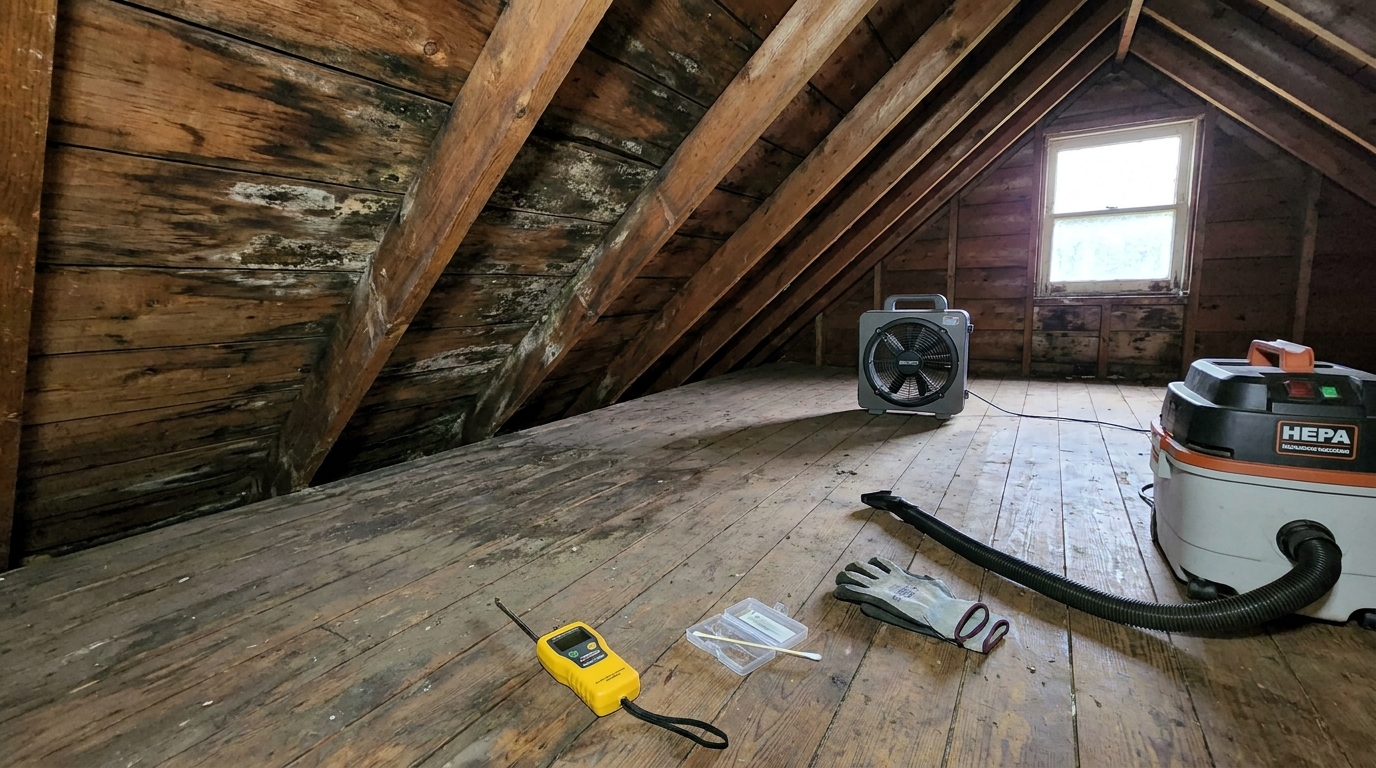
What Does Mold in Attic Look Like?
Attic mold appears as black, gray, white, or brown patches on wood sheathing, rafters, or insulation, often with a fuzzy or powdery texture and a persistent musty odor.
Many homeowners discover mold in attic spaces only during a home inspection, renovation, or when a musty smell becomes impossible to ignore. The tricky part is that attic mold doesn’t always look like the dramatic black patches people expect. It can be subtle, and distinguishing it from dirt, water stains, or natural wood discoloration takes a closer look.
Black or dark gray mold on roof sheathing
The most recognizable form of attic mold is dark discoloration on the underside of roof sheathing (the plywood or OSB panels beneath your shingles). These patches often start near the ridge or along areas where ventilation is weakest. The discoloration may look like soot or dark staining, but if it has a slightly fuzzy texture or the wood feels soft to the touch, mold is the likely culprit. Most dark attic mold is Aspergillus or Cladosporium, not the Stachybotrys (“black mold”) that dominates headlines. All mold types should be addressed, but homeowners shouldn’t panic into assuming the worst species.
White or light-colored mold on wood surfaces
White or light gray mold on rafters and sheathing is common and easy to miss because it blends with the wood grain. It often has a powdery or cottony appearance. This type frequently shows up in cooler, damp areas of the attic where condensation collects but doesn’t fully dry.
Mold on attic insulation
Fiberglass batts and blown-in cellulose can both harbor mold. Look for dark staining on the paper backing of fiberglass batts or clumping and discoloration in loose-fill insulation. Moldy insulation typically loses its thermal effectiveness and usually needs replacement rather than cleaning. According to RestoPros, attic insulation becomes saturated and loses effectiveness as mold grows.
Frost patterns that turn to mold
In cold climates, look for white frost on the underside of roof sheathing during winter. This frost forms when warm, moist air from the living space condenses and freezes on cold wood. When temperatures rise, the frost melts, soaking the sheathing and creating ideal conditions for mold growth. Rusty nail tips poking through the sheathing are another telltale sign: they indicate repeated condensation cycles even when frost isn’t visible.
How Common Is Mold in Attics?
Attic mold is far more prevalent than most homeowners realize, with studies showing high incidence rates in certain climates and building types.
There’s a widespread belief that attic mold only happens after a catastrophic roof leak. The data tells a different story. Surveys in the Gothenburg region of Sweden found that 60 to 80% of single-family houses showed significant mold growth in their attics. [Source: BC Housing] Research on recently constructed, code-compliant buildings in coastal British Columbia found similarly high incidences of mold on attic sheathing. [Source: BC Housing]
Looking at indoor mold more broadly, a population-weighted analysis of U.S. residential buildings found that approximately 47% of homes show indicators of dampness or indoor mold. [Source: Truth About Mold] A separate U.S. study of 831 homes from 75 locations reported that 24% had moisture or mold problems. [Source: Truth About Mold]
| Study / Source | Scope | Mold / Dampness Prevalence |
|---|---|---|
| Gothenburg, Sweden attic surveys | Single-family homes, cool marine climate | 60–80% |
| U.S. population-weighted average | All residential buildings | ~47% |
| U.S. 831-home study (75 locations) | Nationwide sample | 24% |
| Coastal British Columbia | New, code-compliant homes | ”High incidence” (not quantified) |
The takeaway: attic mold isn’t rare. In cool, humid climates with ventilated cold-roof assemblies, it may affect the majority of homes.
What Causes Mold to Grow in Attics?
Attic mold grows when moisture from roof leaks, condensation, or indoor humidity meets organic materials like wood sheathing in poorly ventilated spaces.
Multiple restoration and building science sources rank insufficient ventilation and condensation as the leading drivers of attic mold, sometimes ahead of visible roof leaks. [Source: MoldSci]
Roof leaks and ice dams
Even a small, slow leak around flashing, valleys, or plumbing stacks can wet insulation and sheathing enough to sustain mold growth for months. In cold climates, ice dams form when heat escaping through the roof melts snow that refreezes at the eaves, forcing water under shingles and into the attic.
Condensation from temperature differences
One engineering source found that condensation on the underside of wood sheathing is the moisture source in most attic mold claims, not a visible roof leak. [Source: MoldSci] Warm, humid air from the living space rises through gaps around light fixtures, plumbing penetrations, and attic hatches. When it hits the cold roof deck, it condenses, soaking the wood.
Bathroom and kitchen exhaust vented into attic
This is one of the most common and easily preventable causes. Bath fans, kitchen range hoods, and dryer vents that terminate inside the attic rather than through the roof or soffit dump moisture-laden air directly onto cold surfaces. Building codes require these ducts to exhaust outdoors, but older homes and sloppy installations frequently violate this rule.
Insufficient attic ventilation
Building codes typically require a ventilation ratio of 1:150 (one square foot of net free ventilation area per 150 square feet of attic floor) or 1:300 when a vapor barrier is present and intake/exhaust vents are balanced. Many homes fall short, trapping humid air that has no way to escape.
Blocked soffit or ridge vents
Even homes with adequate vent openings can develop mold if insulation is pushed against the soffits, blocking airflow. Improperly installed baffles, paint-sealed vents, or debris buildup can all reduce effective ventilation to near zero.
Is Mold in the Attic Dangerous?
Attic mold poses health risks if spores enter living spaces through air leaks, but isolated attic growth with proper air sealing typically results in minimal direct exposure.
Homeowners often jump to worst-case scenarios when they hear “attic mold.” The reality is more nuanced. The danger depends on whether spores are migrating into the living space, the volume of mold present, and the health of the occupants.
When attic mold affects indoor air quality
Mold spores and fragments become airborne and can enter living areas via the stack effect (warm air rising and pulling attic air downward through gaps), HVAC returns located near ceiling penetrations, or during activities like opening the attic hatch. Homes with significant air leaks between the attic and living space are at higher risk of spore infiltration.
Health symptoms linked to attic mold
According to the CDC, common symptoms of indoor mold exposure include stuffy nose, sore throat, coughing or wheezing, burning eyes, and skin rash. People with asthma or mold allergies may experience more severe reactions, including asthma attacks. Immunocompromised individuals and those with chronic lung disease can develop lung infections from mold exposure. [Source: CDC]
The 2004 Institute of Medicine report found sufficient evidence linking indoor mold exposure to upper respiratory tract symptoms in otherwise healthy people. [Source: CDC] Subsequent studies suggest early mold exposure may increase the risk of developing asthma in genetically susceptible children. Anyone experiencing persistent respiratory symptoms should consult a physician, especially if symptoms improve when away from home.
Structural damage from prolonged mold growth
Beyond health, mold feeds on wood fibers and gradually weakens roof sheathing, joists, and trusses. [Source: RestoPros] Left unchecked for years, this deterioration can compromise structural integrity and lead to costly repairs well beyond simple mold removal.
How Do You Inspect an Attic for Mold?
Inspect for attic mold by examining roof sheathing, rafters, and insulation with a flashlight on a dry day, checking for discoloration, musty odor, and moisture sources.
What to look for during visual inspection
A thorough attic mold inspection covers several key areas:
-
Roof sheathing underside: Scan for dark patches, white powdery growth, or water stains. Pay extra attention near the ridge, valleys, and around penetrations (vents, chimneys, plumbing stacks).
-
Rafters and trusses: Check for discoloration or soft spots in the wood.
-
Insulation: Look for staining, clumping, or compressed areas that suggest past water intrusion.
-
Nail tips: Rusty or wet nail tips indicate condensation issues.
-
Exhaust ducts: Verify that all bathroom, kitchen, and dryer vents terminate outside the attic, not into it.
-
Soffit areas: Confirm insulation baffles are in place and airflow isn’t blocked.
When to hire a professional mold inspector
Consider a certified mold inspector or industrial hygienist if the affected area is large, if you can’t identify the moisture source, if occupants have unexplained health symptoms, or if the home is involved in a real estate transaction. A professional can take air and surface samples, use moisture meters to map hidden dampness, and provide a written report useful for remediation planning or negotiations.
Testing vs. visual identification
The EPA’s general guidance is that if you can see or smell mold, you should address it regardless of the species. Testing identifies the mold type but doesn’t change the fundamental response: fix the moisture source and remove the mold. Testing becomes more valuable during real estate transactions, insurance claims, or when occupants have health concerns that require documentation. For a deeper look at identifying different mold types, see our guide on black mold vs. regular mold.
Can You Remove Attic Mold Yourself?
DIY attic mold removal is feasible for small areas under 10 square feet with proper PPE and containment, but larger growth or structural damage requires professionals.
When DIY is appropriate
Homeowners can typically handle attic mold removal themselves when the affected area is smaller than about 10 square feet (roughly a 3×3-foot patch), the mold is on hard surfaces like wood (not deeply embedded in insulation or drywall), there’s no structural damage, and the moisture source has already been identified and fixed. [Source: PuroClean]
Safety equipment and containment needed
-
N95 respirator (minimum) or half-face respirator with P100 filters
-
Safety goggles without ventilation holes
-
Disposable gloves extending to mid-forearm
-
Disposable coveralls or old clothing you can discard
-
Plastic sheeting to isolate the work area from the attic hatch
-
HEPA-filtered shop vacuum for cleanup
Step-by-step DIY removal process
-
Fix the moisture source first. Removing mold without addressing the cause guarantees it returns.
-
Seal off the work area. Use plastic sheeting and tape to prevent spores from migrating into living spaces through the attic access.
-
Mist the moldy area lightly with water to reduce airborne spore release during scrubbing.
-
Scrub with a mold-specific cleaner or a borax-water solution (1 cup borax per gallon of water). Avoid bleach on porous wood, as it doesn’t penetrate effectively and can add moisture.
-
HEPA-vacuum the area after scrubbing to capture loosened spores and debris.
-
Dry thoroughly. Use fans or a dehumidifier to ensure the wood dries completely.
-
Dispose of contaminated materials (insulation, rags, PPE) in sealed plastic bags.
When to call a professional
Professional remediation is recommended when the mold covers more than 10 square feet, when it has penetrated structural wood (soft, crumbling rafters or sheathing), when the moisture source is unclear, when occupants include immunocompromised individuals, or when the mold is discovered during a real estate transaction requiring documentation. For more on choosing a qualified contractor, see our guide on mold remediation costs and what to expect.
How Much Does Professional Attic Mold Remediation Cost?
Professional attic mold remediation costs $1,000 to $4,000 for most homes, with complex projects reaching $7,000 or more depending on severity and necessary repairs.
According to Angi, attic mold removal runs $1,000 to $4,000, climbing to $7,000 if a major roof leak went undetected. [Source: Palm Building & Design] confirms a similar $1,000 to $4,000 range for most attic-only jobs.
Cost breakdown by project size
| Project Scope | Typical Cost Range | Notes |
|---|---|---|
| Small area (<50 sq ft) | $1,000–$2,500 | Surface mold on sheathing, no structural damage |
| Moderate area (50–150 sq ft) | $2,500–$4,500 | Multiple sections of sheathing, some insulation removal |
| Large or complex job (150+ sq ft) | $4,500–$9,000+ | Extensive contamination, difficult access, structural repairs |
| Severe / whole-attic contamination | $10,000–$20,000+ | Full sheathing replacement, structural repair, insulation replacement |
Additional costs: roof repair, ventilation upgrades, insulation replacement
Remediation alone doesn’t solve the problem. Budget for the underlying cause: roof repairs ($300–$1,500 for minor fixes), ventilation improvements ($200–$600 for additional soffit or ridge vents), bathroom exhaust rerouting ($150–$500 per vent), and insulation replacement ($1,000–$3,000 for a typical attic). These costs add up but are essential to prevent recurrence.
Insurance coverage considerations
Most standard homeowner’s insurance policies cover mold damage only when it results from a “covered peril,” such as a sudden pipe burst or storm damage. Mold from long-term condensation, poor ventilation, or deferred maintenance is typically excluded. Document everything with photos and get a written moisture assessment from a professional to support any claim.
What Happens If You Don’t Remove Attic Mold?
Untreated attic mold spreads to larger areas, weakens wood structure, increases spore infiltration into living spaces, and complicates future home sales or refinancing.
Ignoring attic mold doesn’t make it dormant. It continues to feed on wood and expand as long as moisture is present. According to RestoPros, mold contamination can spread from the attic into wall cavities and crawl spaces, increasing the scope of damage. If damage becomes widespread, remediation and repair costs can exceed $10,000. [Source: RestoPros]
From a health perspective, a 2017 study cited by Healthline found mold in every public building studied, with an average of about 14 mold instances per building, illustrating how pervasive indoor mold exposure can become when left unchecked. [Source: Inch by Inch Inspections] Spores migrate through air leaks, the stack effect, and HVAC pathways, gradually degrading indoor air quality in the living space below.
How Do You Prevent Mold from Returning After Removal?
Prevent attic mold recurrence by fixing moisture sources, ensuring proper ventilation with soffit and ridge vents, sealing air leaks, and maintaining attic humidity below 60%.
Research and industry guidelines consistently show that mold regrowth is almost always due to unresolved leaks, air leaks, or poor ventilation, not inadequate cleaning. [Source: PuroClean]
Improving attic ventilation
Balanced ventilation requires both intake (soffit vents) and exhaust (ridge vents or powered attic ventilators). The standard code ratio is 1:150, meaning one square foot of net free vent area for every 150 square feet of attic floor. With a vapor barrier and balanced intake/exhaust, the ratio relaxes to 1:300. Verify that insulation baffles keep soffit vents clear, and confirm that ridge vents aren’t capped or painted over.
Fixing roof leaks and ice dam prevention
Inspect shingles, flashing, valleys, and penetrations annually. Keep gutters clean so water doesn’t back up under shingles. For ice dam prevention, focus on air sealing and insulation to reduce heat loss through the roof deck, which is the root cause of snow melt and refreeze cycles.
Redirecting bathroom and kitchen exhaust
Every exhaust fan in the home should vent through a dedicated duct that terminates outside the building envelope, either through the roof or a gable wall. Flexible ducts should be as short and straight as possible, with insulation around the duct to prevent condensation inside it.
Air sealing between living space and attic
PuroClean notes that warm indoor air rises and escapes into the attic through gaps around pipes, lights, and wall frames, and recommends sealing these gaps to stop moisture migration. [Source: PuroClean] Use caulk, spray foam, or metal flashing (around heat-producing fixtures) to seal penetrations at the attic floor. The attic hatch itself is often the biggest single air leak and should be weatherstripped and insulated.
Monitoring humidity levels
Place a digital hygrometer or Wi-Fi humidity sensor in the attic. PuroClean recommends keeping humidity below 60%. [Source: PuroClean] Industry practitioners often suggest a more conservative target of 50–55% RH during cool weather. If readings consistently exceed 55–60%, investigate ventilation deficiencies or hidden moisture sources before mold returns.
Does Attic Mold Affect Home Value or Sales?
Attic mold discovered during a home inspection typically requires remediation before closing, can reduce offers significantly, and may delay or kill sales if unaddressed.
The financial impact of attic mold goes well beyond remediation costs. According to research summarized by Angi, a study in The Appraisal Journal reported that up to 50% of bidders walk away once they learn a property has a mold infestation, even when it has been remediated. Those who remain in the deal typically demand significant price reductions. [Source: Angi]
Documented mold can reduce a home’s market value by 10–37%, depending on severity. [Source: Angi] For a $300,000 home, that translates to $30,000–$111,000 in lost value, far exceeding the cost of proactive remediation. Moderate mold issues typically result in 7–15% reductions. [Source: RoofPredict]
Sellers who remediate before listing and provide documentation of the work, the moisture fix, and post-remediation clearance testing are in the strongest negotiating position. Lenders may also require remediation before approving a mortgage, adding another layer of urgency.
If you’ve discovered mold in your attic, start with a thorough inspection to identify the moisture source. For small areas under 10 square feet with no structural damage, DIY removal may be appropriate with proper safety equipment. For larger growth, unknown mold types, or if you’re unsure about the cause, consult a certified mold inspector or remediation professional. Address the underlying moisture problem, whether it’s a roof leak, ventilation issue, or condensation, to prevent recurrence. Document everything with photos for insurance purposes and future home sales.
Frequently Asked Questions
Below are answers to the most common questions homeowners ask after discovering or suspecting mold in their attic.
Is attic mold always black mold (Stachybotrys)?
No. Most attic mold is Aspergillus, Penicillium, or Cladosporium, not Stachybotrys chartarum. Stachybotrys requires prolonged saturation on cellulose-rich materials and is less common on roof sheathing. All mold types should be addressed, but the “black mold” label shouldn’t trigger panic.
Can I just paint over attic mold?
Painting over mold doesn’t kill it or stop it from growing. Encapsulant coatings exist, but they’re designed for use after proper cleaning and only on surfaces where the moisture source has been eliminated. Painting over active mold on wet wood simply hides the problem temporarily.
Does bleach kill mold on attic wood?
Bleach is ineffective on porous surfaces like wood. It kills surface mold but doesn’t penetrate deeply enough to reach the root structure (hyphae) embedded in the wood grain. It also adds moisture. Borax solutions, hydrogen peroxide, or commercial mold-specific cleaners are more effective on wood.
Will attic mold spread to the rest of my house?
It can. Mold spores travel through air leaks, the stack effect, and HVAC pathways. According to RestoPros, mold contamination can spread from the attic into wall cavities and crawl spaces if left untreated. Proper air sealing between the attic and living space significantly reduces this risk.
Should I get mold testing done before remediation?
Testing isn’t always necessary. If you can see mold and identify the moisture source, remediation can proceed without species identification. Testing is most valuable during real estate transactions, insurance claims, or when occupants have health symptoms that need documentation for a physician.
Does homeowner’s insurance cover attic mold removal?
Typically only if the mold resulted from a sudden, covered event like storm damage or a burst pipe. Mold from long-term condensation, poor ventilation, or deferred maintenance is generally excluded. Review your policy’s mold coverage limits, which are often capped at $5,000–$10,000 even when coverage applies.
How long does professional attic mold remediation take?
Most attic remediation projects take one to three days for the mold removal itself. Additional time may be needed for roof repairs, ventilation upgrades, or insulation replacement. Post-remediation clearance testing, if requested, adds another day or two for lab results.
Can attic mold come back after professional remediation?
Yes, if the moisture source isn’t fixed. Remediation removes existing mold, but mold spores are always present in the environment. They’ll recolonize any surface that stays damp long enough. Fixing ventilation, sealing air leaks, and monitoring humidity are the only reliable ways to prevent recurrence.