What Does a Mold Inspector Actually Do in San Diego?
A mold inspector conducts visual assessment, moisture mapping, air and surface sampling, and provides a written report identifying mold species and moisture sources, without performing remediation.
Hiring a mold inspector San Diego homeowners can trust starts with understanding what the job actually involves. Many people assume an inspector simply walks through the house, points at visible mold, and hands over a bill. The reality is far more technical, and the difference between a thorough inspection and a superficial one can mean thousands of dollars in unnecessary remediation or, worse, missed contamination behind walls.
Visual Inspection vs. Laboratory Testing
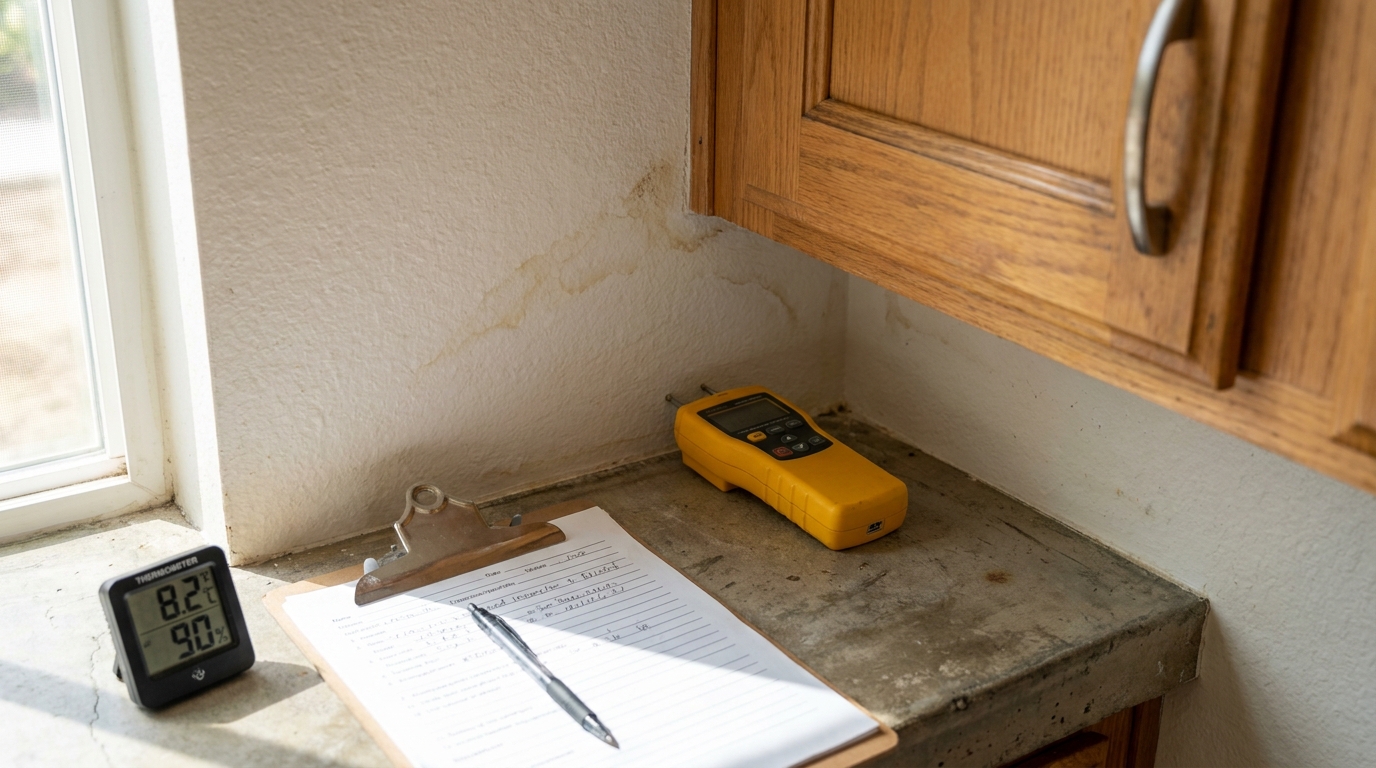
Every credible mold inspection in San Diego begins with a non-invasive visual examination. According to IAC2 Standards of Practice, the inspector should perform a visual examination, measure moisture, temperature, and humidity, and take mold samples according to established sampling procedures. Visual inspection identifies obvious growth, water staining, and structural damage. But it can’t tell you what species you’re dealing with or whether hidden mold is elevating indoor spore counts.
That’s where laboratory testing comes in. San Diego inspectors typically collect three types of samples:
-
Air sampling using spore traps to measure airborne mold spores and compare them to outdoor levels [Source: Rareairenv]
-
Surface sampling via swab or tape-lift from visible or suspect areas like wallboard, trim, and HVAC registers [Source: Rareairenv]
-
Bulk sampling, removing small sections of building materials such as drywall or insulation to evaluate contamination depth [Source: Rareairenv]
Why San Diego Inspectors Focus on Moisture Sources
San Diego averages about 11.5 inches of rain per year, so chronic mold issues typically come from plumbing failures, HVAC condensation, and indoor humidity rather than prolonged rain [Source: Moldcompass]. A qualified inspector uses moisture meters and infrared thermal imaging to trace water intrusion paths that aren’t visible to the naked eye. Without identifying the moisture source, any remediation is temporary.
What’s Included in a Standard Inspection Report
San Diego mold inspectors don’t analyze samples themselves. They work with certified labs specializing in fungal and environmental testing [Source: Rareairenv]. Lab results typically include species identification (genera like Aspergillus, Penicillium, Stachybotrys, Cladosporium), spore counts per cubic meter, and documentation suitable for insurance or legal use. Turnaround times run 24 to 72 hours for full lab results after sample collection [Source: 24hmoldinspection].
What Certifications Should a San Diego Mold Inspector Have?
Look for ACAC, IICRC, or equivalent national certifications, and avoid inspectors who also offer remediation services due to conflict of interest.
Here’s the fact most San Diego homeowners don’t know: according to the Professional Mold Inspection Institute, “There is currently no state license required to become a mold inspector or mold remediator in California” [Source: Moldinspectioninstitute]. That means anyone can advertise mold inspection San Diego services without passing a state exam or meeting minimum training hours.
California State Requirements (CDPH Certification)
Because California lacks a state mold license, voluntary national certifications and related training are the primary way San Diego inspectors demonstrate competence [Source: Moldinspectioninstitute]. Some inspectors reference the California Department of Public Health (CDPH) guidelines for mold assessment, but these are advisory frameworks, not licensing requirements. This gap makes it essential for homeowners to verify credentials independently rather than trusting marketing claims.
National Certifications That Matter (ACAC, IICRC, IAQA)
The certifications that carry weight in the industry include:
-
ACAC (American Council for Accredited Certification): Offers the Council-certified Indoor Environmental Consultant (CIE) and related credentials. These require documented education, field experience, and passing a proctored exam.
-
IICRC (Institute of Inspection, Cleaning and Restoration Certification): The AMRT (Applied Microbial Remediation Technician) certification is widely recognized. The IICRC S520 standard is the industry benchmark for mold remediation protocols.
-
IAQA (Indoor Air Quality Association): Provides continuing education and credentialing for indoor environmental professionals.
Any certified mold inspector San Diego residents hire should be able to provide a certification number you can verify through the issuing organization’s online database.
Red Flags: Dual-Role Inspector-Remediators
The IICRC S520 standard requires the removal company and the verification inspector to be separate entities [Source: Moldremovalsource]. When the same company inspects your home and then offers to fix the problem, they have a direct financial incentive to find more mold or recommend more extensive work. Legitimate mold inspectors charge for their services, typically $200 to $600, whereas “free inspections” are often used as a sales tool for remediation [Source: Moldremovalsource]. If someone offers a free mold inspection, ask yourself what they’re actually selling.
How Much Does Mold Inspection Cost in San Diego?
San Diego mold inspections typically cost $300 to $600 for standard homes, with costs rising when additional samples and lab analysis are required.
Price confusion is one of the biggest barriers for homeowners considering mold testing San Diego services. The range varies significantly based on property size, number of samples, and turnaround speed.
Base Inspection Fees by Property Size
| Service Level | Typical Cost Range | What’s Included |
|---|---|---|
| Basic sampling (2 samples) | $239 | Two air or surface samples, lab fees, written report |
| Standard inspection | $395 | Visual inspection, moisture meter, IR thermal imaging, 2 indoor air samples, 1 outdoor reference, lab fees, next-day results |
| Standard + additional samples | $395 + $75/sample | Everything above plus extra sampling locations |
| Full inspection, larger home | $500–$1,000+ | Comprehensive inspection with multiple sampling points for homes over 2,000 sq ft |
Sources: [SD Mold Inspection] lists the $395 standard package. [Mold Inspections & Lab Tests, Inc] offers the $239 base rate. [A/S General Contracting] reports the $300 to $600 typical range. Pacific Flood Restoration notes full inspections with sampling often total $500 to $1,000+ for larger homes.
Air Sampling and Lab Testing Costs
Additional air samples beyond the base package typically cost $75 per sample [Source: Sdmoldinspection]. Rush turnaround adds to the bill: next-day analysis runs about $25 per sample extra, while same-day analysis costs $50 per sample extra [Source: Sdmoldinspection]. Some providers charge as little as $30 per additional test [Source: Moldinspectionssandiego].
When Insurance Covers Inspection Costs
Homeowners insurance in California typically covers mold damage only when it results from a “covered peril” like a sudden pipe burst, not from long-term neglect or deferred maintenance. Industry practitioners generally advise getting the inspection done first, then submitting the report with your claim. The lab-verified documentation from a qualified inspection, including mold species ID and spore count data, holds up with insurers and attorneys.
Do You Need Air Sampling or Just a Visual Inspection?
Air sampling is necessary when mold is suspected but not visible, after remediation for clearance verification, or for health documentation. Visible mold usually requires only visual inspection and surface samples.
When Visual Inspection Is Sufficient
If you can already see obvious mold, a visual inspection plus moisture investigation is usually the first and most important step [Source: IAC2]. KIC Restoration in San Diego notes that mold testing, including black mold testing, may not be necessary when there is visible mold and clear moisture issues [Source: Kicrestoration]. In these cases, the priority is identifying and fixing the moisture source, not spending money on lab confirmation of something you can already see.
Situations That Require Air Testing
Air sampling becomes valuable in specific scenarios:
-
Musty odors persist but no visible mold is found
-
Multiple rooms may be affected and you need to determine the extent
-
Post-remediation clearance testing is needed to verify the problem is resolved
-
A real estate transaction requires documented indoor air quality data
-
Health symptoms suggest mold exposure but the source is unclear
According to IAC2 Standards of Practice, air sampling may be necessary if mold is suspected but cannot be identified visually, and its purpose is to determine the location and extent of contamination [Source: IAC2].
Understanding Spore Count Results
Spore count results quantify spores per cubic meter of air, allowing comparison to outdoor baselines. At least three samples are usually collected to provide baseline and accurate indoor information, with the outdoor air sample being the most important for comparison. There are no widely accepted federal regulations regarding biological air sampling thresholds, which is why interpretation depends heavily on the inspector’s experience and the specific building conditions. If you’re dealing with health concerns, consult a physician who can correlate lab findings with your symptoms.
What Mold Issues Are Common in San Diego Homes?
San Diego homes frequently develop mold in coastal areas due to marine layer moisture, in older homes with poor ventilation, and in properties with HVAC condensation or irrigation leaks.
Coastal Moisture and Marine Layer Effects
Despite San Diego’s reputation as a dry climate, the marine layer creates persistent humidity along the coast. Local environmental experts recommend keeping indoor relative humidity between 30% and 50% and drying wet materials within 24 to 48 hours to prevent mold colonization [Source: Moldcompass]. Coastal neighborhoods from Imperial Beach to Oceanside see higher ambient moisture that penetrates homes through window and door seal failures, feeding mold growth in wall cavities.
Older Housing Stock and Ventilation Problems
A significant share of mid-century and coastal North County homes in Carlsbad, Oceanside, Encinitas, Vista, Rancho Santa Fe, and San Marcos are built over crawl spaces where chronic dampness fosters mold on wood framing, insulation, and subfloor sheathing [Source: Rareairenv]. Common inspection findings include musty odors stronger near the floor, softness or “bouncy” wood floors, and visible mold on joists and subflooring. Bathrooms in older homes frequently lack exhaust fans or have fans that aren’t vented outdoors, creating consistent humidity that drives mold growth on ceilings, grout, and drywall.
HVAC and Irrigation-Related Growth
HVAC condensation from clogged condensate lines or poorly insulated ductwork is one of the top moisture drivers cited by San Diego mold professionals [Source: Moldcompass]. Hidden plumbing leaks, including pinholes in supply lines, slow drain leaks in walls, and leaks under sinks or behind appliances, are also frequent culprits. Short, intense storms still cause roof edge, window, and patio door leaks that seed mold behind walls and ceilings. For more on addressing water damage before mold takes hold, see our guide on preventing mold after water damage.
How Do You Verify an Inspector’s Credentials?
Verify national certifications through ACAC or IICRC online databases, confirm liability insurance with a certificate of insurance, and check for independence from remediation services.
Checking California State Certification Status
Since California has no state mold license [Source: Moldinspectioninstitute], there’s no state registry to check. This is precisely why independent verification matters more here than in states with licensing requirements. Don’t accept “state certified” as a claim without asking which state certification they mean and how you can verify it.
Verifying National Certifications Online
Both ACAC and IICRC maintain searchable online databases where you can confirm an inspector’s certification status, certification type, and whether it’s current. Ask for the certification number before booking, then verify it yourself. This takes five minutes and eliminates a large percentage of unqualified operators.
Requesting Proof of Insurance and References
Ask for a certificate of insurance that includes professional liability and errors and omissions coverage. A legitimate inspector will provide this without hesitation. Request references from clients with similar concerns to yours, not only real estate transactions. For guidance on what to look for in a remediation company after your inspection, see our resource on mold remediation costs.
What Questions Should You Ask Before Hiring?
Ask about certification type and number, whether they perform remediation, what’s included in the base fee, turnaround time for lab results, and whether they provide moisture mapping.
The strongest screening approach for San Diego homeowners prioritizes no remediation conflict, moisture-detection capability, written reporting, and clear sampling methodology [Source: Moldinspectiontexas]. Here are the specific questions to ask by phone before booking:
-
“Do you also perform mold remediation or cleaning?” If yes, consider a different inspector. The same company should not profit from both finding and fixing the problem.
-
“What certifications do you hold, and can I have the certification number?” California doesn’t have mold-testing licenses, so certifications and continuing education matter more for qualification checks.
-
“What tools do you use for moisture detection?” Expect to hear moisture meter, infrared camera, and possibly a borescope for wall cavities.
-
“What’s included in your base fee, and what costs extra?” Get the total cost in writing before the inspector arrives.
-
“What lab do you use, and is it accredited?” AIHA-accredited labs follow strict quality assurance and proficiency testing protocols.
-
“Will I receive a written report with photos, moisture readings, and recommendations?” A verbal “looks fine” is not enough.
-
“How long is the turnaround for lab results and the final report?” Standard is 3 to 7 business days for the complete report.
-
“Are you insured, including professional liability and errors and omissions?” This protects you if the inspection misses something significant.
What Happens After the Inspection?
You receive a written report within 3 to 7 days identifying mold species, moisture sources, and remediation recommendations. Use this to obtain competitive bids from separate remediation contractors.
Understanding Your Inspection Report
Your report should include species identification, spore counts with indoor-to-outdoor comparisons, moisture readings mapped to specific locations, photographs of problem areas, and clear recommendations. Reports from San Diego inspectors are typically ready within 3 to 5 business days, with rush turnaround available [Source: 24hmoldinspection]. GP Mold Inspection specifies that post-remediation air samples are analyzed by an AIHA-accredited third-party laboratory [Source: Gpmoldinspection].
Getting Remediation Quotes (From Different Companies)
Take your inspection report to at least three remediation contractors who are completely separate from your inspector. The report gives each contractor the same baseline information, which makes their bids directly comparable. Watch for contractors who dismiss the report or insist on their own inspection. That’s often a sign they want to expand the scope of work beyond what’s documented.
When to Request Post-Remediation Clearance Testing
The IICRC S520 standard requires the final step of any legitimate mold removal job to be a clearance test by an independent inspector [Source: Moldremovalsource]. This means your original inspector (or another independent professional) returns after remediation to collect new air and surface samples. These are compared against the pre-remediation baseline and outdoor reference samples. Don’t sign off on remediation as complete until clearance testing confirms spore counts have returned to acceptable levels.
Before hiring, verify your inspector’s national certifications and confirm they don’t offer remediation services. Request a detailed scope of work in writing, including what testing methods will be used and what the final report will contain.
Frequently Asked Questions
San Diego homeowners commonly ask these questions when searching for a qualified mold inspector. Here are direct answers based on industry standards and local market data.
Does California require a license for mold inspectors?
No. According to the Professional Mold Inspection Institute, there is currently no state license required to become a mold inspector or mold remediator in California [Source: Moldinspectioninstitute]. This makes voluntary national certifications from organizations like ACAC and IICRC the primary way to verify competence.
How much does a mold inspection cost in San Diego?
Most professional mold inspections in San Diego cost $300 to $600, depending on property size and testing scope [Source: Asgeneralcontracting]. Basic sampling packages start around $239 [Source: Moldinspectionssandiego], while comprehensive inspections with multiple samples for larger homes can exceed $1,000.
Should the mold inspector also do the remediation?
No. The IICRC S520 industry standard requires the removal company and the verification inspector to be separate [Source: Moldremovalsource]. When one company does both, they have a financial incentive to find more problems and recommend more extensive work.
How long does it take to get mold inspection results?
Lab results typically return within 24 to 72 hours after sample collection [Source: 24hmoldinspection]. The complete written report, including analysis and recommendations, is usually ready within 3 to 5 business days. Rush turnaround is available from most San Diego providers for an additional fee.
Is a “free mold inspection” legitimate?
Generally, no. Legitimate mold inspectors charge for their services, typically $200 to $600. Free inspections are often used as a sales tool by companies that also perform remediation [Source: Moldremovalsource]. The “inspection” becomes a pitch for expensive remediation services.
Do I need air testing if I can already see mold?
Not always. When there is visible mold and clear moisture issues, air testing may not be necessary [Source: Kicrestoration]. A visual inspection with surface sampling and moisture investigation is usually the priority. Air sampling becomes important when mold is suspected but hidden, or when you need documentation for insurance or health purposes.
Why does San Diego get mold if the climate is so dry?
San Diego averages only about 11.5 inches of rain per year, but chronic mold issues come from plumbing failures, HVAC condensation, poor ventilation, and coastal marine layer humidity rather than prolonged rain [Source: Moldcompass]. Indoor moisture sources are the primary driver.
What should I do with the inspection report?
Use the report to obtain competitive remediation bids from at least three contractors who are independent of your inspector. The report provides a documented baseline that makes bids comparable. After remediation is complete, have an independent inspector perform clearance testing to verify the work was successful.