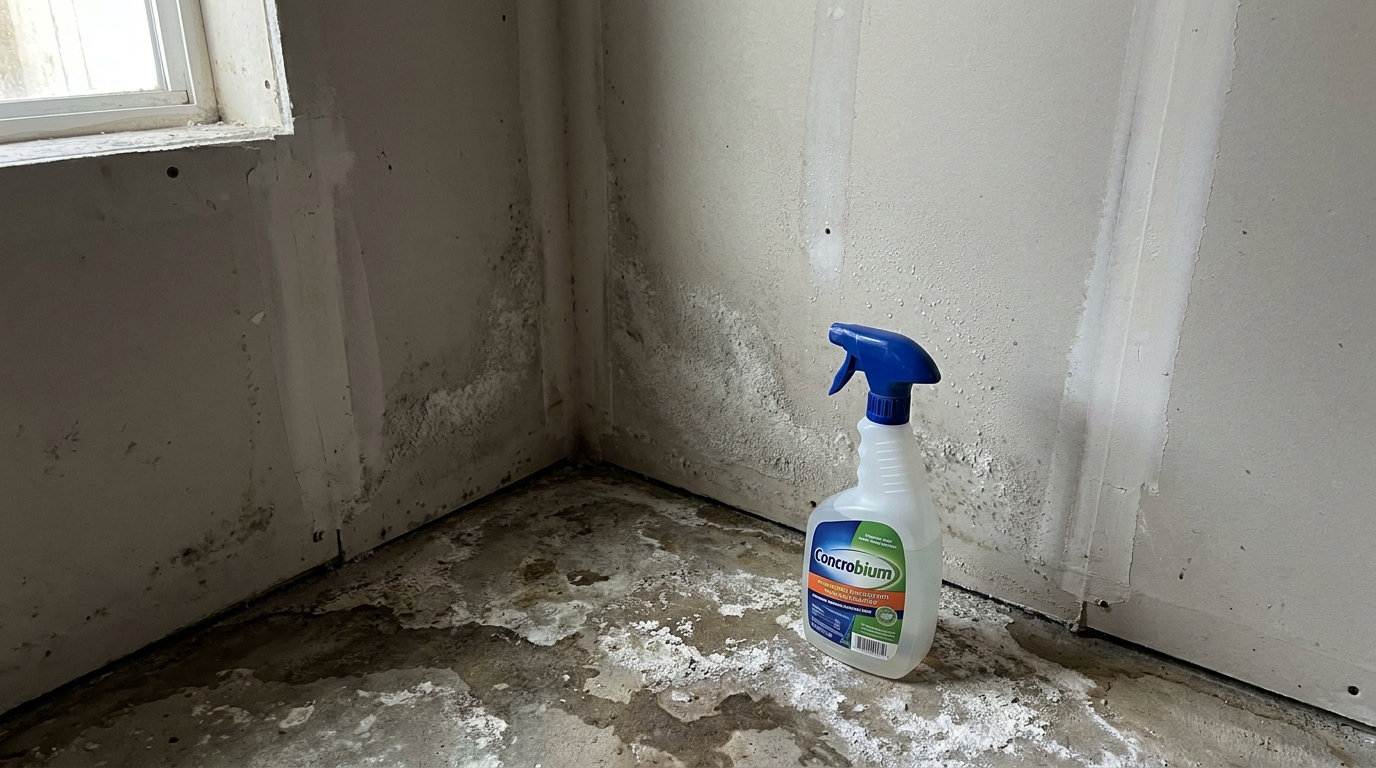
What Is Concrobium Mold Control?
Concrobium Mold Control is a water-based, EPA-registered antimicrobial product that eliminates existing mold, prevents regrowth, and reduces musty odors by forming a tri-salt polymer film on treated surfaces.
Concrobium works differently from bleach-based cleaners. Instead of using chlorine chemistry to oxidize mold on contact, it relies on a mineral salt formulation that physically disrupts mold cell structures as the product dries. This distinction matters for homeowners weighing their options, because the mechanism affects which surfaces respond well, how long treatment takes, and what kind of protection remains afterward.
How Concrobium Works: The Mechanical Crushing Mechanism
When sprayed onto a surface, Concrobium’s liquid solution saturates the mold colony. As the water evaporates, the dissolved salts concentrate and form a thin, hard film. This drying film exerts physical pressure on mold spore cell walls, crushing and disrupting them mechanically. According to Mold Advisor, the product is commonly described as forming a mineral/salt film that suppresses mold and creates a barrier against regrowth.
The key difference from biocides: Concrobium doesn’t rely on a chemical poison to kill mold. It uses physical force at the microscopic level. This is why the product needs to dry completely to work, and why wiping it off before it dries undermines the entire mechanism.
Active Ingredients and What They Do
Concrobium contains three active mineral salts: sodium carbonate (washing soda), sodium bicarbonate (baking soda), and trisodium phosphate. Individually, these are common household and industrial cleaning compounds. Together in Concrobium’s patented formulation, they create the tri-salt polymer that forms the crushing barrier. The manufacturer states the product contains no bleach, ammonia, or volatile organic compounds (VOCs).
EPA Registration Status and What It Means
Concrobium Mold Control holds EPA registration number 82552-1. According to the EPA product label, it is registered to “kill, eliminate 99.9% of” mold, mildew, and fungi. EPA registration means the product’s efficacy claims have been reviewed by a federal agency, not just the manufacturer. That’s a higher bar than many competing products clear, though it doesn’t mean independent field testing matches lab conditions in every scenario.
Does Concrobium Actually Kill Mold?
Yes. EPA labeling supports the claim that Concrobium eliminates 99.9% of mold and mildew under labeled conditions, though real-world results vary by surface type and application method.
The strongest evidence comes directly from the EPA product label, which states Concrobium achieves a greater than 99.9% kill level against common mold species including Aspergillus, Penicillium, and Stachybotrys chartarum (commonly called black mold). According to the Concrobium Technical Specification Sheet, lab testing showed no growth on treated surfaces versus 100% growth on untreated control surfaces.
Lab Test Results: Surface Mold Reduction by Material Type
Lab performance and real-world performance are two different things. The 99.9% figure comes from controlled laboratory conditions. On hard, non-porous surfaces like tile and sealed countertops, Concrobium performs closest to its lab claims. On porous materials like untreated wood and drywall, effectiveness depends on how deeply mold has penetrated the substrate. For a deeper look at drywall-specific performance, see our guide on what actually kills mold on drywall.
Real-World Performance Data from Field Studies
One field report documented airborne mold spores dropping from 70,000 spores/m³ to 2,000 spores/m³ after Concrobium treatment, a 97% reduction. According to MoldGuide’s lab-tested review, this kind of reduction is significant but still leaves residual spore counts above typical outdoor baselines in some climates.
What “Kill” Means vs. What Concrobium Does
Killing mold and removing mold are not the same thing. Concrobium can render mold organisms non-viable, but dead mold can still leave dark discoloration behind. Multiple review sources note that the product does not contain bleach or whitening agents, so staining often remains after treatment. Homeowners expecting visible mold to disappear completely may need a separate stain-removal step.
How Does Concrobium Compare to Bleach for Mold Removal?
Bleach kills surface mold faster but provides no residual protection and performs poorly on porous materials, while Concrobium works slower, leaves a protective barrier, and is safer for indoor use.
This is the comparison most homeowners want. According to MoldGuide’s review, bleach is faster for visible stain removal on non-porous surfaces, while Concrobium is generally better for mold control and regrowth prevention, especially on porous materials like drywall, wood, and grout. Concrobium’s own product documentation states that bleach is “particularly ineffective” on porous materials and that mold may return within weeks after bleach use.
| Factor | Bleach | Concrobium |
|---|---|---|
| Kill speed | Minutes on non-porous surfaces | 4 to 24 hours (must dry fully) |
| Porous surface performance | Poor penetration; often ineffective on drywall and wood | Better suited for porous materials |
| Residual protection | None; mold can return quickly | 7 days on hard surfaces, 28 days on cotton fabrics |
| Stain removal | Strong whitening/bleaching action | Does not remove staining |
| Lab kill claims | Surface-only action on non-porous materials | >99.9% under correct application |
| Fumes/VOCs | Releases chlorine gas; irritates eyes and lungs | No bleach, ammonia, or VOCs |
| Approximate cost per sq ft | $0.01–$0.03 | $0.03–$0.05 |
Kill Speed: Bleach vs. Concrobium Timeline
Bleach works within minutes on non-porous surfaces. Concrobium requires 4 to 24 hours of drying time for the tri-salt film to form and exert its crushing effect. In humid conditions, drying can take 24 to 48 hours. Homeowners who need immediate visible results will find bleach faster, but that speed comes with trade-offs.
Surface Penetration and Porous Material Performance
Bleach’s active ingredient, sodium hypochlorite, cannot effectively penetrate porous materials like drywall, untreated wood, or grout. The water in bleach solution can actually feed mold roots embedded in porous substrates. Concrobium, while still a surface treatment, is more commonly recommended for porous materials because its film-forming mechanism doesn’t introduce the same moisture problem.
Safety Profile: Fumes, Skin Contact, and Indoor Air Quality
Bleach releases chlorine gas, which irritates eyes, skin, and respiratory passages. It should never be mixed with ammonia or other household cleaners. Concrobium contains no bleach, ammonia, or VOCs, making it a safer choice for enclosed spaces, homes with children, or areas with limited ventilation.
Cost Per Square Foot Comparison
Bleach is cheaper per application, typically costing $0.01 to $0.03 per square foot. Concrobium runs approximately $0.03 to $0.05 per square foot when a gallon covers roughly 800 to 1,600 square feet. According to MoldGuide, the cost difference narrows when you factor in bleach’s lack of residual protection and the likelihood of needing repeat applications.
What Surfaces Can You Use Concrobium On?
Concrobium is safe for drywall, wood, concrete, tile, fabric, and most painted surfaces, but performance varies significantly depending on surface porosity.
Best-Performing Surfaces: Where Concrobium Works Well
According to the EPA product label, Concrobium is intended for use on hard non-porous surfaces, wood, wallboard, concrete, and masonry block. It also performs well on cotton fabrics, where the EPA label states it provides residual protection for up to 28 days. Tile, sealed countertops, and painted walls are strong candidates for treatment.
Problem Surfaces: Where Effectiveness Drops
On deeply porous or heavily contaminated materials, Concrobium’s surface-level mechanism has limits. Mold embedded deep within drywall or soft wood may survive treatment because the film cannot reach subsurface growth. Over-application on dark, non-porous surfaces like glass or glazed tile can leave a visible white residue. Homeowners dealing with mold on drywall should review our guide on how to remove mold from drywall to understand when treatment is appropriate versus when replacement is necessary.
Surface Preparation Requirements
For best results, remove loose debris and visible mold growth before applying Concrobium. The product works as a treatment and preventative, not a heavy-duty cleaner. Surfaces should be reasonably clean so the solution can make direct contact with the mold colony and the underlying material.
How Do You Apply Concrobium Mold Control?
Spray Concrobium directly onto moldy surfaces until saturated, allow it to dry completely without wiping for at least 4 to 6 hours, then scrub away dead mold residue with a brush or cloth.
Step-by-Step Application Process
-
Ensure the area is well-ventilated (open windows or run fans).
-
Spray Concrobium evenly over the affected area. Apply a thin, even coat rather than soaking the surface.
-
Allow the product to dry completely. This takes 4 to 24 hours depending on humidity and airflow.
-
Once dry, scrub the surface with a Concrobium-dampened cloth or brush to remove dead mold residue.
-
For prevention, apply a second thin coat and allow it to dry in place without scrubbing.
For larger areas, Concrobium can be applied via fogging, which covers approximately 1,400 square feet per gallon according to the product documentation.
Common Application Mistakes That Reduce Effectiveness
The most common mistake is wiping the product off before it dries. The crushing mechanism only works when the tri-salt film forms completely. Applying too thick a coat can also cause problems, leading to white residue buildup without improving efficacy. In humid environments, failing to improve airflow during drying can extend cure times to 24 to 48 hours, reducing the product’s effectiveness.
Reapplication: When and How Often
Consumer guidance suggests reapplying weekly or when growth or odor reappears. The EPA label states residual protection lasts 7 days on hard non-porous surfaces and untreated wood, and 28 days on cotton fabrics. If mold returns quickly, that’s a signal the underlying moisture problem hasn’t been addressed.
Can Concrobium Prevent Mold Growth?
Concrobium leaves an antimicrobial barrier that inhibits new mold growth for 7 to 28 days depending on the surface, but it cannot prevent mold if moisture problems persist.
How the Protective Barrier Works
After the product dries, the tri-salt film remains on the surface as a physical barrier. According to the EPA product label, Concrobium’s patented technology “prevents mold and mildew growth” on treated surfaces. The barrier works by creating an inhospitable surface for new spore colonization.
Duration of Protection: What Research Shows
The EPA label specifies 7 days of protection on hard non-porous surfaces and untreated wood, and 28 days on cotton fabrics. Lab testing showed no growth on treated surfaces versus 100% growth on untreated control surfaces, according to the Concrobium Technical Specification Sheet. These are controlled-condition results. Real-world protection duration depends on humidity, temperature, and whether the surface gets wet again.
Why Moisture Control Still Matters
No mold treatment product, Concrobium included, can overcome an active water source. If a roof leaks, a pipe drips, or indoor humidity stays above 60%, mold will return regardless of surface treatment. Concrobium’s own reapplication guidance instructs users to “determine and correct the cause of regrowth before reapplication.” Homeowners who suspect hidden moisture should learn how to check for hidden mold before relying on any surface treatment.
What Are the Limitations of Concrobium?
Concrobium cannot remediate mold inside walls or HVAC systems, requires complete drying to work, and is ineffective against active water intrusion or heavily contaminated porous materials.
When Concrobium Isn’t Enough: Hidden Mold and Structural Issues
Concrobium is a surface treatment. Mold growing behind drywall, inside wall cavities, or within HVAC ductwork is beyond its reach. Independent reviews consistently note that the product is not a replacement for professional remediation on large infestations or structural damage. According to Mold Help For You, Concrobium has limited penetration into porous substrates, so mold embedded deep in building materials may remain a problem.
Moisture-Active Environments Where It Fails
The product must dry fully to form its protective barrier. In actively wet environments, such as a basement with ongoing water intrusion or a bathroom with persistent condensation, the film may never form properly. Drying times can extend to 24 to 48 hours in humid conditions, and if the surface gets wet again before the film cures, the treatment is essentially wasted.
Material Replacement vs. Treatment Decisions
Industry practitioners typically recommend replacing rather than treating porous materials with heavy mold contamination. Drywall, insulation, and carpet padding that have been saturated and colonized by mold usually need removal. Concrobium works best as a treatment for surface-level mold on materials that are structurally sound, or as a preventative coating on clean surfaces in mold-prone areas. For context on when professional help makes sense, see our breakdown of professional mold remediation costs.
Is Concrobium Safe to Use Indoors?
Concrobium contains no bleach, ammonia, or VOCs, and independent lab material reports it received the safest toxicity ratings possible in testing.
Toxicity Profile and Safety Data
The product is marketed as non-toxic, and that claim is supported by its EPA registration and safety data. It does not release harmful fumes during application. However, direct eye contact can cause irritation, so safety glasses are a reasonable precaution.
Ventilation Requirements During Application
While Concrobium doesn’t produce chlorine gas or other hazardous fumes, adequate ventilation helps the product dry faster, which is essential for effectiveness. Open windows, run exhaust fans, or use a box fan to improve airflow during and after application.
Pet and Child Safety Considerations
The absence of bleach, ammonia, and VOCs makes Concrobium a more practical choice for households with children and pets compared to chlorine-based products. That said, keep children and animals away from treated surfaces until the product has dried completely. The dried film is inert, but wet product should not be ingested or contacted directly.
How Much Does Concrobium Cost?
Concrobium costs approximately $11 to $14 for a 32 oz spray bottle and $40 to $51 for a one-gallon container at major retailers, working out to roughly $0.03 to $0.05 per square foot.
| Format | Typical Price | Approx. Cost Per Oz |
|---|---|---|
| 32 oz spray bottle | $10.99–$13.97 | $0.34–$0.44/oz |
| 1 gallon (128 oz) | $39.96–$50.90 | $0.31–$0.40/oz |
| 14.1 oz aerosol | $16.99–$20.37 | $1.20–$1.44/oz |
| 5 gallon | $199.99 | ~$0.31/oz |
Pricing data sourced from Home Depot and Amazon listings.
Retail Pricing by Container Size
The 32 oz spray bottle is the most common entry point for homeowners tackling a small mold problem. The gallon jug offers better per-ounce value and makes sense for larger projects or ongoing preventative use. The aerosol format carries a significant premium per ounce but offers convenience for spot treatments in tight spaces.
Cost Per Square Foot by Surface Type
Coverage varies by application method and surface porosity. Spray application on non-porous surfaces yields roughly 800 to 1,600 square feet per gallon. Fogging can cover approximately 1,400 square feet per gallon. Porous surfaces absorb more product, reducing coverage and increasing per-square-foot cost toward the higher end of the $0.03 to $0.05 range.
Where to Buy: Price Comparison Across Retailers
Home Depot consistently offers the lowest price on the 32 oz spray at $10.99. Walmart and Amazon prices run slightly higher at $13.48 to $13.97 for the same size. For gallon containers, Home Depot listings show $39.96 to $41.97, while Walmart lists the same product at $50.90. Buying in bulk (six-packs) can lower the per-unit cost at Home Depot.
What Do Professional Remediators Say About Concrobium?
Most mold professionals view Concrobium as effective for post-remediation surface treatment and small DIY projects, but not as a substitute for professional remediation on large or structural mold problems.
Industry Perspective: When Pros Recommend It
According to Mold Advisor, Concrobium is described as “versatile” and effective on different materials and surfaces. MoldScanner rates it 4.5 out of 5 and calls it the best DIY mold cleaning product for homeowners dealing with small to medium mold problems on hard surfaces. Consumer review data supports this: Lowe’s listings show ratings around 4.1 to 4.3 out of 5, with 83% to 86% recommendation rates on some listings. Amazon reviews reportedly average 4.3 stars across 19,000+ reviews.
When Professionals Say to Call Instead of DIY
The general professional consensus, reflected across multiple review sources, is that Concrobium works well for surface mold on areas under 10 square feet. Beyond that threshold, or when mold is hidden inside walls, in HVAC systems, or caused by ongoing water damage, professional assessment becomes necessary. A certified industrial hygienist can determine the extent of contamination and whether materials need removal rather than treatment.
Integration into Professional Remediation Protocols
Some remediation professionals use Concrobium as a post-remediation preventative treatment. After removing contaminated materials and addressing the moisture source, applying Concrobium to cleaned surfaces provides an additional layer of protection against regrowth. This use case plays to the product’s strengths: prevention on clean, dry surfaces rather than treatment of active, heavy contamination.
If you’re dealing with visible mold on hard surfaces under 10 square feet, Concrobium is worth trying as a first step. For larger areas, hidden mold, or recurring growth, consult a certified mold inspector to identify the moisture source before treating symptoms.
Frequently Asked Questions
Here are answers to the most common questions homeowners ask about Concrobium Mold Control, its effectiveness, and proper use.
Does Concrobium kill black mold?
According to the EPA product label and supporting technical documentation, Concrobium achieves greater than 99.9% kill rates against Stachybotrys chartarum (black mold) under labeled conditions. However, it works best on surface-level growth. Deeply embedded black mold in porous materials like drywall may require material removal. Anyone with health concerns about black mold exposure should consult a physician.
How long does Concrobium take to work?
Concrobium needs 4 to 24 hours to dry and form its tri-salt film. In humid conditions, drying can take 24 to 48 hours. The product should not be wiped off before it dries completely, as the mechanical crushing mechanism only activates during the drying process.
Can you paint over Concrobium?
Yes. Once Concrobium has dried completely, surfaces can be painted over. The dried film is thin and does not interfere with paint adhesion. Many homeowners apply Concrobium as a preventative layer before repainting mold-prone areas like bathroom ceilings or basement walls.
Is Concrobium better than bleach for mold?
It depends on the goal. Bleach removes stains faster on non-porous surfaces but provides no residual protection and performs poorly on porous materials. Concrobium works slower but leaves a protective barrier and is safer for indoor use. For porous surfaces like drywall and wood, Concrobium is the stronger choice according to multiple independent review sources.
Does Concrobium remove mold stains?
No. Concrobium kills mold but does not contain bleaching or whitening agents. Dead mold can leave dark discoloration behind. Homeowners who need stain removal may need to use a separate product after Concrobium treatment, or accept that some discoloration will remain.
How often should you reapply Concrobium?
The EPA label states residual protection lasts 7 days on hard non-porous surfaces and untreated wood, and 28 days on cotton fabrics. Consumer guidance recommends reapplying weekly or when mold growth or musty odor reappears. Frequent reapplication signals an unresolved moisture problem that needs to be addressed at its source.
Can you use Concrobium in a fogger?
Yes. Concrobium is compatible with cold fogging machines, which can cover approximately 1,400 square feet per gallon. Fogging is useful for treating large areas, attics, crawl spaces, and other spaces where direct spraying is impractical. The manufacturer sells a dedicated fogger designed for use with the product.
Is Concrobium safe around pets and children?
Concrobium contains no bleach, ammonia, or VOCs, and independent lab testing reports it received the safest toxicity ratings possible. Keep children and pets away from treated surfaces until the product has dried. Once dry, the film is inert. As with any cleaning product, avoid ingestion and direct eye contact.